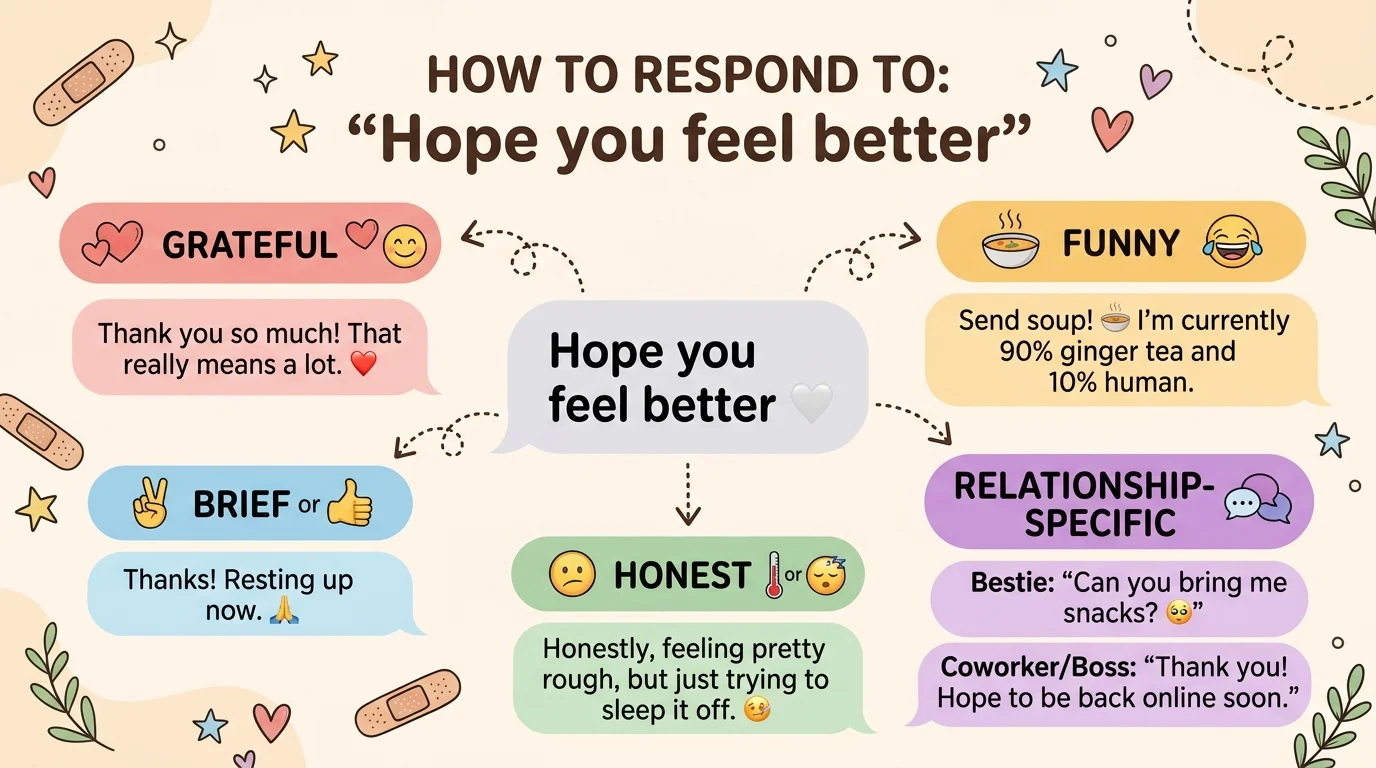
Quick Ans: The best replies to “Hope you feel better” depend on your relationship and how you’re actually feeling. For gratitude, try “Thank you, that means a lot” or “Thanks, I appreciate you checking in.” For humor, “Thanks, I’ll add it to my collection of get-well wishes” or “If hoping worked, I’d be invincible by now” work brilliantly. For warmth, “You just made me feel a little better already” or “Thanks for thinking of me” land perfectly. For honesty, “Thanks, I’m taking it one day at a time” keeps it real.
You’re sick. And You’re tired. You’re lying on the couch in your least flattering pajamas. Then your phone buzzes. Someone texted: “Hope you feel better.” It’s a small gesture, but it matters. Now you have to respond.
“Hope you feel better” is one of the most common, well-meaning messages people send when someone is unwell. It can come from a close friend, a family member, a coworker, or someone you barely know. It can feel heartfelt, perfunctory, or awkward depending on who sent it and how they said it.
Your reply sets the tone. You can be grateful, funny, warm, honest, or brief. The key is matching your response to your relationship, your energy level, and how you actually feel. Whether you’re battling a cold, recovering from surgery, or just having a rough mental health day, these 200+ replies will help you respond with grace, humor, and authenticity. Pick your vibe, honor your energy, and reply in a way that feels right for you.
Grateful and Warm Replies
1. Thank you, that means a lot
Example: When someone you care about sends their well wishes
Meaning: You’re sincerely appreciating their thoughtfulness
2. Thanks, I appreciate you checking in
Example: When a friend or family member reaches out
Meaning: You’re acknowledging their effort to stay connected
3. You just made me feel a little better already
Example: When their message genuinely lifted your spirits
Meaning: You’re letting them know their kindness had an immediate effect
4. Thanks for thinking of me
Example: When someone reaches out unexpectedly
Meaning: You’re grateful they remembered you during a difficult time
5. That’s so kind of you, thank you
Example: When the message feels especially thoughtful
Meaning: You’re recognizing the generosity behind their words
6. I really needed to hear that, thank you
Example: When you’ve been feeling low
Meaning: You’re honestly sharing how much their message helped
7. Thanks, it means more than you know
Example: When their words hit deeper than expected
Meaning: You’re expressing profound gratitude for their care
8. You’re so sweet, thank you
Example: When the sender is someone close to you
Meaning: You’re appreciating their warmth and affection
9. Thanks for checking in, it really helps
Example: When you’ve been feeling isolated
Meaning: You’re acknowledging the value of their connection
10. I appreciate you, thank you
Example: When you want to be direct and warm
Meaning: You’re expressing gratitude simply and sincerely
11. Thank you, I’m lucky to have you
Example: When the sender is a close loved one
Meaning: You’re acknowledging their important role in your life
12. That means everything right now, thank you
Example: When you’re going through something hard
Meaning: You’re sharing how much their support matters
13. Thanks for being so thoughtful
Example: When the message feels especially caring
Meaning: You’re recognizing their consideration for your feelings
14. You have no idea how much this helped
Example: When their timing was perfect
Meaning: You’re expressing deep gratitude for their words
15. Thank you, I’m feeling the love
Example: When you want to be warm and slightly playful
Meaning: You’re acknowledging their care in a lighthearted way
Funny and Playful Replies
1. Thanks, I’ll add it to my collection of get-well wishes
Example: When you want to be dry and witty
Meaning: You’re humorously treating their message like a collector’s item
2. If hoping worked, I’d be invincible by now
Example: When multiple people have sent well wishes
Meaning: You’re joking about the limits of positive thoughts
3. Thanks, I’m currently accepting soup and sympathy
Example: When you want to be playfully needy
Meaning: You’re humorously requesting additional care packages
4. I’ll try, but no promises
Example: When you’re feeling stubbornly unwell
Meaning: You’re joking about your body’s refusal to cooperate
5. Thanks, I’m planning to feel better as soon as I’m done being sick
Example: When you want to be dry and matter-of-fact
Meaning: You’re humorously stating the obvious timeline
6. Does hoping come with a side of chicken soup?
Example: When you want to be playfully demanding
Meaning: You’re joking about wanting more than words
7. I’m adding this to my official medical record
Example: When you want to be mock-serious
Meaning: You’re humorously treating their text like clinical documentation
8. Thanks, I’m currently in negotiations with my immune system
Example: When you want to be wittily dramatic
Meaning: You’re joking about your body’s internal battle
9. I’ll feel better when I stop coughing, so maybe 2027
Example: When your illness is dragging on
Meaning: You’re humorously exaggerating the timeline
10. Thanks, I’m accepting donations in the form of snacks
Example: When you want to be playfully opportunistic
Meaning: You’re joking about turning illness into a gift opportunity
11. Hope is all I have left, so thanks
Example: When you want to be dramatically funny
Meaning: You’re playfully exaggerating your situation
12. I’ll feel better when I can breathe through my nose again
Example: When you have a cold
Meaning: You’re humorously listing your simple goals
13. Thanks, I’m currently on the couch achieving nothing
Example: When you want to be self-deprecating
Meaning: You’re joking about your lack of productivity
14. I’m hoping your hope works better than my medicine
Example: When you want to be wittily desperate
Meaning: You’re humorously questioning the effectiveness of treatment
15. Thanks, I’ll be here, dramatically suffering
Example: When you want to be theatrically funny
Meaning: You’re playfully exaggerating your discomfort
Brief and Simple Replies
1. Thanks
Example: When you’re too tired for a long reply
Meaning: You’re acknowledging their message simply and politely
2. Thank you
Example: When you want to be brief but warm
Meaning: You’re expressing basic gratitude without extra words
3. Thanks, appreciate it
Example: When you want to be friendly but concise
Meaning: You’re acknowledging their kindness without overdoing it
4. Thank you, I appreciate that
Example: When you want to be polite and direct
Meaning: You’re recognizing their message with sincerity
5. Thanks for the kind words
Example: When you want to be gracious but brief
Meaning: You’re appreciating their thoughtfulness
6. Thank you so much
Example: When you want to be warm but efficient
Meaning: You’re expressing deeper gratitude without a long message
7. Thanks, friend
Example: When the sender is a close friend
Meaning: You’re acknowledging their care with casual warmth
8. Appreciate you
Example: When you want to be simple and genuine
Meaning: You’re expressing gratitude in a modern, relaxed way
9. Thanks, I’m hanging in there
Example: When you want to be honest but not dramatic
Meaning: You’re acknowledging their message while sharing your status
10. Thank you, taking it easy
Example: When you want to reassure them without details
Meaning: You’re letting them know you’re resting
11. Thanks, one day at a time
Example: When you’re recovering slowly
Meaning: You’re sharing your approach without overexplaining
12. Thank you, I’ll be okay
Example: When you want to reassure them
Meaning: You’re expressing gratitude while easing their concern
13. Thanks, I’m getting there
Example: When you’re on the mend
Meaning: You’re acknowledging progress without exaggeration
14. Thank you, resting up
Example: When you want to be brief and clear
Meaning: You’re letting them know what you’re doing
15. Thanks, I appreciate the thought
Example: When you want to be polite but keep it short
Meaning: You’re recognizing their gesture without inviting conversation
Honest and Vulnerable Replies
1. Thanks, I’m really struggling today
Example: When you need to be honest about your state
Meaning: You’re sharing your reality without sugarcoating
2. Thank you, it’s been a tough few days
Example: When you’re going through something difficult
Meaning: You’re opening up about your experience
3. I appreciate that, I’m not doing great
Example: When you want to be truthful
Meaning: You’re acknowledging their kindness while being honest
4. Thanks, I’m taking it one hour at a time
Example: When things feel overwhelming
Meaning: You’re sharing your coping strategy
5. Thank you, I needed that today
Example: When their message arrived at the right moment
Meaning: You’re expressing how much their timing mattered
6. Thanks, I’m trying to stay positive
Example: When you’re making an effort despite difficulty
Meaning: You’re sharing your mindset honestly
7. I appreciate you, this has been hard
Example: When you want to be vulnerable with a trusted person
Meaning: You’re acknowledging their support while admitting struggle
8. Thank you, I’m exhausted but hopeful
Example: When you’re tired but not defeated
Meaning: You’re sharing both your fatigue and your optimism
9. Thanks, some days are better than others
Example: When recovery is up and down
Meaning: You’re honestly describing the process
10. I needed to hear that, thank you
Example: When you’ve been feeling alone
Meaning: You’re sharing how much their words helped
11. Thank you, I’m doing my best
Example: When you’re managing as well as you can
Meaning: You’re acknowledging your effort without overpromising
12. Thanks, I’m trying to rest but it’s hard
Example: When you’re struggling to recover
Meaning: You’re sharing your challenge honestly
13. I appreciate that, I’m not myself right now
Example: When illness has changed your mood or energy
Meaning: You’re explaining your state without making excuses
14. Thank you, I’m focusing on getting through today
Example: When the future feels uncertain
Meaning: You’re sharing your present-focused approach
15. Thanks, I’m grateful for people like you
Example: When you want to express deep appreciation
Meaning: You’re acknowledging their role in your support system
Replies for Different Relationships
1. Thanks, I appreciate you (close friend)
Meaning: You’re acknowledging the depth of your friendship
2. Thank you, that’s so sweet (family member)
Meaning: You’re appreciating familial care and concern
3. Thanks, I’ll be back to normal soon (coworker)
Meaning: You’re keeping it professional while being friendly
4. Thank you, I’m taking care of myself (acquaintance)
Meaning: You’re being polite without oversharing
5. Thanks, love you (partner)
Meaning: You’re expressing affection along with gratitude
6. Thank you, you’re so thoughtful (someone you’re dating)
Meaning: You’re appreciating their care while building connection
7. Thanks, I’ll let you know if I need anything (friend)
Meaning: You’re leaving the door open for support
8. Thank you, that means a lot coming from you (mentor)
Meaning: You’re honoring their role in your life
9. Thanks, I’m in good hands (doctor or healthcare provider)
Meaning: You’re reassuring them while expressing gratitude
10. Thank you, I’ll keep you posted (boss)
Meaning: You’re being professional and communicative
11. Thanks, I’m resting up (roommate)
Meaning: You’re keeping it casual and informative
12. Thank you, I’m grateful for you (parent)
Meaning: You’re honoring their lifelong care
13. Thanks, I’ll be okay (sibling)
Meaning: You’re being honest without worrying them
14. Thank you, you’re the best (best friend)
Meaning: You’re celebrating your special bond
15. Thanks, I’m taking it easy (neighbor)
Meaning: You’re being friendly but brief
Replies When You’re Actually Feeling Better
1. Thanks, I’m actually feeling much better today
Example: When you’ve turned a corner
Meaning: You’re sharing good news with gratitude
2. Thank you, I’m on the mend
Example: When recovery is underway
Meaning: You’re reassuring them while expressing thanks
3. Thanks, I’m almost back to normal
Example: When you’re nearly recovered
Meaning: You’re acknowledging progress with appreciation
4. Thank you, I woke up feeling human again
Example: When you’ve had a good morning
Meaning: You’re humorously celebrating recovery
5. Thanks, I’m finally on the upside
Example: When you’ve been sick but are improving
Meaning: You’re sharing optimism with gratitude
6. Thank you, I’m feeling more like myself
Example: When energy is returning
Meaning: You’re expressing relief and appreciation
7. Thanks, I’m getting there slowly but surely
Example: When recovery is gradual
Meaning: You’re acknowledging progress with patience
8. Thank you, I think the worst is over
Example: When you’ve passed the peak of illness
Meaning: You’re sharing hope with gratitude
9. Thanks, I’m taking it easy but feeling better
Example: When you’re cautious but improving
Meaning: You’re balancing rest with recovery
10. Thank you, I’m grateful for the good days
Example: When you’re appreciating improvement
Meaning: You’re expressing thanks for progress
11. Thanks, I’m back to about 80%
Example: When you’re mostly recovered
Meaning: You’re giving an honest update with gratitude
12. Thank you, I can finally taste food again
Example: When a specific symptom has resolved
Meaning: You’re humorously celebrating a milestone
13. Thanks, I’m feeling stronger every day
Example: When recovery is steady
Meaning: You’re sharing progress with appreciation
14. Thank you, I’m almost ready to rejoin the world
Example: When you’re nearly recovered
Meaning: You’re humorously anticipating normal life
15. Thanks, I’m grateful to be feeling better
Example: When you’re reflecting on recovery
Meaning: You’re expressing deep appreciation for health
FAQs
What does “hope you feel better” mean?
It’s a well-wishing message expressing concern and care for someone who is unwell. It’s a common way to show support.
How do I respond to “hope you feel better”?
A simple “thank you” works. You can also add warmth (“that means a lot”), humor (“if hoping worked, I’d be invincible”), or honesty (“I’m taking it one day at a time”).
What’s the best response if I’m close to the person?
Warm responses like “You just made me feel a little better already” or “I appreciate you, thank you” work best for close relationships.
What’s a good response for a coworker?
Keep it professional but friendly: “Thanks, I appreciate you checking in” or “Thank you, I’ll be back to normal soon.”
Can I use humor in my response?
Yes, if the relationship allows it. “Thanks, I’m currently accepting soup and sympathy” is playful and light.
What if I don’t feel like responding?
A simple “Thanks” or a heart emoji is enough. You don’t owe anyone a lengthy reply when you’re unwell.
How do I respond if I’m actually feeling terrible?
Be honest: “Thanks, I’m really struggling today” or “I appreciate that, I’m not doing great.” Vulnerability is okay.
What if I’m already feeling better?
Share the good news: “Thanks, I’m actually feeling much better today” or “I’m on the mend.”
Should I ask how they’re doing in return?
You can, but it’s not required. If you have the energy, “Thanks, how are you?” keeps the conversation going.
What’s a good response for a text from someone I’m dating?
“Thank you, you’re so thoughtful” or “That means a lot coming from you” are warm and flirty.
Can I just respond with an emoji?
Yes. A heart, a smiling face, or a prayer hands emoji can express gratitude without words.
What if multiple people send well wishes?
You can use the same simple response for everyone, or personalize based on your relationship with each person.
How do I respond if I don’t want to talk about being sick?
Keep it brief: “Thanks, I appreciate the thought” and leave it at that.
What’s the best response for a family member?
“Thank you, I’m lucky to have you” or “Thanks, love you” work well for family.
Should I respond to every well-wish message?
It’s polite to respond, but if you’re overwhelmed, a simple “Thanks, everyone” in a group chat or a blanket social media post can cover it.
Conclusion
“Hope you feel better” is a small message with a big heart. It’s someone reaching out, taking a moment to think of you, and sending care through words. How you respond can honor that gesture while also honoring your own energy and honesty.
From grateful to funny to brief to vulnerable, this guide gives you 200+ replies for every relationship and situation. Bookmark it for the next time you’re unwell and your phone fills with well wishes. Share it with a friend who’s recovering. Save it for when you want to reply with warmth, humor, or honesty.
The best response is the one that feels true to you. Don’t overthink it. A simple “thank you” is always enough. And if you’re the one sending well wishes, keep doing that. It matters more than you know.
