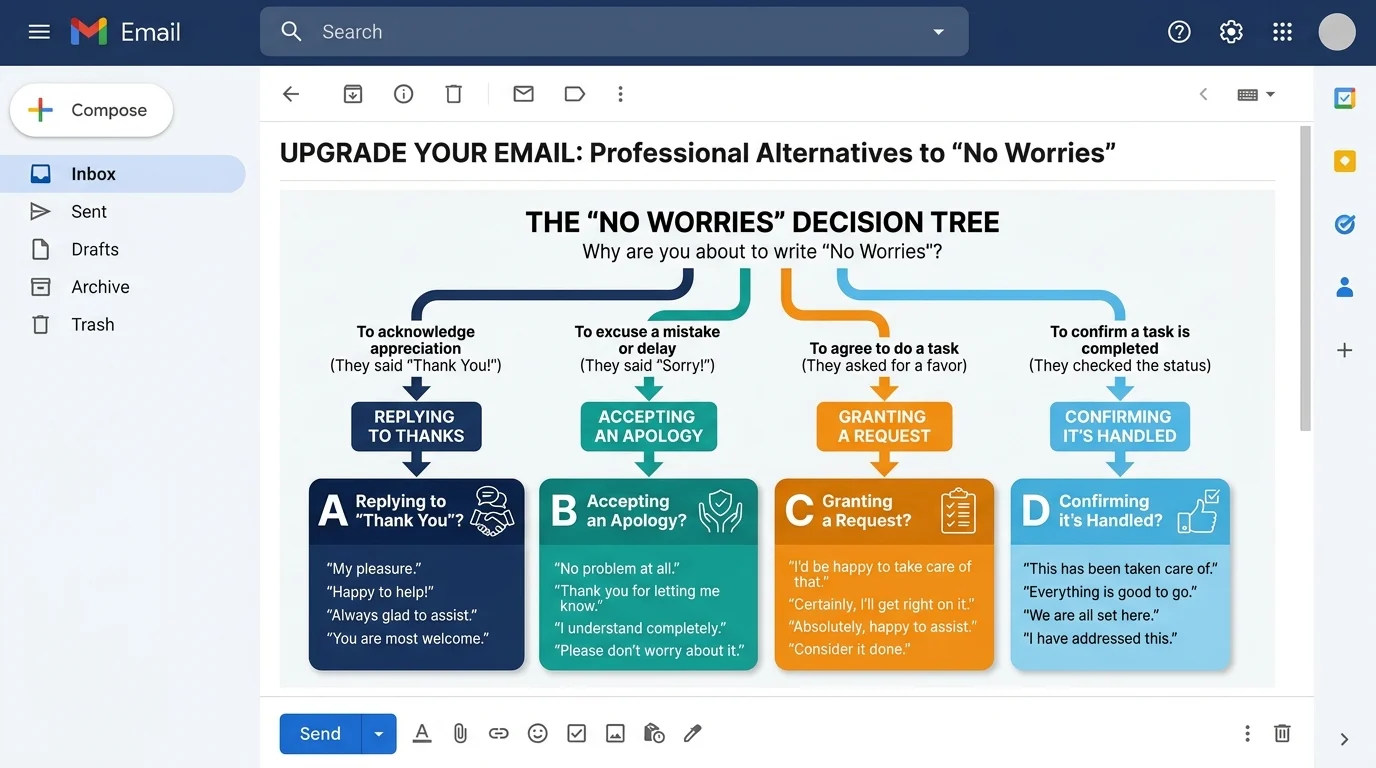
Quick Ans: The best professional “no worries” email responses depend on the situation. For replying to thanks, use “Happy to help” or “My pleasure.” For accepting an apology, try “That’s perfectly fine” or “Thank you for the update.” For granting a request, “Of course” or “Happy to accommodate” work well. For confirming something is handled, “It’s taken care of” or “No further action needed on your end” are clear and professional. The key is matching your response to what prompted it, not just swapping in a formal phrase.
You’re drafting a reply to a client or colleague. They’ve just thanked you, apologized for a delay, or asked for a favor. Your fingers hover over the keyboard. “No worries” feels natural, but something stops you. Is it professional enough? Will it read as dismissive? Does it match the tone of the email chain?
“No worries” is not rude or wrong. It’s casual, friendly, and works perfectly in Slack, spoken conversation, and low-stakes internal exchanges . But in formal email, client-facing messages, or replies to serious apologies, it can land differently than you intend. The phrase works by minimizing. It says “what you did was no burden,” which feels warm in person but can seem dismissive in writing .
The right replacement depends on what you’re responding to. Replying to thanks, accepting an apology, granting a request, and confirming something is handled are different speech acts. Each needs different wording. This guide gives you 200+ professional alternatives organized by situation, so you can pick the right phrase for the right moment and email with confidence.
Why “No Worries” Falls Flat at Work
1. It Dismisses Appreciation
When someone expresses gratitude, “no worries” doesn’t fully honor their thanks. A better response like “You’re welcome” or “My pleasure” shows your actions were a deliberate choice .
2. It Minimizes Apologies
Accepting an apology with “no worries” can dismiss the courage it took for someone to admit a mistake. The receiver of an apology should acknowledge the effort to make things right .
3. It Removes the Opportunity to Share More
An overly informal response eliminates the chance to build connection. “I’m glad you like it!” conveys more genuine warmth than a quick wave-off .
4. Context Decides Whether It Fits
Cambridge Dictionary classifies “no worries” as a friendly, informal response. It works with first names and no subject lines. If the message has a salutation and sign-off, reach for something more explicit .
5. Email Needs More Care Than Chat
A phrase that sounds warm in person can read as dismissive in writing. Recipients often interpret ambiguous emails more negatively than the sender intended, especially across hierarchies .
6. It Can Undermine Authority
Many workplace communication guides recommend retiring “no worries” from emails in favor of “Always happy to help,” which conveys both warmth and confidence .
7. It Doesn’t Confirm Next Steps
“No worries! I’ll take a look” minimizes the apology without setting expectations. “That’s perfectly fine. I’ll review it this afternoon” acknowledges the situation and moves forward .
8. The Stakes Vary by Relationship
With a close colleague, “no worries” is perfectly fine. With a client, senior leader, or first-time contact, the lightness may read as if the situation didn’t matter .
Replying to Thanks: Professional Alternatives
1. Happy to help
Example: When a client thanks you for resolving their issue
Meaning: You’re signaling willingness and warmth without being casual
2. You’re welcome
Example: Standard reply to any expression of gratitude
Meaning: You’re accepting their thanks directly and politely
3. My pleasure
Example: When someone thanks you for a significant effort
Meaning: You’re conveying genuine enjoyment in assisting
4. It was my pleasure
Example: Client-facing communication after a major project
Meaning: You’re adding warmth and formality to your acknowledgment
5. Glad I could help
Example: When a colleague thanks you for quick assistance
Meaning: You’re expressing satisfaction in being useful
6. I’m glad it was useful
Example: When you want to acknowledge the value of your work
Meaning: You’re confirming your effort had a positive impact
7. Always happy to help
Example: Replacing “no worries” in professional emails
Meaning: You’re signaling ongoing willingness to assist
8. It’s what I’m here for
Example: When someone thanks you for doing your job
Meaning: You’re framing assistance as part of your role
9. Anytime
Example: Friendly but professional reply to thanks
Meaning: You’re indicating availability without being overly casual
10. Of course
Example: When someone thanks you for an obvious courtesy
Meaning: You’re suggesting the help was natural and expected
11. No thanks needed
Example: When someone thanks you multiple times
Meaning: You’re graciously downplaying the need for gratitude
12. I was glad to do it
Example: When someone thanks you for a favor
Meaning: You’re confirming your willingness was genuine
Accepting an Apology: Professional Alternatives
1. That’s perfectly fine
Example: Client apologizes for a delayed response
Meaning: You’re confirming no harm was done in a polished way
2. Thank you for the update
Example: Colleague apologizes for missing a deadline
Meaning: You’re acknowledging their communication and moving forward
3. There’s no need to apologize
Example: Someone over-apologizes for a minor issue
Meaning: You’re reassuring them the situation is minor
4. It’s completely fine
Example: Vendor apologizes for a small delay
Meaning: You’re confirming the issue is inconsequential
5. Please don’t give it another thought
Example: Formal client apology for a rescheduled meeting
Meaning: You’re graciously dismissing their concern
6. These things happen
Example: Colleague apologizes for an honest mistake
Meaning: You’re normalizing the error without dismissing it
7. I appreciate your transparency
Example: Client proactively flags an issue
Meaning: You’re turning the apology into trust-building
8. No harm done
Example: Someone apologizes for a minor inconvenience
Meaning: You’re confirming no negative impact occurred
9. Not at all, please don’t worry about it
Example: Warm email reply to a colleague’s apology
Meaning: You’re putting them at ease without being too casual
10. Thanks for letting me know
Example: Someone apologizes for a miscommunication
Meaning: You’re acknowledging their communication without dwelling on the issue
11. It’s all good
Example: Internal email with a close colleague
Meaning: You’re using a neutral phrase that works in most professional contexts
12. No further action needed on your end
Example: Confirming an apology is unnecessary because the issue is resolved
Meaning: You’re closing the loop clearly and professionally
Granting a Request or Favor: Professional Alternatives
1. Of course
Example: Colleague asks you to review a document
Meaning: You’re agreeing willingly and politely
2. Certainly
Example: Client asks for a small accommodation
Meaning: You’re granting the request with formal warmth
3. Happy to accommodate
Example: Someone asks you to adjust a meeting time
Meaning: You’re signaling flexibility and goodwill
4. Consider it done
Example: Manager asks you to handle a task
Meaning: You’re confirming immediate action
5. I’ll take care of it
Example: Colleague asks for help with a shared responsibility
Meaning: You’re accepting the task clearly
6. Absolutely
Example: Friendly but professional agreement
Meaning: You’re granting the request with enthusiasm
7. Sure thing
Example: Low-stakes internal request from a close colleague
Meaning: You’re agreeing casually but appropriately
8. I’d be glad to
Example: Client asks for a small favor
Meaning: You’re expressing willingness with warmth
9. No problem at all
Example: Neutral professional alternative to “no worries”
Meaning: You’re confirming the request is easily handled
10. It’s no trouble
Example: Someone apologizes for asking a favor
Meaning: You’re reassuring them the request isn’t burdensome
11. Happy to pitch in
Example: Team member asks for help on a group project
Meaning: You’re signaling teamwork and willingness
12. I’m on it
Example: Quick, confident confirmation of a task
Meaning: You’re taking ownership without being casual
13. Will do
Example: Simple acknowledgment of a request
Meaning: You’re confirming action with minimal words
14. Got it
Example: Confirming receipt of a request
Meaning: You’re acknowledging and accepting the task
15. At your service
Example: Formal reply to a client request
Meaning: You’re signaling readiness to help
Confirming Something Is Handled: Professional Alternatives
1. It’s taken care of
Example: Reassuring someone that an issue is resolved
Meaning: You’re confirming completion clearly
2. No further action needed
Example: Closing out a request thread
Meaning: You’re signaling the matter is fully resolved
3. All set
Example: Quick confirmation that everything is ready
Meaning: You’re indicating readiness without being casual
4. Consider it handled
Example: Reassuring a manager that a task is complete
Meaning: You’re confirming action has been taken
5. Everything looks good on my end
Example: Confirming a document or deliverable is approved
Meaning: You’re signaling review completion
6. We’re all set here
Example: Team update confirming readiness
Meaning: You’re communicating completion with confidence
7. I’ve got it covered
Example: Reassuring someone about a responsibility
Meaning: You’re confirming you’re managing the task
8. That’s been resolved
Example: Closing out a support ticket or issue
Meaning: You’re confirming the problem no longer exists
9. It’s handled
Example: Quick confirmation of task completion
Meaning: You’re signaling no action is required
10. Nothing else needed
Example: Confirming a request is fully fulfilled
Meaning: You’re closing the loop clearly
11. All taken care of
Example: Reassuring a client about their request
Meaning: You’re confirming complete resolution
12. Done and done
Example: Friendly confirmation with a close colleague
Meaning: You’re signaling completion with a touch of personality
13. Consider it resolved
Example: Formal confirmation of issue closure
Meaning: You’re signaling finality
14. It’s all squared away
Example: Reassuring a colleague about logistics
Meaning: You’re confirming everything is in order
15. You’re all set
Example: Confirming a client’s request is complete
Meaning: You’re signaling they need take no further action
Responses for Specific Email Scenarios
1. Client apologizes for delayed feedback
“Thank you for the update. I’ll review it this afternoon and keep you posted on next steps.”
2. Colleague apologizes for missing a deadline
“That’s perfectly fine. Thanks for letting me know. Let’s touch base tomorrow to adjust the timeline.”
3. Manager thanks you for extra effort
“Happy to help. Let me know if there’s anything else you need before Friday.”
4. Vendor apologizes for a shipping delay
“I appreciate you letting me know. No concerns on our end. Please keep us updated.”
5. Client thanks you for resolving an issue
“My pleasure. I’m glad we could sort it out. Let me know if anything else comes up.”
6. Coworker asks you to cover a task
“Of course. I’ll take care of it and send you an update by end of day.”
7. Someone apologizes for a miscommunication
“Thanks for clarifying. No issues at all. Let’s move forward.”
8. Client asks for a deadline extension
“Happy to accommodate. How much additional time do you need?”
9. Colleague thanks you for a quick favor
“Anytime. That’s what I’m here for.”
10. Someone apologizes for overstepping
“I appreciate you saying that. It’s completely fine. Let’s keep working together.”
11. Manager asks you to handle an urgent task
“Got it. I’m on it and will confirm once complete.”
12. Client apologizes for a mistake on their end
“These things happen. We’re in good shape and can proceed as planned.”
13. Colleague thanks you for covering a meeting
“Glad I could help. I’ll send you my notes.”
14. Someone apologizes for a last-minute request
“No problem at all. I’ll see what I can do.”
15. Client thanks you for your patience
“Thank you for your patience as well. It was a pleasure working with you.”
FAQs
Is “no worries” unprofessional?
It’s casual, not unprofessional. It works in Slack, spoken conversation, and low-stakes internal exchanges. In formal email, client-facing messages, or replies to serious apologies, clearer alternatives are safer .
What’s the best professional alternative to “no worries” when someone thanks me?
“Happy to help” is the most natural, widely used professional alternative. “You’re welcome” and “My pleasure” also work well .
How do I professionally accept an apology in email?
“That’s perfectly fine” or “Thank you for the update” acknowledge the apology and set expectations for next steps .
What if a client apologizes for a delay?
Use client-focused responses like “Please don’t worry — we’re in good shape” or “I completely understand, and it’s not a concern at all” .
Can I use “no problem” in professional emails?
It’s slightly more formal than “no worries” but still casual. “Happy to help” or “Of course” are better professional choices .
What’s a good alternative when granting a request?
“Of course,” “Certainly,” or “Happy to accommodate” grant the request with professional warmth .
How do I confirm something is handled professionally?
“It’s taken care of” or “No further action needed on your end” are clear and professional .
Why do etiquette experts discourage “no worries”?
It can dismiss appreciation, minimize apologies, and remove the opportunity to share more. “You’re welcome” and “My pleasure” honor the other person’s gratitude .
Does “no worries” work in internal emails?
Yes. With close colleagues and in low-stakes exchanges, “no worries” is perfectly fine. Context and relationship matter .
Conclusion
“No worries” isn’t wrong. It’s casual. And casual has its place in workplace communication. But email is different from Slack. Client messages are different from internal notes. Serious apologies are different from small favors.
The professional alternatives in this guide give you options for every situation. When someone thanks you, “Happy to help” conveys warmth and confidence. And When someone apologizes, “That’s perfectly fine” acknowledges their effort and moves forward. When someone asks for a favor, “Of course” grants it with grace. When something is handled, “It’s taken care of” closes the loop clearly.
The right phrase depends on what you’re responding to and who’s reading. Match your tone to the channel and the relationship. A phrase that sounds warm in person can read as dismissive in writing, so choose words that honor the other person’s effort while maintaining your professionalism.
Bookmark this guide for your next email draft. Share it with a colleague who defaults to “no worries” in client messages. And remember: you don’t have to eliminate casual phrases from your vocabulary. Just know when to reach for something more deliberate. Your emails will sound more confident, more considerate, and more professional. That’s always a good look.

2 thoughts on “200+ Professional “No Worries” Email Responses for Every Work Situation 2026”