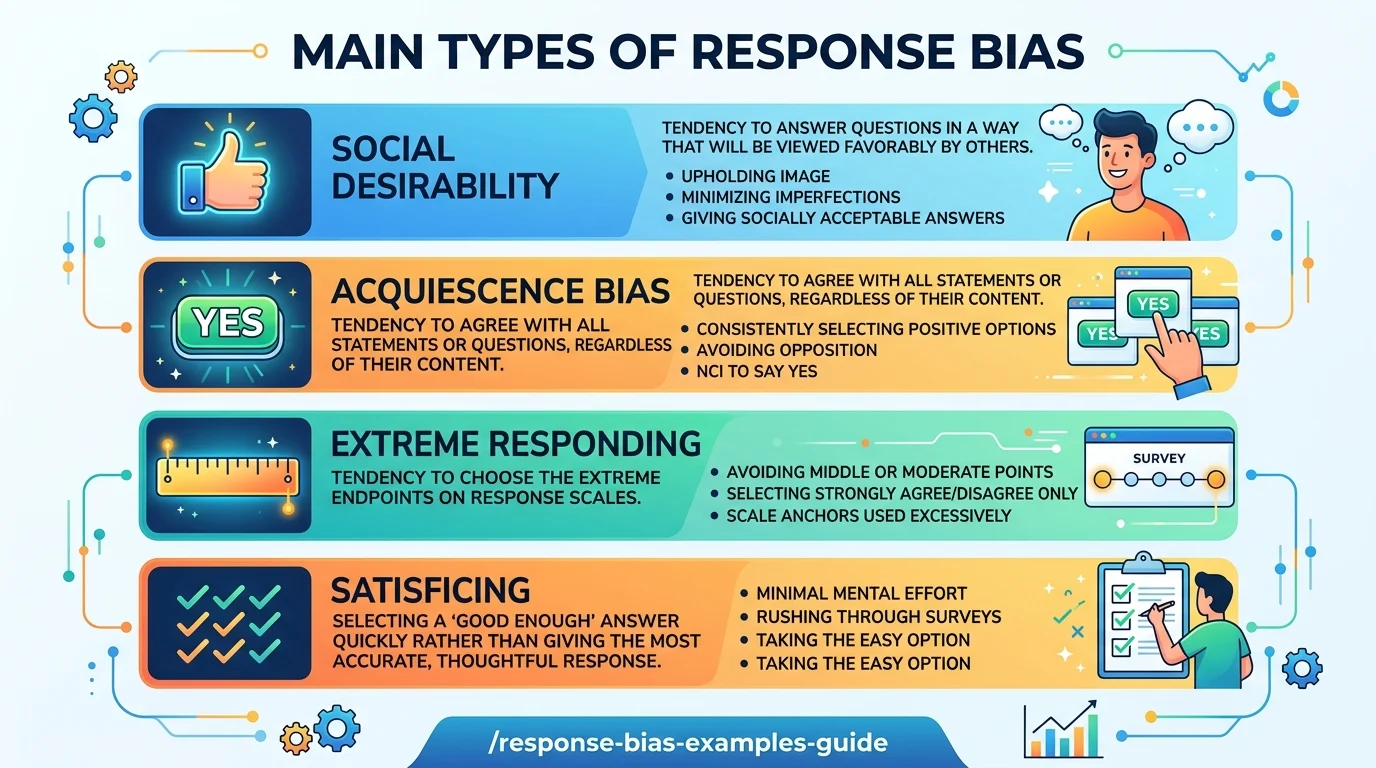
Quick Ans: Response bias happens when survey participants don’t give truthful answers . The most common types are social desirability bias (people underreporting bad behavior), acquiescence bias (always saying “yes”), and extreme responding (always picking the strongest option). These biases can completely distort research findings.
Picture this: you take a survey, you want to look good, and suddenly you are not telling the whole truth. Maybe you have never done it, but it happens all the time. This is response bias in action. It is a systematic error where participants do not respond honestly . Instead, they give answers shaped by social pressure, question wording, or even simple boredom .
These biases matter deeply. They can make a study about sexual health look radically different from reality . And they can inflate the success of a diet program because participants want to please the researcher . They can even make a survey seem to support a policy that participants do not actually like .
Understanding these common biases is the first step to spotting them. This guide breaks down the most frequent types of response bias with clear, real-world examples. You will see exactly how these biases sneak into data and learn to recognize the patterns.
Social Desirability Bias
1. Underreporting sexual activity
A psychologist runs a phone survey about sexual habits, but participants feel uncomfortable and do not answer honestly .
Meaning: People often underreport behaviors they consider private or taboo.
2. Students denying cheating
A professor uses an anonymous survey and asks, “Have you cheated on an exam in my class?” Students who have cheated still answer “no” .
Meaning: Respondents choose answers that make them look better, even with guaranteed anonymity.
3. Overstating healthy eating
People in a diet study get a video about the dangers of high-fat diets. Their food questionnaires show bigger reductions in fat intake than reality supports .
Meaning: Respondents bias their reports to appear in line with health messages.
4. Overreporting cancer screenings
Patients’ self-reports of colorectal cancer screenings sometimes do not match their medical records .
Meaning: People claim to have gotten preventive health tests even when they have not.
5. Embarrassment about STI reporting
In a campus sexual health survey, students might be embarrassed to report STIs, which creates misleading trends .
Meaning: Sensitive or embarrassing questions are prime territory for this bias.
6. Downplaying drug use
If high school students are interviewed about drinking and drug habits, the statistics will most likely underestimate the real rates .
Meaning: Young people strongly underreport illegal or age-restricted activities.
7. Overstating voting behavior
Election surveys consistently show higher voter turnout than official records indicate.
Meaning: People say they voted because it is the socially approved thing to do.
8. Workplace harassment surveys
Employees underreport harassment for fear of retaliation.
Meaning: Power dynamics significantly influence willingness to report.
9. Income underreporting
People often understate their income in surveys.
Meaning: Wealth is a sensitive topic, and people may feel judged.
10. Parental behavior exaggeration
Parents overstate how much they read to their children.
Meaning: “Good parenting” behaviors are heavily subject to social pressure.
Acquiescence Bias
1. Agreeing regardless of content
Respondents select “agree,” “true,” or “yes” to statements irrespective of their actual content .
Meaning: Some people have a tendency to say “yes” to almost anything.
2. Proposal question distortion
A survey asks, “To what extent do you agree with decreasing the public sector?” Some respondents agree without genuinely considering the policy .
Meaning: The “agree/disagree” format strongly encourages yes-saying.
3. Affirmative answers to reverse questions
A respondent might agree with both “The public sector should increase” and “The public sector should decrease” .
Meaning: This pattern reveals agreement is about the format, not the content.
4. Personality trait explanation
Acquiescence may be a stable personality trait or behavioral tendency for some people .
Meaning: It is not just a mistake; it can be a consistent style.
5. Satisficing shortcut
Acquiescence can result from a satisficing strategy, which means participants give quick, shallow answers rather than thoughtful ones .
Meaning: It is a mental shortcut for lazy or rushed participants.
6. Lower motivation and cognitive ability
People with lower motivation are more susceptible to acquiescence .
Meaning: Bored or tired participants agree more readily.
7. Cultural differences
Some cultures show higher rates of acquiescence in surveys .
Meaning: This can distort cross-cultural research findings.
8. Medical symptom checklists
A patient marks “yes” to most symptoms on a long intake form.
Meaning: Exhaustion from a long questionnaire makes respondents mindlessly agree.
9. Customer satisfaction surveys
A customer gives five-star ratings for every question without reading them.
Meaning: This inflates average satisfaction scores and hides real issues.
10. Political attitude surveys
A respondent agrees with every statement from a politician they support.
Meaning: Loyalty to a group overrides thoughtful response.
Extreme and Moderacy Response Bias
1. Always choosing the strongest option
Extreme response bias is the tendency to select the extreme options in rating scales, irrespective of question content .
Meaning: These respondents always pick “strongly agree” or “very important.”
2. Always choosing the middle
Moderacy response bias is the tendency to choose a middle category regardless of the question .
Meaning: Some people always play it safe in the center.
3. Demographic influences
Older persons, and people with lower education and income, are particularly susceptible to extreme response style .
Meaning: Demographics predict these response patterns.
4. Cross-cultural comparison problems
Linguistic or cultural response styles can bias comparisons between groups .
Meaning: Different cultural groups have different baseline response styles.
5. Stable over survey duration
Extreme response style is a stable behavior over the course of a survey .
Meaning: It is not random; it is a consistent pattern.
6. Satisficing expression
Moderacy response bias may be an expression of satisficing .
Meaning: Choosing the middle is a mental shortcut.
7. Single middle category problem
The bias is reinforced when one middle category is offered, which may result in less thorough responding .
Meaning: The survey design itself encourages this behavior.
8. Educational setting surveys
High school students give 10/10 ratings to every teacher on evaluation forms.
Meaning: Students use extremes when they are not invested in the task.
9. Product testing
All testers rate a new product as “average” on every attribute.
Meaning: The results are useless because they lack differentiation.
10. Patient pain assessments
A patient consistently reports 0 or 10 on a pain scale, never the levels in between.
Meaning: Extreme responses make it impossible to gauge treatment effectiveness.
Priming and Question Order Effects
1. Earlier questions shape later answers
Prior survey questions can prime respondents to think about certain information, biasing later responses .
Meaning: The order of questions is not neutral; it shapes answers.
2. Contextual bias in satisfaction surveys
A survey that asks about negative experiences first creates a more negative overall rating.
Meaning: Participants carry mood from earlier questions into later ones.
3. Political polling order effects
A political poll that asks about one candidate before another changes the results .
Meaning: Question order can literally change election predictions.
4. Healthcare surveys
Patients asked about specific symptoms before general health report worse overall health.
Meaning: Specific questions make related issues more salient.
5. Product preference experiments
Listing product features in positive-to-negative order inflates overall liking.
Meaning: The last information you see sticks more.
6. Employee engagement surveys
Questions about pay before questions about workplace culture lower satisfaction scores .
Meaning: Framing from the previous question colors everything.
7. Demographic question placement
Putting income questions before job satisfaction makes people less happy with their jobs.
Meaning: Sensitive questions at the start create defensive responses.
8. Social issue polling
When gun rights questions are asked before gun control questions, results shift.
Meaning: The order reflects the framing of the debate.
9. Health behavior surveys
Asking about exercise before eating habits makes people report healthier diets.
Meaning: A positive behavior primes another positive response.
10. Consumer research
Presenting a high-end product first makes a mid-range product seem cheaper.
Meaning: Comparison is heavily order-dependent.
Satisficing and Participant Fatigue
1. Random answers in long surveys
Participants may select random answers when they get bored .
Meaning: People want to complete the task quickly, not accurately.
2. Selecting the same answer repeatedly
Especially in long surveys, participants care more about finishing than doing the task well .
Meaning: “Straightlining” is a clear sign of disengagement.
3. Answering in a pattern
Participants develop patterns like “1, 2, 3, 4, 1, 2, 3, 4” to speed through questions .
Meaning: These patterns make the data useless.
4. Only those experiencing fatigue are affected
Satisficing affects only participants experiencing fatigue or lower motivation .
Meaning: The bias depends on the respondent’s state.
5. Random error introduced
This adds largely unpredictable error to the data .
Meaning: It is hard to correct for because it is inconsistent.
6. Web survey mobile fatigue
Taking a long survey on a phone leads to high dropout and satisficing.
Meaning: Device choice impacts data quality.
7. The last 20% of survey decline
Data quality declines significantly in the final section of any long survey.
Meaning: Good surveys put important questions at the front.
8. Low-stakes participant panels
Paid panel participants race through questions to get paid faster.
Meaning: The incentive structure creates bias.
9. Multi-page survey drop-off
Quality drops on each subsequent page of a survey.
Meaning: Survey length is a key determinant of data quality.
10. Student subject pool participants
Students complete surveys just to get course credit without care.
Meaning: The source of your sample matters for data quality.
Frequently Asked Questions
What exactly is response bias?
It is a systematic error where participants do not answer survey questions truthfully. They may do so to align with social norms or to appease the researcher .
What is social desirability bias?
This is when respondents overreport behaviors that are seen as positive or underreport behaviors that are seen as negative . Think of people saying they exercise more than they actually do.
What is acquiescence bias?
It is the tendency for people to agree with statements regardless of their actual content . This is why survey design matters so much.
Why does question order matter?
Prior questions prime respondents to think about certain information. This can bias later answers in a specific direction . The order is never neutral.
What is satisficing?
Satisficing is when participants choose quick, shallow answers instead of thoughtful ones . It happens when surveys are too long or boring.
How can I reduce response bias?
Use neutral wording, randomize question order, ensure anonymity, and keep surveys short. Also, consider using randomized response techniques for sensitive questions .
Conclusion
Response bias is everywhere. It is in the survey you took last week, the poll you read this morning, and the research paper you are citing for your next project. The bias shows up as social desirability, acquiescence, extreme responses, and plain old participant fatigue. Each one distorts data in its own way.
Understanding these patterns helps you see through flawed research. You will know why a survey on drug use always underestimates the real number. You will see why a customer satisfaction survey with all five-star ratings is probably worthless.
Share this guide with anyone who uses surveys or reads statistics. Knowing about response bias is the first step to getting real answers.

1 thought on “30+ Response Bias Examples That Completely Mess With Survey Results”