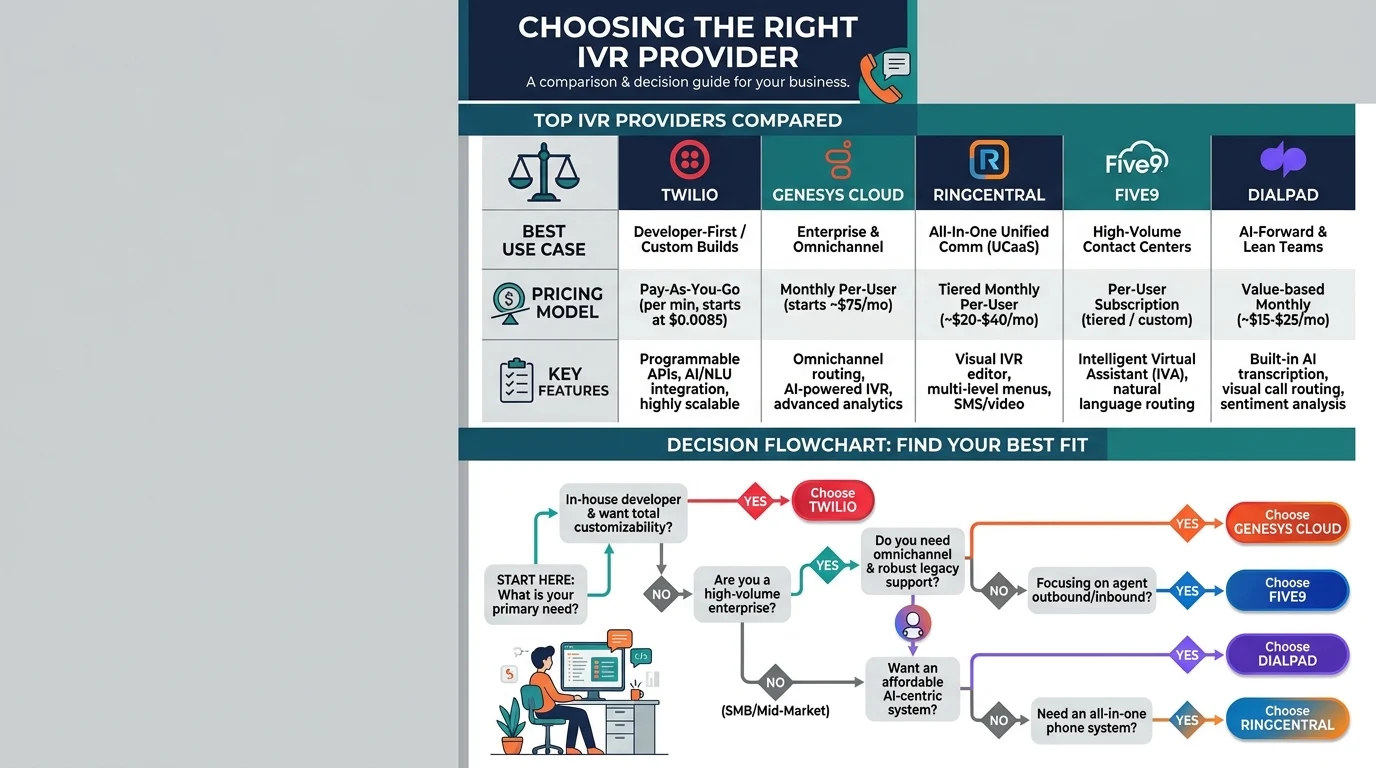
Quick Ans: Interactive voice response (IVR) companies provide technology that automates phone interactions using voice and keypad inputs. Top providers include Twilio, Plivo, Five9, Genesys, and Nextiva. Key features to compare: pricing models (per-minute vs per-seat), integration capabilities (CRM, APIs), scalability, AI-powered features like natural language processing, and customer support quality. Costs range from $0.005 per minute for basic APIs to $200+ per user monthly for enterprise solutions. Choosing the right IVR company depends on your call volume, budget, technical resources, and desired features.
Your phone rings. A friendly voice answers, guides you through menu options, and connects you to the right department without a single human interaction. That’s the power of interactive voice response, and behind every smooth IVR system is a company making it happen.
Businesses of all sizes rely on IVR technology to handle customer calls efficiently, reduce wait times, and free up human agents for complex issues. But with dozens of IVR companies competing for your business, choosing the right one feels overwhelming. Some offer pay-as-you-go APIs for developers. Others provide turnkey cloud contact center solutions. A few specialize in AI-powered conversational IVR that sounds almost human.
The wrong choice means wasted money, frustrated customers, and endless technical headaches. The right choice transforms your customer experience and boosts operational efficiency. This guide breaks down everything you need to know about IVR companies, from pricing models to key features to top providers in 2026.
What Are Interactive Voice Response Companies?
1. Technology Providers
These companies develop and sell IVR software that automates phone interactions using voice recognition and keypad inputs .
2. Cloud-Based Solutions
Most modern IVR companies offer cloud-hosted services, eliminating the need for on-premise hardware .
3. API-First Platforms
Some providers focus on developer-friendly APIs that let businesses build custom IVR flows from scratch .
4. Turnkey Contact Center Suites
Others offer complete contact center solutions with IVR as one component alongside routing, analytics, and workforce management .
5. AI-Powered Specialists
A growing segment focuses on conversational AI and natural language processing for more human-like interactions .
6. Industry-Specific Providers
Some companies tailor their IVR solutions for healthcare, banking, e-commerce, or hospitality .
7. White-Label Resellers
Certain providers offer white-label solutions that other companies rebrand and resell .
8. Open-Source Alternatives
Platforms like Asterisk and FreeSWITCH offer free foundations, though commercial support is often needed .
9. Hybrid Providers
Some companies combine cloud IVR with on-premise components for flexibility .
10. Global vs Regional Players
Large providers offer worldwide coverage, while regional companies focus on local language and compliance needs .
11. Telecom Carriers
Traditional telecom companies like Verizon and AT&T also offer IVR services alongside their core offerings .
12. Startup Innovators
Newer companies bring fresh approaches, often specializing in specific niches or AI capabilities .
13. Legacy System Integrators
Older providers still support traditional on-premise IVR systems for enterprises with existing infrastructure .
14. CPaaS Platforms
Communications Platform as a Service companies bundle IVR with SMS, email, and other channels .
15. Vertical Integrators
Some companies integrate IVR directly into industry-specific software like EHR systems or banking platforms .
Top Interactive Voice Response Companies in 2026
1. Twilio
A developer-first CPaaS platform offering programmable voice, IVR, and AI-powered virtual agents. Pricing starts at $0.0085 per minute for voice calls. Best for businesses with technical teams building custom solutions .
2. Plivo
Similar to Twilio but often more affordable, with voice starting at $0.005 per minute. Offers robust APIs and global coverage. Best for cost-conscious developers .
3. Five9
An enterprise cloud contact center platform with advanced IVR, AI, and workforce optimization. Pricing is custom-quoted. Best for large contact centers needing comprehensive features .
4. Genesys
A leader in customer experience orchestration with AI-powered IVR, omnichannel routing, and deep analytics. Enterprise-focused with custom pricing. Best for complex, global operations .
5. Nextiva
A unified communications platform with built-in IVR, toll-free numbers, and CRM integrations. Pricing starts around $30 per user monthly. Best for small to mid-sized businesses .
6. RingCentral
A cloud communications provider with IVR capabilities, team messaging, and video meetings. Pricing starts around $20 per user monthly. Best for businesses wanting unified communications .
7. Vonage
A CPaaS and business communications provider with programmable IVR and AI features. Voice pricing starts around $0.005 per minute. Best for developers and SMBs .
8. Cisco
Offers Webex Contact Center with IVR, AI, and omnichannel capabilities. Enterprise pricing. Best for large organizations already using Cisco infrastructure .
9. Avaya
A legacy contact center provider with cloud and on-premise IVR options. Custom pricing. Best for enterprises with existing Avaya investments .
10. NICE
Specializes in AI-powered customer experience with IVR, analytics, and workforce management. Enterprise pricing. Best for data-driven contact centers .
11. Amazon Connect
AWS-based contact center with pay-as-you-go IVR, AI, and integration with AWS services. Pricing starts around $0.018 per minute. Best for AWS-native businesses .
12. Google Cloud Contact Center AI
Offers conversational IVR with Google’s AI capabilities. Pay-as-you-go pricing. Best for businesses using Google Cloud .
Key Features to Compare
1. Pricing Model
Understand whether you pay per minute, per user, per concurrent call, or a flat monthly fee .
2. Call Volume Limits
Check included minutes and overage rates .
3. IVR Builder
Look for drag-and-drop or visual flow builders versus code-only options .
4. Natural Language Processing
AI-powered NLP enables callers to speak naturally rather than pressing buttons .
5. Speech-to-Text Accuracy
Higher accuracy means fewer frustrating misunderstandings .
6. Text-to-Speech Quality
Natural-sounding voices improve caller experience .
7. Language Support
Multi-language capabilities matter for diverse customer bases .
8. CRM Integrations
Native integrations with Salesforce, HubSpot, Zendesk, and others .
9. API Availability
Robust APIs allow custom development and integration .
10. Analytics and Reporting
Real-time dashboards, call recordings, and performance metrics .
11. Scalability
Ability to handle peak call volumes without degradation .
12. Uptime SLA
Guaranteed uptime percentages and response times .
13. Security Certifications
SOC 2, HIPAA, PCI DSS, and GDPR compliance .
14. Customer Support
24/7 support, dedicated account managers, and response times .
15. Trial Availability
Free trials or sandbox environments for testing .
Pricing Models Explained
1. Pay-Per-Minute
Charges based on call duration. Ideal for low to moderate call volumes. Twilio and Plivo use this model .
2. Per-User Monthly
Fixed monthly fee per agent or user. Predictable costs for stable teams. Nextiva and RingCentral use this model .
3. Per-Concurrent-Call
Charges based on simultaneous calls. Good for businesses with peak periods .
4. Tiered Pricing
Volume discounts as usage increases. Common with enterprise providers .
5. Custom Enterprise Pricing
Negotiated contracts based on specific needs. Typical for Five9, Genesys, and Cisco .
6. Freemium Models
Basic features free with paid upgrades. Some providers offer limited free tiers .
7. Setup Fees
One-time charges for implementation, configuration, or custom development .
8. Professional Services
Additional fees for consulting, training, or custom integrations .
9. Overage Charges
Penalties for exceeding included minutes or users .
10. Add-On Modules
AI, analytics, or advanced features sold separately .
11. Annual vs Monthly Billing
Discounts for annual commitments .
12. Minimum Commitments
Some enterprise contracts require minimum monthly spend .
13. Trial Periods
Free trials ranging from 14 to 30 days .
14. Hidden Costs
Watch for charges for phone numbers, storage, or API calls .
15. Total Cost of Ownership
Consider all costs including implementation, training, and maintenance .
How to Choose the Right IVR Company
1. Assess Your Call Volume
High volumes favor per-minute pricing; stable volumes favor per-user .
2. Define Required Features
List must-have versus nice-to-have capabilities .
3. Evaluate Technical Resources
API-first platforms require developers; turnkey solutions don’t .
4. Consider Integration Needs
Ensure compatibility with your existing CRM and tools .
5. Check Scalability Requirements
Will the solution grow with your business?
6. Review Security Compliance
Match certifications to your industry requirements .
7. Test Customer Support
Response times and quality matter for ongoing success .
8. Request Demos
See the platform in action before committing .
9. Read Reviews
Check G2, Capterra, and TrustRadius for user feedback .
10. Calculate Total Cost
Include setup, training, and ongoing fees .
11. Start With a Trial
Test with real call flows before full deployment .
12. Consider Future Needs
Choose a platform that can evolve with your business .
13. Evaluate Uptime History
Check status pages and SLA guarantees .
14. Assess AI Capabilities
If conversational IVR matters, prioritize AI-native providers .
15. Ask About Migration
Understand how easy it is to switch if needed later .
Industry-Specific IVR Applications
1. Healthcare
Patient appointment reminders, prescription refills, and triage routing. HIPAA compliance is essential .
2. Banking and Finance
Account balance inquiries, transaction history, and fraud alerts. PCI DSS compliance required .
3. E-commerce
Order status, returns processing, and delivery updates. Integration with order management systems .
4. Hospitality
Reservations, room service, and concierge services. Multi-language support critical .
5. Insurance
Claims filing, policy inquiries, and payment processing. Secure authentication needed .
6. Telecommunications
Service activation, troubleshooting, and billing inquiries. High call volumes require scalability .
7. Government
Public information, permit applications, and service requests. Accessibility compliance matters .
8. Education
Admissions inquiries, course registration, and financial aid. Seasonal peaks require flexibility .
9. Real Estate
Property inquiries, showing scheduling, and tenant support. Mobile-friendly options important .
10. Logistics
Shipment tracking, delivery scheduling, and driver support. Integration with TMS systems .
11. Utilities
Outage reporting, billing inquiries, and service requests. Emergency routing capabilities .
12. Automotive
Service scheduling, roadside assistance, and parts inquiries. Integration with dealer systems .
13. Travel
Booking, cancellations, and itinerary changes. Global language support essential .
14. Pharmaceuticals
Clinical trial support, adverse event reporting, and patient assistance. Regulatory compliance critical .
15. Nonprofits
Donation processing, volunteer coordination, and information lines. Cost-effective solutions needed .
Implementation Best Practices
1. Map Caller Journeys
Understand why customers call and design flows accordingly .
2. Keep Menus Simple
Limit options to 3-5 per level to avoid confusion .
3. Offer Human Escape
Always provide a path to a live agent .
4. Use Natural Language
Allow callers to speak rather than navigate menus when possible .
5. Personalize Greetings
Use caller data to tailor the experience .
6. Test Extensively
Run pilot programs before full launch .
7. Monitor Analytics
Track completion rates, drop-offs, and satisfaction scores .
8. Iterate Continuously
Refine flows based on data and feedback .
9. Train Staff
Ensure agents understand the IVR system and can support callers .
10. Document Everything
Maintain records of configurations and changes .
11. Plan for Peaks
Ensure scalability during high-volume periods .
12. Provide Multilingual Support
Serve diverse customer bases effectively .
13. Ensure Accessibility
Comply with ADA and other accessibility requirements .
14. Integrate With CRM
Pass caller data to agents for personalized service .
15. Measure ROI
Track cost savings, resolution rates, and customer satisfaction .
Frequently Asked Questions
What is an interactive voice response company?
A company that provides IVR technology, either through APIs, cloud platforms, or turnkey contact center solutions .
How much do IVR companies charge?
Pricing ranges from $0.005 per minute for basic APIs to $200+ per user monthly for enterprise solutions .
Which IVR company is best for small businesses?
Nextiva, RingCentral, and Vonage offer affordable, easy-to-use solutions for SMBs .
Which IVR company is best for developers?
Twilio and Plivo offer robust APIs and pay-as-you-go pricing ideal for custom development .
What features should I look for in an IVR company?
Pricing model, NLP capabilities, integrations, scalability, security certifications, and customer support .
Do IVR companies offer free trials?
Many do, typically 14-30 days. Twilio and Plivo offer free credits for testing .
Can I build my own IVR without a company?
Open-source options like Asterisk exist, but commercial support is often needed for production systems .
How long does IVR implementation take?
Simple setups take days; complex enterprise deployments can take weeks or months .
What is AI-powered IVR?
IVR that uses natural language processing and machine learning to understand and respond to callers more naturally .
Do I need technical skills to use IVR companies?
API-first platforms require developers. Turnkey solutions are designed for non-technical users .
How do I migrate from one IVR company to another?
Plan carefully, document existing flows, and test thoroughly before switching .
What industries use IVR companies most?
Healthcare, banking, e-commerce, telecommunications, and government are among the heaviest users .
Can IVR companies handle international calls?
Most major providers offer global coverage, though pricing and features vary by region .
What compliance standards should IVR companies meet?
SOC 2, HIPAA, PCI DSS, and GDPR depending on your industry and location .
How do I measure IVR success?
Track containment rate, customer satisfaction, average handle time, and cost per call .
Conclusion
Choosing the right interactive voice response company transforms your customer experience and operational efficiency. The market offers options for every budget and technical capability, from developer-friendly APIs like Twilio and Plivo to comprehensive enterprise platforms like Five9 and Genesys. Your decision should hinge on call volume, required features, technical resources, and long-term scalability needs.
Start by clearly defining your requirements. Test with free trials before committing. Calculate total cost of ownership, not just headline pricing. And remember that the best IVR company is the one that fits your specific needs, not necessarily the one with the most features or lowest price.
The right IVR partner will help you reduce costs, improve customer satisfaction, and free your team to focus on complex issues that truly need human attention. Take your time, do your research, and choose wisely.
Discover More:
- 30+ Response Bias Examples That Completely Mess With Survey Results
- 150+ Best Responses to “Buenos Días” for Every Situation 2026
