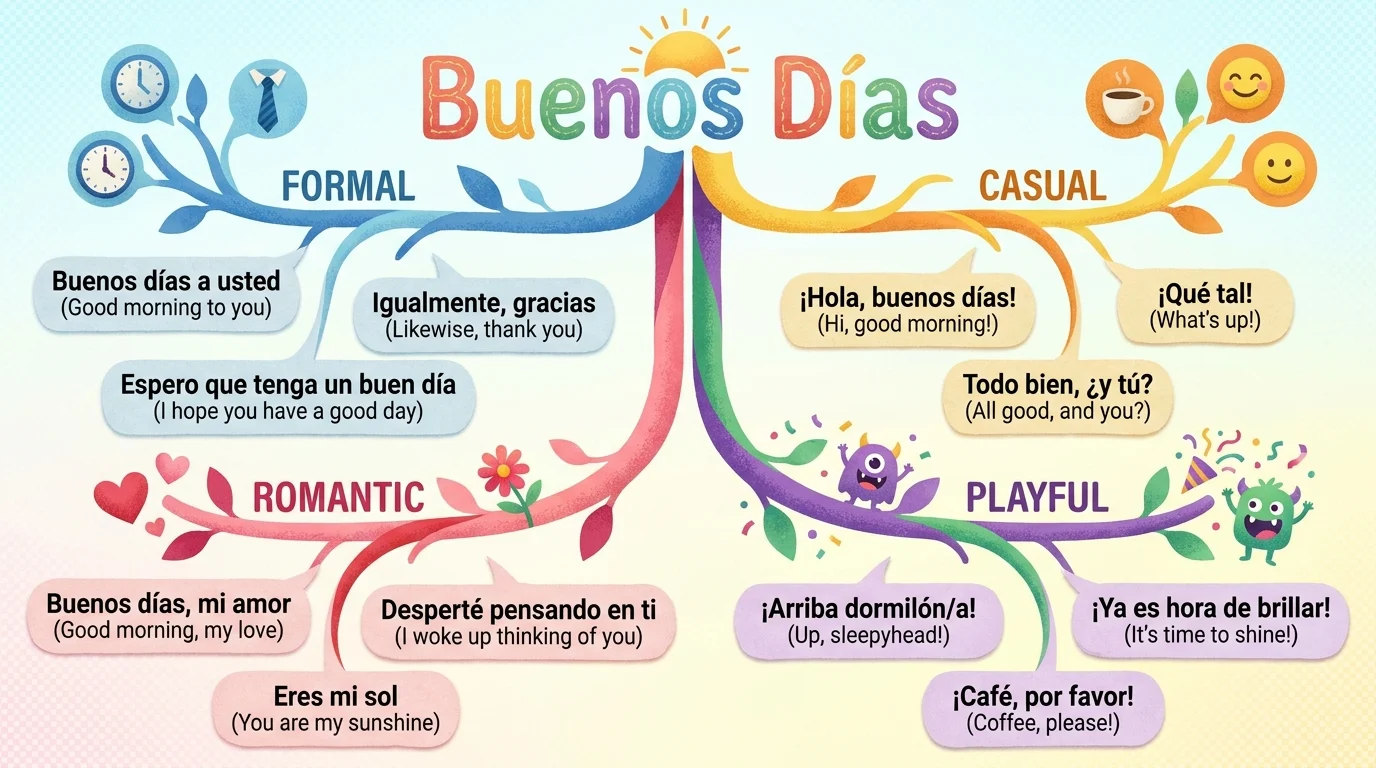
Quick Ans: The best and easiest response to “buenos días” is simply “buenos días” right back. Other excellent replies include “hola, buenos días” (hello, good morning), “buen día” (good day), “igualmente” (likewise), “buenas” (morning), and “¿cómo está?” (how are you?) . Each option sets a different tone, from casual to polite.
Picture this: you walk into a café, and the barista greets you with a cheerful “¡Buenos días!” You freeze. Should you just say it back? Add a “hola”? Ask how they’re doing? If you’ve ever felt that split-second panic, you’re definitely not alone. It happens to the best of us.
Greetings are the handshake of conversation, and getting them right matters more than you think. A well-chosen response to “buenos días” can set a warm, respectful, or playful tone for the entire interaction that follows . Whether you’re chatting with a friend, greeting a colleague, or speaking to someone older, the right reply shows you understand the cultural rhythm of the conversation .
The beauty of “buenos días” is its versatility. You can use it in almost every situation, from formally greeting your partner’s parents to casually acknowledging your best friend after a late night . Let’s explore all the ways you can respond like a native speaker.
The Simple and Polite Responses
1. Buenos días
The most common and foolproof reply. Just say it right back .
Example: Perfect for any situation, formal or casual.
Meaning: You’re acknowledging the greeting politely and simply.
2. Hola, buenos días
Add “hola” (hello) in front for a friendly touch .
Example: Great for casual encounters with neighbors or coworkers.
Meaning: You’re greeting them warmly with a simple hello.
3. Buen día
A slightly shortened version, very common in Latin America .
Example: Used in Mexico as often as “buenos días” itself.
Meaning: A casual but polite “good day.”
4. Igualmente
Means “likewise.” A quick and polite reply .
Example: When you want to return the greeting without repeating it.
Meaning: You’re wishing them the same good morning.
5. Buenos días, ¿cómo está?
The polite version that asks how they are.
Example: In formal settings or when speaking to elders .
Meaning: You return the greeting and show genuine interest.
6. Buenos días, ¿cómo estás?
The informal version for friends and family .
Example: With people you know well.
Meaning: You care about their well-being in a casual way.
7. Muy buenos días
Adding “muy” (very) emphasizes your good wishes.
Example: When you’re feeling especially cheerful.
Meaning: “A very good morning to you.”
The Casual and Chill Responses
8. Buenas
A shortened, super casual version of “buenos días” .
Example: Very common in Spain, especially in Barcelona.
Meaning: Just “morning.”
9. Buenos
Another casual abbreviation.
Example: When you’re in a hurry or being extra relaxed.
Meaning: A quick, informal “good.”
10. Hola
Just “hello.” Works if you want to keep it extremely simple.
Example: When you’re not fully awake and want minimal words.
Meaning: Acknowledging the greeting without repeating it.
11. ¿Qué tal?
Means “what’s up?” or “how’s it going?”
Example: With close friends or coworkers you see daily.
Meaning: You’re greeting them back and checking in.
12. ¿Qué pasa?
Another casual “what’s happening?”
Example: Among peers in a relaxed setting.
Meaning: A laid-back way to return the greeting .
13. ¿Cómo amaneciste?
Means “how did you wake up?” – a thoughtful, personal touch.
Example: With friends or partners who care about each other’s mornings.
Meaning: You’re asking about their specific morning experience .
The Warm and Affectionate Responses
14. Bonito día
Means “beautiful day” – a sweet, cutesy response .
Example: With friends, family, or anyone you’re close to.
Meaning: You’re wishing them a lovely day in return.
15. Lindo día
The same as “bonito día,” interchangeable .
Example: Great for warm, affectionate exchanges.
Meaning: “A lovely day to you.”
16. Buenos días, mi amor
Adds “my love” for romantic or very close relationships .
Example: Greeting your partner or significant other.
Meaning: You’re returning the greeting with affection.
17. Buenos días, amigo/amiga
Adds “friend” for a warm, friendly touch .
Example: With good friends you appreciate.
Meaning: “Good morning, my friend.”
18. Buenos días, hermosa/hermoso
Means “beautiful” or “handsome” – a flirty, affectionate reply .
Example: With a partner or someone you’re attracted to.
Meaning: You’re returning the greeting with a compliment.
19. Buenos días, mi reina/mi rey
Means “my queen” or “my king” – playful and loving .
Example: With a partner or children.
Meaning: You’re making them feel special and cherished.
20. Buenos días, mi cielo
Means “my sky” or “my heaven” – a poetic, loving term.
Example: With someone very dear to you.
Meaning: You’re expressing deep affection.
21. Buenos días, vida mía
Means “my life” – an intense, romantic response.
Example: With a partner you’re very close to.
Meaning: You’re calling them your everything.
The Conversation-Starting Responses
22. Buenos días, ¿cómo amaneciste hoy?
Asking specifically how they woke up today .
Example: When you genuinely want to know about their morning.
Meaning: You care about their morning experience.
23. Buenos días, ¿dormiste bien?
Asking if they slept well.
Example: After a night when you know they were tired.
Meaning: You’re showing concern for their rest.
24. Buenos días, ¿qué tal la noche?
Asking about their night.
Example: At work after a weekend.
Meaning: You’re interested in what they did.
25. Buenos días, ¡qué gusto verlo/verte!
Means “what a pleasure to see you!” – enthusiastic.
Example: When you’re genuinely happy to see someone.
Meaning: You’re expressing joy at their presence.
26. Buenos días, ¡qué buen tiempo hace!
Commenting on the nice weather .
Example: When you want to start a light conversation.
Meaning: You’re making small talk about the day.
27. Buenos días, parece que hoy va a ser un gran día
Means “looks like today’s going to be a great day.”
Example: When you’re feeling optimistic and want to share it.
Meaning: You’re setting a positive tone.
28. Buenos días, ¿cómo va todo?
Means “how’s everything going?”
Example: With someone you haven’t seen in a while.
Meaning: You’re checking in on their overall situation.
The Formal and Professional Responses
29. Buenos días a usted también
Means “good morning to you too” – polite and formal .
Example: In professional settings or with older people.
Meaning: You’re respecting them with formal language.
30. Buenos días a ti también
Same as above but informal .
Example: With coworkers you know well.
Meaning: You’re returning the greeting casually.
31. Buenos días, señor/señora
Adds “sir” or “ma’am” for extra respect .
Example: With superiors, clients, or strangers.
Meaning: You’re showing proper respect.
32. Que tenga muy buen día
Means “have a very good day” – a formal farewell tone .
Example: When leaving a shop or ending a professional interaction.
Meaning: You’re wishing them well as you part.
33. Buenos días, ¿cómo le va?
Formal version of “how’s it going?” .
Example: In a business meeting or with someone senior.
Meaning: You’re showing respect while engaging.
The Playful and Funny Responses
34. Buenos días, aunque no sé qué tiene de bueno
“Good morning, though I don’t know what’s so good about it.”
Example: With close friends on a tough morning.
Meaning: A playful complaint disguised as a greeting.
35. Buenos días, si el café lo permite
“Good morning, if the coffee allows it.”
Example: Before your first coffee of the day.
Meaning: You’re joking that you need caffeine to be functional.
36. Buenas, buenas, buenas
Repeating it three times for emphasis.
Example: With friends who appreciate energy.
Meaning: An enthusiastic, “Good, good, good morning.”
37. Buenos días, ya hasta el perro se cansó de desearlo
“Good morning, even the dog got tired of wishing it.”
Example: When you’ve heard “buenos días” too many times.
Meaning: A silly, over-the-top response.
38. Buenos días, pero no te confíes
“Good morning, but don’t get too comfortable.”
Example: Playful banter with friends.
Meaning: You’re joking that things might go wrong later.
39. Buenos días, ¿y los buenos deseos?
“Good morning, and where are the good wishes?”
Example: When you want to tease someone.
Meaning: You’re playfully asking if they actually mean it.
Frequently Asked Questions
What is the simplest response to “buenos días”?
Simply say “buenos días” right back. It works in every situation and is the most common response .
How do you respond to “buenos días” formally?
Use “buenos días a usted también” or “buenos días, señor/señora” . These show proper respect.
What does “igualmente” mean in response?
It means “likewise” – a quick and polite way to return the greeting .
What’s a casual response for friends?
“Buenas,” “hola,” “¿qué tal?” or “¿qué pasa?” are all casual, friendly options .
Can I respond with “buen día”?
Yes! “Buen día” is common in Latin America, especially Mexico. It’s a slightly shortened version .
What should I say to a romantic partner?
Try “buenos días, mi amor” or “buenos días, hermosa” for a warm, affectionate reply .
Do I always need to add “cómo está”?
No. It’s optional and shows additional interest. “Buenos días” alone is perfectly fine .
Is there a difference between “bonito día” and “lindo día”?
No, they’re synonyms and completely interchangeable. Both mean “beautiful day” .
Can I use “buenas” in Latin America?
It’s less common than in Spain, but you’ll still hear it occasionally, especially in casual settings .
What’s a good response if I’m not a native speaker?
Stick with the basics: “buenos días” or “buenos días, ¿cómo está?” These are safe and polite .
Conclusion
Responding to “buenos días” isn’t complicated. The simplest choice, “buenos días,” works perfectly every time . But now you have a whole toolbox of responses at your disposal.
Think about your situation. Who are you talking to? What mood are you in? A casual “buenas” works for friends, while a formal “buenos días a usted también” shows respect. Want to make someone smile? Try “bonito día” or a sweet “buenos días, mi amor.”
The best response is the one that feels natural to you. Don’t overthink it. Practice a few favorites until they roll off your tongue. Your conversations will feel warmer and more connected.
So the next time someone says “¡Buenos días!” you’ll know exactly what to say.
Discover More:
- SM7B Frequency Response: The Complete Guide to Its Legendary Sound 2026
- Direct Mail Response Rates in 2026: Words on the Channel That Refuses to Quit

1 thought on “150+ Best Responses to “Buenos Días” for Every Situation 2026”