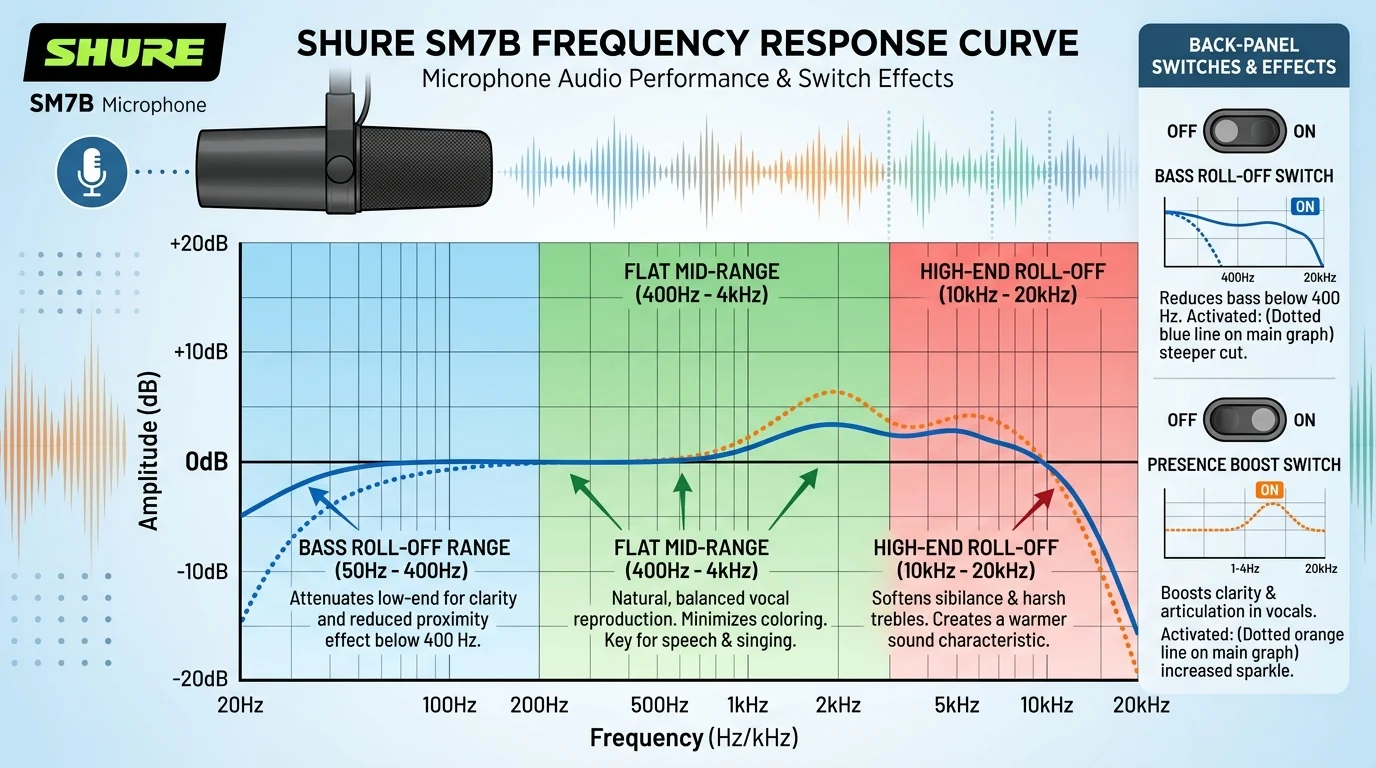
Quick Ans: The Shure SM7B frequency response ranges from 50 Hz to 20,000 Hz with a smooth, flat profile designed for natural music and speech reproduction. It features a slightly recessed low-end to minimize boominess, a flat mid-range for natural voice character, and a gentle roll-off above 12 kHz that reduces sibilance. The SM7B includes bass roll-off and mid-range presence boost switches for tonal shaping.
You’ve seen it on every podcast, YouTube channel, and recording studio. The Shure SM7B has become the undisputed king of vocal microphones. But what makes it sound so good? The answer lies in the SM7B frequency response. Understanding the frequency response of SM7B helps you get the best possible sound from this legendary dynamic microphone.
The Shure SM7B large diaphragm cardioid dynamic microphone is a broadcast and studio icon. Its smooth, flat, wide-range frequency response delivers clean, natural reproduction for music and speech in professional audio applications . Whether you’re recording vocals, podcasts, or instruments, the frequency response of this microphone shapes your sound in a unique way.
Let’s break down exactly what the SM7B frequency response looks like and why it matters for your recordings.
The Technical Specs: What the Numbers Say
1. Frequency Range: 50 Hz to 20,000 Hz
Example: The full audible spectrum for humans, covering deep lows to crisp highs.
Meaning: This range captures everything from the lowest bass notes to the highest overtones, making the mic extremely versatile .
2. Sensitivity: -59 dBV/Pa (1.12 mV)
Example: Explains why you need a strong preamp to get a good signal.
Meaning: This mic output level is quite low, requiring about 60 dB of gain for optimal performance .
3. Output Impedance: 150 Ω
Example: How the mic interacts with your audio interface or mixer.
Meaning: Works well with most professional mic inputs rated at 19-300 Ω .
4. Polar Pattern: Cardioid
Example: Picks up sound mainly from the front, rejecting noise from the sides and back.
Meaning: Perfect for vocal recording because it minimizes room ambience and bleed .
5. Built-in Bass Roll-off Switch
Example: Reduces low frequencies to combat proximity effect and rumble.
Meaning: Cuts unnecessary low-end when you’re working close to the mic .
6. Built-in Presence Boost Switch
Example: Adds clarity to the mid-range frequencies for better vocal definition.
Meaning: Brightens your sound when you need more cut in a dense mix .
7. Shielding: Excellent Electromagnetic Hum Rejection
Example: Protects your recording from computer monitor and electrical interference.
Meaning: Cleaner signal even when recording near electronics .
Bass Response: Controlled and Clean Low-End
The SM7B low-end frequency response is designed to be recessed and controlled. Unlike many condenser microphones, the SM7B won’t pick up excessive rumble or boomy bass .
This is incredibly useful for vocals. The proximity effect—the boost in low frequencies when you get close to the mic—is well-managed. You can work close to the SM7B without your voice becoming muddy . The result is a clean, warm low-end that sits well in a mix.
The bass roll-off switch gives you even more control. Push the left switch down to activate it and reduce bass frequencies when you don’t need them . This is ideal for reducing plosives or cutting unwanted room rumble.
Mid-Range: Where the Magic Happens
The mid-range frequency response of the SM7B is flat and neutral. This is the key to its legendary vocal sound.
The Shure SM7B has a flat mid section, which provides a natural and accurate representation of the voice or instrument . This makes it incredibly versatile for different voices and applications.
The presence boost switch is a great feature if you want a brighter sound. Push the right switch up to add a boost in the mid-range frequencies . This enhances clarity and helps vocals cut through in dense mixes.
High-End: Smooth and Forgiving
The high-frequency response of the SM7B is where it really stands out. The SM7b has a roll-off beginning at around 12 kHz .
This means the ultra-high frequencies are slightly reduced. Many dynamic microphones have a dip at 7 kHz, which is about 5 dB lower than at 5 kHz . The SM7b has a more recessed high-end, which provides a very smooth and pleasant listening experience .
This high-end roll-off is excellent for reducing sibilance (harsh “s” and “t” sounds) . The result is a warm, non-fatiguing sound that many podcasters and singers prefer.
How to Use the SM7B Frequency Response for Better Recordings
The Flat Setting
Example: Default setup with no switches engaged.
Meaning: You get the classic SM7B sound, natural and neutral.
Adding Presence Boost
Example: Engaged when you need extra cut and clarity.
Meaning: Better articulation and bite for vocals in a busy mix.
Using Bass Roll-off
Example: Activated to reduce proximity effect or low-frequency rumble.
Meaning: Cleans up the low-end for tighter, more controlled sound.
Close-Miking Vocals
Example: Working 2-3 inches from the mic.
Meaning: You get warmth without excessive boominess.
Distance Miking
Example: Staying 6-8 inches away.
Meaning: You get a more natural room sound with less proximity effect.
Recording Instruments
Example: Using the SM7B on guitar cabinets or brass.
Meaning: Flat response captures instrument character accurately.
FAQs
What is the frequency response of the Shure SM7B?
The Shure SM7B has a frequency response of 50 Hz to 20,000 Hz, with a smooth, flat profile. It also features bass roll-off and presence boost switches .
Why is the SM7B frequency response good for vocals?
The flat mid-range and gentle high-end roll-off produce natural, warm sound while reducing sibilance. The controlled low-end helps manage proximity effect .
Can I use the SM7B without a preamp?
The SM7B has low sensitivity (-59 dBV/Pa) and requires about 60 dB of gain. Most professional interfaces or dedicated preamps are recommended .
What are the tone switches on the SM7B?
The SM7B has a bass roll-off switch for reducing low frequencies and a presence boost switch for adding mid-range clarity. Both can be used together to shape the sound .
Is the SM7B good for instruments?
Yes. Its flat frequency response makes it suitable for close-miking instruments where a warm, smooth, full-frequency sound is needed .
Conclusion
The Shure SM7B frequency response is the foundation of its legendary status. Its smooth, flat profile from 50 Hz to 20,000 Hz captures natural sound with exceptional clarity. The subtle low-end roll-off, neutral mid-range, and gentle high-end reduction make it the perfect choice for vocals, podcasts, and instruments.
Understanding the frequency response of SM7B helps you get the most from this iconic microphone. Whether you’re using the bass roll-off to clean up your low-end or engaging the presence boost for more clarity, you have control over your sound. No wonder the SM7B remains the standard for professional audio.

2 thoughts on “SM7B Frequency Response: The Complete Guide to Its Legendary Sound 2026”