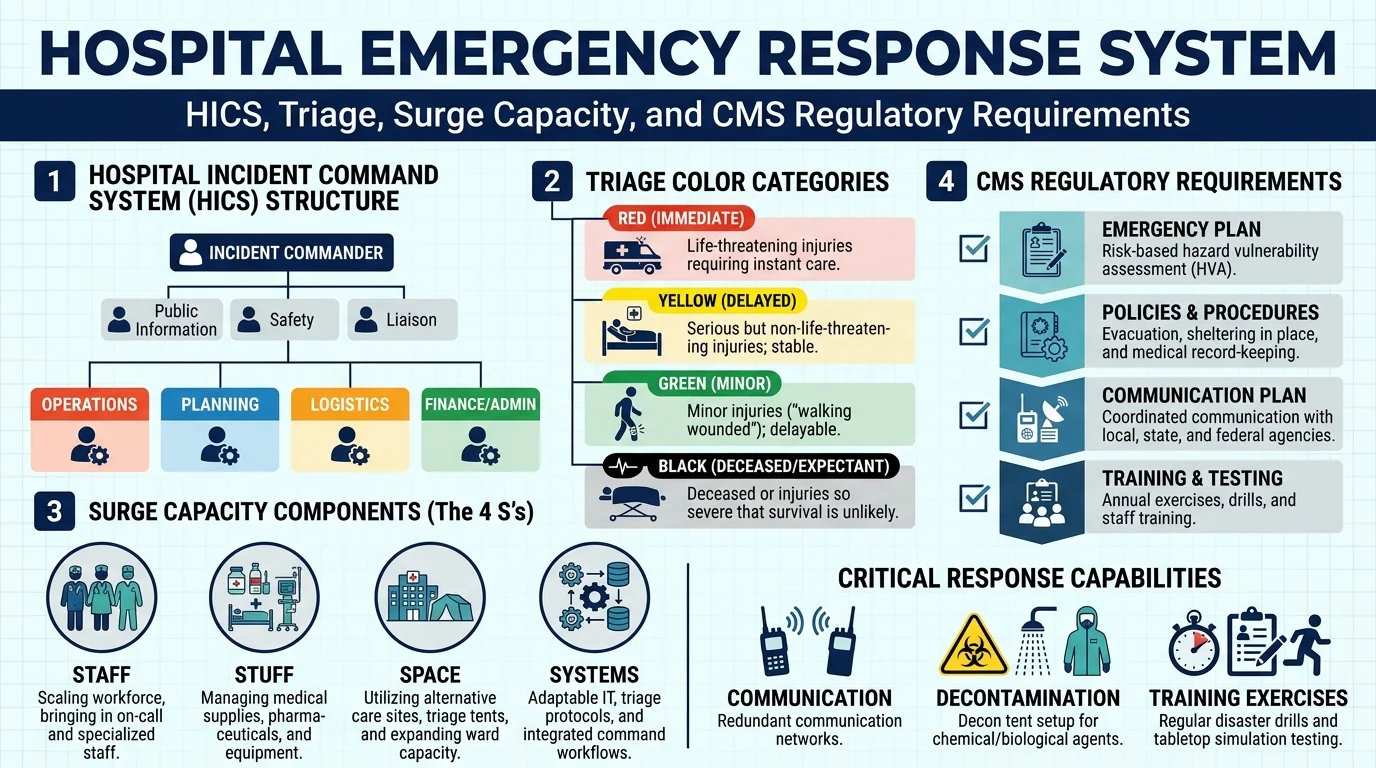
Quick Ans: Hospital emergency response is the coordinated system hospitals use to prepare for, respond to, and recover from sudden events that threaten public health or patient safety. Key components include the Hospital Incident Command System (HICS), emergency operations plans (EOPs), triage protocols, surge capacity management, and interagency coordination. Hospitals must comply with CMS Emergency Preparedness Rules, Joint Commission standards, and OSHA requirements. Effective response saves lives during disasters, mass casualties, pandemics, and everyday emergencies.
When disaster strikes, hospitals become the frontline. A mass shooting, a hurricane, a chemical spill, or a sudden disease outbreak. Within minutes, emergency departments must transform from routine operations into high-stakes response centers. This is hospital emergency response in action.
Hospital emergency response refers to the comprehensive system hospitals use to prepare for, respond to, and recover from events that threaten patient safety or public health. It encompasses everything from triage protocols and surge capacity plans to communication systems and interagency coordination. Every hospital that receives Medicare or Medicaid funding must maintain an emergency operations plan under CMS rules.
Understanding how hospitals respond to emergencies matters for healthcare workers, administrators, first responders, and the communities they serve. A well-prepared hospital can save hundreds of lives during a mass casualty event. A poorly prepared one can become a bottleneck that delays care when every second counts. Let’s break down exactly how hospital emergency response works.
What Is Hospital Emergency Response?
1. A Coordinated System of Preparedness
Hospital emergency response is the organized approach hospitals use to prepare for, respond to, and recover from emergencies .
2. Built on the Hospital Incident Command System
HICS provides a standardized management structure for emergency response .
3. Governed by Federal Regulations
CMS Emergency Preparedness Rules require all Medicare/Medicaid hospitals to maintain emergency plans .
4. Encompasses All Hazards
Plans address natural disasters, mass casualties, pandemics, chemical events, and cyberattacks .
5. Requires Interagency Coordination
Hospitals coordinate with EMS, public health, law enforcement, and emergency management .
6. Includes Triage Protocols
Standardized systems prioritize patients based on severity during mass casualty events .
7. Relies on Surge Capacity Planning
Hospitals plan for increased patient volumes during disasters .
8. Involves Staff Training and Drills
Regular exercises ensure staff know their roles during emergencies .
9. Mandates Communication Systems
Redundant communication tools ensure coordination when normal systems fail .
10. Includes Resource Management
Plans cover supplies, equipment, pharmaceuticals, and staffing during emergencies .
11. Requires Community Integration
Hospitals participate in community-wide emergency planning and response .
12. Involves Recovery Planning
Plans include steps to return to normal operations after an emergency .
13. Subject to Joint Commission Standards
Accredited hospitals must meet specific emergency management requirements .
14. Includes Security Protocols
Plans address lockdowns, active shooter situations, and patient safety .
15. Based on Continuous Improvement
After-action reviews identify gaps and improve future response .
Key Components of Hospital Emergency Response
1. Emergency Operations Plan (EOP)
The EOP is the foundational document outlining how the hospital responds to emergencies .
2. Hospital Incident Command System (HICS)
HICS provides a flexible management structure for emergency response .
3. Triage Protocols
Standardized systems like START and SALT prioritize patients during mass casualty events .
4. Surge Capacity Plans
Hospitals plan for expanded patient capacity during disasters .
5. Communication Systems
Redundant systems ensure coordination when primary tools fail .
6. Resource Management
Plans cover supplies, equipment, and pharmaceuticals during emergencies .
7. Staffing Plans
Hospitals identify how to staff during emergencies, including call-back procedures .
8. Security Protocols
Plans address lockdowns, active shooters, and patient safety during crises .
9. Decontamination Capabilities
Hospitals maintain decontamination units for chemical or radiological events .
10. Isolation Capacity
Plans cover isolation rooms for infectious disease outbreaks .
11. Alternate Care Sites
Hospitals identify locations for expanded care during surges .
12. Evacuation Plans
Plans cover horizontal and vertical evacuation procedures .
13. Interagency Coordination
Hospitals coordinate with EMS, public health, and emergency management .
14. Training and Exercises
Regular drills ensure staff are prepared for emergencies .
15. Recovery Planning
Plans include steps to return to normal operations after an emergency .
The Hospital Incident Command System (HICS)
1. Standardized Management Structure
HICS provides a clear chain of command during emergencies .
2. Incident Commander Role
The Incident Commander has overall authority during an emergency response .
3. Command Staff Positions
Public Information Officer, Safety Officer, and Liaison Officer support the Incident Commander .
4. General Staff Sections
Operations, Planning, Logistics, and Finance/Administration sections manage response functions .
5. Operations Section
Manages tactical operations, including patient care and facility management .
6. Planning Section
Collects information, assesses situation, and develops response plans .
7. Logistics Section
Provides resources, supplies, and support services during emergencies .
8. Finance/Administration Section
Tracks costs and manages financial aspects of the response .
9. Scalable Structure
HICS can expand or contract based on the size and complexity of the incident .
10. Modular Organization
Sections can be activated independently as needed .
11. Common Terminology
Standardized language ensures clear communication across agencies .
12. Integrated Communications
Communication systems are managed through the Command Staff .
13. Transfer of Command
Clear procedures exist for transferring command between shifts or agencies .
14. Unified Command
Multiple agencies can work together under a unified command structure .
15. After-Action Review
HICS includes processes for evaluating and improving future responses .
Triage Protocols in Hospital Emergency Response
1. START Triage System
Simple Triage and Rapid Treatment is the most common mass casualty triage system .
2. SALT Triage System
Sort, Assess, Lifesaving Interventions, Treatment/Transport is an alternative system .
3. Color-Coded Categories
Patients are categorized as Red (immediate), Yellow (delayed), Green (minor), or Black (deceased) .
4. Red Category
Immediate: Patients requiring immediate lifesaving intervention .
5. Yellow Category
Delayed: Patients with injuries that can wait for treatment .
6. Green Category
Minor: Patients with minor injuries who can walk and wait .
7. Black Category
Deceased or injuries so severe that survival is unlikely .
8. Primary Triage
Rapid assessment performed immediately upon patient arrival .
9. Secondary Triage
More detailed assessment performed after initial sorting .
10. Continuous Re-Triage
Patients are re-evaluated as conditions change .
11. Pediatric Triage
Modified systems account for children’s unique physiological responses .
12. Burn Triage
Specific protocols exist for burn patients during mass casualty events .
13. Chemical Triage
Special considerations for chemical exposure events .
14. Radiation Triage
Protocols for radiological events and contamination .
15. Documentation Requirements
Triage decisions must be documented for tracking and quality improvement .
Surge Capacity Management
1. Definition of Surge Capacity
The ability to manage increased patient volumes during disasters .
2. Four S’s of Surge Capacity
Staff, Stuff, Space, and Systems are the key components .
3. Staff Surge
Calling in additional personnel, extending shifts, and using temporary staff .
4. Stuff Surge
Managing supplies, equipment, and pharmaceuticals during shortages .
5. Space Surge
Expanding patient care areas, using alternate sites, and discharging stable patients .
6. Systems Surge
Adapting processes and protocols to manage increased volume .
7. Conventional Capacity
Normal resources and spaces used during routine operations .
8. Contingency Capacity
Adapting normal spaces and resources for increased volume .
9. Crisis Capacity
Using unconventional spaces and resources during extreme surges .
10. Surge Tents
Temporary structures used for patient triage and treatment .
11. Alternate Care Sites
Non-hospital locations converted for patient care during surges .
12. Elective Procedure Cancellation
Canceling scheduled surgeries to free up resources .
13. Early Discharge Protocols
Discharging stable patients to create capacity .
14. Patient Transfer Agreements
Transferring patients to other facilities to balance load .
15. Regional Coordination
Working with other hospitals to manage regional surge .
Regulatory Requirements and Standards
1. CMS Emergency Preparedness Rule
Requires all Medicare/Medicaid hospitals to maintain emergency plans .
2. Four Core Elements
Risk assessment, emergency plan, policies and procedures, and training .
3. Joint Commission Standards
Accredited hospitals must meet emergency management requirements .
4. Emergency Operations Plan Requirement
Hospitals must maintain a written emergency operations plan .
5. Annual Review Requirement
Plans must be reviewed and updated at least annually .
6. Training Requirements
Staff must receive emergency preparedness training .
7. Exercise Requirements
Hospitals must conduct two exercises per year, including one community-wide .
8. After-Action Review Requirement
Hospitals must evaluate responses and identify improvements .
9. OSHA Requirements
Workplace safety standards apply during emergency response .
10. HIPAA Considerations
Patient privacy rules apply during emergencies, with limited exceptions .
11. EMTALA Requirements
Emergency Medical Treatment and Labor Act applies during emergencies .
12. State Health Department Requirements
States may have additional emergency preparedness requirements .
13. Public Health Accreditation
Health departments must meet emergency preparedness standards .
14. Joint Commission Emergency Management Standards
Specific standards for emergency management planning and response .
15. Documentation Requirements
Hospitals must document planning, training, and exercise activities .
Training and Exercises
1. Importance of Training
Regular training ensures staff know their roles during emergencies .
2. Tabletop Exercises
Discussion-based exercises that test plans and decision-making .
3. Functional Exercises
Operations-based exercises that test specific functions .
4. Full-Scale Exercises
Large-scale exercises involving multiple agencies and realistic scenarios .
5. Drill Types
Specific drills for fire, evacuation, lockdown, and other scenarios .
6. HICS Training
Training on the Hospital Incident Command System structure .
7. Triage Training
Training on mass casualty triage protocols .
8. Decontamination Training
Training on decontamination procedures for chemical events .
9. Personal Protective Equipment Training
Training on proper use of PPE during emergencies .
10. Communication Training
Training on emergency communication systems .
11. Just-in-Time Training
Rapid training delivered during actual emergencies .
12. Competency Assessment
Evaluating staff competency in emergency response skills .
13. Multi-Agency Exercises
Exercises involving EMS, fire, police, and public health .
14. Community-Wide Exercises
Exercises that test community-wide response capabilities .
15. After-Action Reviews
Structured reviews to identify lessons learned and improve plans .
What to Do During a Hospital Emergency
1. Follow Your Training
Apply the training you received during drills and exercises .
2. Report to Your Assigned Role
Go to your designated location and assume your assigned role .
3. Follow HICS Structure
Report to your supervisor and follow the chain of command .
4. Stay Calm and Professional
Maintain composure to support patients and colleagues .
5. Communicate Clearly
Use standardized communication tools and terminology .
6. Prioritize Patient Safety
Patient safety remains the top priority during emergencies .
7. Follow Triage Protocols
Apply triage protocols consistently and accurately .
8. Document Your Actions
Document all actions, decisions, and patient care activities .
9. Conserve Resources
Use supplies and equipment judiciously during shortages .
10. Support Your Colleagues
Support team members during high-stress situations .
11. Stay Informed
Monitor communication channels for updates and instructions .
12. Adapt to Changing Conditions
Be flexible as the situation evolves and plans change .
13. Escalate Concerns
Report safety concerns or resource shortages to supervisors .
14. Take Care of Yourself
Monitor your own physical and emotional needs during extended responses .
15. Participate in After-Action Reviews
Share your observations to improve future responses .
Frequently Asked Questions
What is hospital emergency response?
It’s the coordinated system hospitals use to prepare for, respond to, and recover from emergencies that threaten patient safety or public health .
What is HICS?
The Hospital Incident Command System is a standardized management structure for emergency response .
What is surge capacity?
The ability to manage increased patient volumes during disasters, encompassing staff, stuff, space, and systems .
What is triage?
A system for prioritizing patients based on injury severity during mass casualty events .
What are the triage categories?
Red (immediate), Yellow (delayed), Green (minor), and Black (deceased) .
What is CMS Emergency Preparedness Rule?
A federal regulation requiring Medicare/Medicaid hospitals to maintain emergency plans .
How often must hospitals conduct exercises?
Hospitals must conduct two exercises per year, including one community-wide .
What is an Emergency Operations Plan?
A written document outlining how the hospital responds to emergencies .
What is the Incident Commander role?
The Incident Commander has overall authority during an emergency response .
What is the difference between tabletop and functional exercises?
Tabletop exercises are discussion-based, while functional exercises are operations-based .
How do hospitals communicate during emergencies?
Hospitals use redundant communication systems, including radios, phones, and alert systems .
What is decontamination?
The process of removing hazardous substances from patients, equipment, and facilities .
What is an alternate care site?
A non-hospital location converted for patient care during surges .
What is EMTALA?
The Emergency Medical Treatment and Labor Act, which requires hospitals to provide emergency care regardless of ability to pay .
How can I prepare for a hospital emergency?
Participate in training, know your role, and stay familiar with your hospital’s emergency plans .
Conclusion
Hospital emergency response is a complex, coordinated system that saves lives during disasters and everyday emergencies. From the Hospital Incident Command System to triage protocols and surge capacity management, every component works together to ensure hospitals can respond effectively when minutes matter.
Understanding these systems matters for healthcare workers, administrators, first responders, and the communities they serve. A well-prepared hospital can handle mass casualties, pandemics, and natural disasters. Preparation comes from planning, training, and exercises conducted long before an emergency occurs.
Whether you work in healthcare or simply want to understand how hospitals protect communities, knowing the fundamentals of hospital emergency response helps you appreciate the dedication and preparation behind every response. Share this guide with colleagues and bookmark it for future reference. Preparedness starts with knowledge.
Discover More:
- SM7B Frequency Response: The Complete Guide to Its Legendary Sound 2026
- 150+ Cloud Threat Detection and Response Strategies for Modern Security Teams 2026

3 thoughts on “Hospital Emergency Response: Complete Guide for 2026”