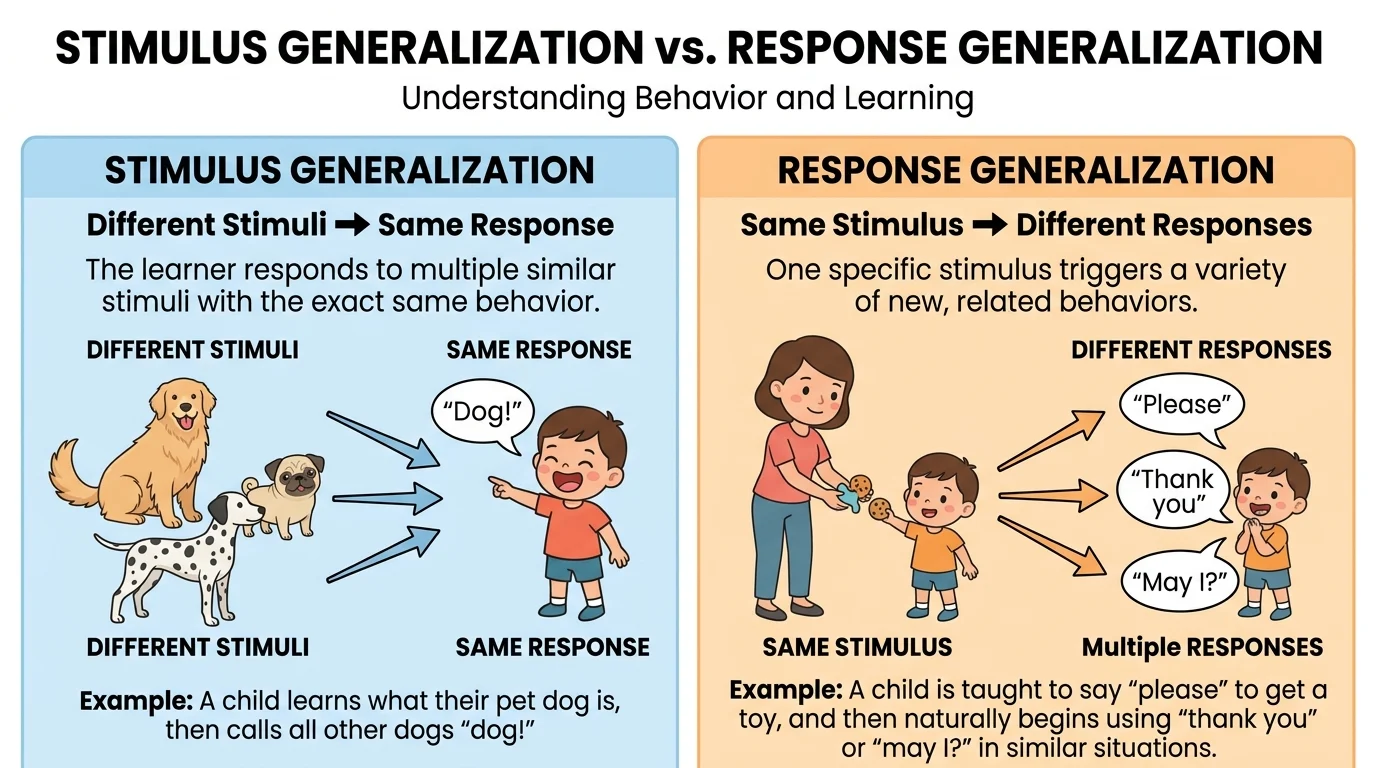
Quick Ans: Response generalization and stimulus generalization are two distinct concepts in behavioral psychology. Stimulus generalization occurs when a response learned to one stimulus is elicited by similar stimuli (e.g., a child says “dog” for both a Chihuahua and a Labrador). Response generalization occurs when a behavior learned in one situation leads to similar but different behaviors in the same situation (e.g., a child learns to say “please” and then uses “thank you” appropriately without direct training). Stimulus generalization involves different stimuli producing the same response. Response generalization involves the same stimulus producing different but functionally related responses.
You teach a child to clap when they hear a song. The next day, they clap when they hear a different song. Is that stimulus generalization or response generalization? This is exactly the kind of confusion that trips up students, therapists, and educators alike.
Both concepts come from the science of applied behavior analysis (ABA) and learning theory. Both describe how learned behaviors spread beyond their original training conditions. But they describe two very different phenomena. Stimulus generalization is about the stimulus side of the equation: different inputs producing the same output. Response generalization is about the behavior side: the same input producing different but related outputs.
Getting this distinction right matters for anyone designing interventions, teaching new skills, or working in behavioral therapy. If you’re training a child to communicate, you want both types of generalization to happen. The skill should work across different settings, people, and materials (stimulus generalization). And the learner should develop a repertoire of flexible responses rather than one rigid behavior (response generalization). Let’s break down exactly how these two concepts differ and why both matter.
What Is Stimulus Generalization?
1. Definition of Stimulus Generalization
Stimulus generalization occurs when a response that has been reinforced in the presence of one stimulus also occurs in the presence of similar stimuli .
2. The Classic Example
A child learns to say “dog” when seeing a Golden Retriever. Later, the child says “dog” when seeing a Chihuahua, a Poodle, or a Labrador .
3. Different Stimuli, Same Response
The key feature is that different but similar stimuli elicit the same learned response.
4. Based on Stimulus Similarity
The more similar a new stimulus is to the original training stimulus, the more likely generalization will occur .
5. Can Be Measured
Generalization gradients show how response strength changes as stimuli become less similar to the original .
6. Occurs Naturally
Stimulus generalization happens without additional training. It’s a fundamental property of learning.
7. Can Be Problematic
If a child calls every animal “dog,” including cats and cows, that’s overgeneralization .
8. Can Be Beneficial
Generalizing “stranger danger” from one stranger to all strangers keeps children safe.
9. Shaped by Discrimination Training
Teaching discrimination narrows generalization. The learner learns to respond differently to different stimuli.
10. Central to ABA Practice
ABA practitioners deliberately program for stimulus generalization to ensure skills transfer across settings .
11. Involves the Antecedent
Stimulus generalization is about the antecedent conditions that evoke behavior.
12. Example in Language
Learning to read the word “cat” in one font, then reading it in other fonts is stimulus generalization.
13. Example in Fear Learning
A child bitten by one dog may fear all dogs. That’s stimulus generalization of fear.
14. Example in Social Skills
Greeting one teacher with “good morning” and then greeting other teachers the same way.
15. Example in Academic Skills
Solving 2+2=4 with apples, then solving it with blocks or written numbers.
What Is Response Generalization?
1. Definition of Response Generalization
Response generalization occurs when a behavior change resulting from reinforcement of one response leads to changes in other, similar responses .
2. The Classic Example
A child learns to say “please” when requesting a toy. Later, the child spontaneously uses “thank you” and “excuse me” in appropriate contexts .
3. Same Stimulus, Different Responses
The key feature is that the same situation evokes different but functionally related behaviors.
4. Also Called Response Induction
Some behavior analysts use the term “response induction” to describe this phenomenon .
5. Involves Behavior Repertoire Expansion
The learner develops a broader range of responses rather than one rigid behavior.
6. Can Be Planned or Unplanned
Therapists can deliberately program for response generalization by reinforcing varied responses .
7. Example in Communication Training
Teaching a child to request with “I want” may lead to spontaneous use of “Can I have” or “May I please.”
8. Example in Social Skills
Learning to say “hello” may lead to spontaneous use of “goodbye,” “please,” and “thank you.”
9. Example in Daily Living Skills
Learning to wash hands may generalize to washing face and brushing teeth.
10. Example in Vocational Skills
Learning to greet customers may generalize to asking if they need help.
11. Example in Academic Skills
Learning to add single digits may generalize to adding double digits.
12. Example in Emotional Regulation
Learning to take deep breaths when frustrated may generalize to taking a break when overwhelmed.
13. Example in Safety Skills
Learning to stop at a red light may generalize to stopping at stop signs.
14. Example in Athletic Skills
Learning to dribble a basketball may generalize to dribbling a soccer ball.
15. Example in Artistic Skills
Learning to mix blue and yellow to make green may generalize to mixing other colors.
Key Differences Between Stimulus and Response Generalization
1. Focus of Generalization
Stimulus generalization focuses on the antecedent (what comes before behavior). Response generalization focuses on the behavior itself .
2. Direction of Effect
Stimulus generalization: different stimuli produce the same response. Response generalization: the same stimulus produces different responses.
3. Role of Similarity
Stimulus generalization depends on similarity between stimuli. Response generalization depends on similarity between responses.
4. Measurement Approach
Stimulus generalization is measured by testing novel stimuli. Response generalization is measured by observing novel responses.
5. Training Implications
Stimulus generalization requires training across multiple stimuli. Response generalization requires reinforcing varied responses.
6. Example Pair
Stimulus: Child says “dog” for all dogs. Response: Child says “dog,” “puppy,” and “woof woof” for one dog.
7. Relationship to Discrimination
Stimulus generalization is the opposite of stimulus discrimination. Response generalization is the opposite of response differentiation.
8. Clinical Relevance
Both are critical for ABA interventions. Stimulus generalization ensures skills work in the real world. Response generalization ensures flexible repertoires.
9. Programming Strategies
Stimulus generalization: train across settings, people, and materials. Response generalization: reinforce varied responses.
10. Common Confusion
Many people confuse the two. Remember: stimulus = input, response = output.
11. Both Involve Transfer
Both involve transfer of learning beyond original training conditions.
12. Both Can Be Overdone
Overgeneralization of stimuli leads to errors. Overgeneralization of responses can lead to inappropriate behaviors.
13. Both Require Planning
Effective interventions deliberately program for both types of generalization .
14. Both Are Foundational
Both concepts are foundational to understanding how learning spreads.
15. Both Are Lifelong
Generalization continues throughout life as new situations and responses are encountered.
Stimulus Generalization in Practice
1. Applied Behavior Analysis (ABA)
ABA therapists program for stimulus generalization by training skills across multiple settings, people, and materials .
2. Language Acquisition
Children naturally generalize words to new objects. A child who learns “ball” may call anything round a “ball” at first.
3. Fear and Phobias
A person bitten by one dog may develop fear of all dogs. This is stimulus generalization of fear .
4. Academic Learning
A student who learns to read “cat” in one book can read it in another book.
5. Social Skills Training
Greeting skills taught with one person generalize to other people.
6. Safety Training
Fire drill training generalizes from one alarm sound to similar alarm sounds.
7. Vocational Training
Job skills taught in one setting generalize to similar work environments.
8. Animal Training
Dogs trained to sit on command generalize to different locations and tones of voice.
9. Music Education
Learning to read music in one key generalizes to other keys.
10. Athletic Training
Tennis skills practiced on one court generalize to other courts.
11. Medical Training
CPR skills learned on a mannequin generalize to real emergency situations.
12. Driving Skills
Driving one car generalizes to driving other cars.
13. Cooking Skills
Following one recipe generalizes to following other recipes.
14. Computer Skills
Learning one software program generalizes to similar programs.
15. Cultural Adaptation
Social norms learned in one culture may generalize inappropriately to another culture.
Response Generalization in Practice
1. Applied Behavior Analysis (ABA)
ABA therapists reinforce varied responses to promote response generalization .
2. Language Expansion
Teaching a child to say “more” may lead to spontaneous use of “please” and “thank you.”
3. Social Skills Development
Learning to share may generalize to taking turns and helping others.
4. Emotional Regulation
Learning to take deep breaths may generalize to other calming strategies.
5. Daily Living Skills
Learning to brush teeth may generalize to brushing hair.
6. Vocational Skills
Learning to greet customers may generalize to asking if they need assistance.
7. Academic Skills
Learning to add may generalize to subtracting and multiplying.
8. Athletic Skills
Learning to dribble a basketball may generalize to dribbling a soccer ball.
9. Artistic Skills
Learning to mix blue and yellow may generalize to mixing red and blue.
10. Safety Skills
Learning to stop at red lights may generalize to stop signs.
11. Communication Training
Teaching one mand may lead to spontaneous use of other mands.
12. Play Skills
Learning to play with blocks may generalize to playing with puzzles.
13. Self-Care Skills
Learning to wash hands may generalize to washing face.
14. Community Skills
Learning to cross the street may generalize to using crosswalks.
15. Leisure Skills
Learning to play one game may generalize to playing similar games.
How to Program for Generalization
1. Train Across Multiple Stimuli
Present the same skill with different materials, people, and settings to promote stimulus generalization .
2. Reinforce Varied Responses
Reinforce different but functionally related responses to promote response generalization .
3. Use Naturalistic Teaching
Teach skills in the environments where they will be used.
4. Vary Instructions
Use different phrasing and tones when giving instructions.
5. Train Loosely
Avoid rigid training conditions that don’t reflect real-world settings.
6. Use Multiple Exemplars
Teach with many different examples to promote stimulus generalization.
7. Reinforce Novel Responses
When a learner produces a new but appropriate response, reinforce it.
8. Program Common Stimuli
Use stimuli that are likely to be encountered in the natural environment.
9. Teach Self-Monitoring
Help learners track their own generalization progress.
10. Involve Caregivers
Train parents and caregivers to reinforce skills in natural settings.
11. Conduct Generalization Probes
Regularly test whether skills are generalizing.
12. Adjust Interventions
If generalization isn’t happening, modify the teaching approach.
13. Use Mediation Strategies
Teach learners to use self-instructions or visual cues to promote generalization.
14. Plan for Maintenance
Ensure skills maintain over time, not just across situations.
15. Celebrate Success
Reinforce both the learner and the team when generalization occurs.
Frequently Asked Questions
What is stimulus generalization?
Stimulus generalization occurs when a response learned to one stimulus is elicited by similar stimuli. A child who learns to say “dog” for a Golden Retriever may say “dog” for a Chihuahua .
What is response generalization?
Response generalization occurs when reinforcing one behavior leads to changes in other, similar behaviors. A child who learns to say “please” may spontaneously use “thank you” .
What is the main difference?
Stimulus generalization: different stimuli, same response. Response generalization: same stimulus, different responses.
Can you give an example of each?
Stimulus: A child calls all four-legged animals “dog.” Response: A child learns to say “please” and then also says “thank you.”
Why do both matter in ABA?
Both are critical for ensuring skills work in the real world. Stimulus generalization ensures skills transfer across settings. Response generalization ensures flexible repertoires .
How do you program for stimulus generalization?
Train across multiple settings, people, and materials. Use multiple exemplars. Vary instructions .
How do you program for response generalization?
Reinforce varied responses. Teach functionally related behaviors. Reinforce novel appropriate responses .
What is overgeneralization?
Overgeneralization occurs when a response is applied too broadly. Calling all animals “dog” is stimulus overgeneralization .
What is discrimination?
Discrimination is the opposite of generalization. It’s learning to respond differently to different stimuli .
Can both types of generalization occur together?
Yes. In real-world learning, both often occur simultaneously.
How do you measure stimulus generalization?
By testing whether the response occurs with novel stimuli not used in training.
How do you measure response generalization?
By observing whether novel but functionally related responses occur.
What is the difference between response generalization and response induction?
They are often used interchangeably, though some behavior analysts prefer “response induction” .
Conclusion
Response generalization and stimulus generalization are two sides of the same learning coin. Stimulus generalization is about the input: different stimuli producing the same response. Response generalization is about the output: the same stimulus producing different but related responses.
Understanding this distinction matters for anyone teaching new skills, whether you’re a behavior analyst, teacher, parent, or therapist. Both types of generalization are essential for learning to be useful in the real world. A skill that only works in one setting with one person isn’t truly learned. A repertoire that only includes one rigid response isn’t truly flexible.
Program for both. Train across multiple stimuli. Reinforce varied responses. Conduct generalization probes. Adjust your approach when needed. With deliberate planning, you can help learners develop skills that work anywhere and responses that adapt to any situation. Share this guide with colleagues and bookmark it for your next training session. Generalization is the goal, and now you know how to get there.
Discover More:
