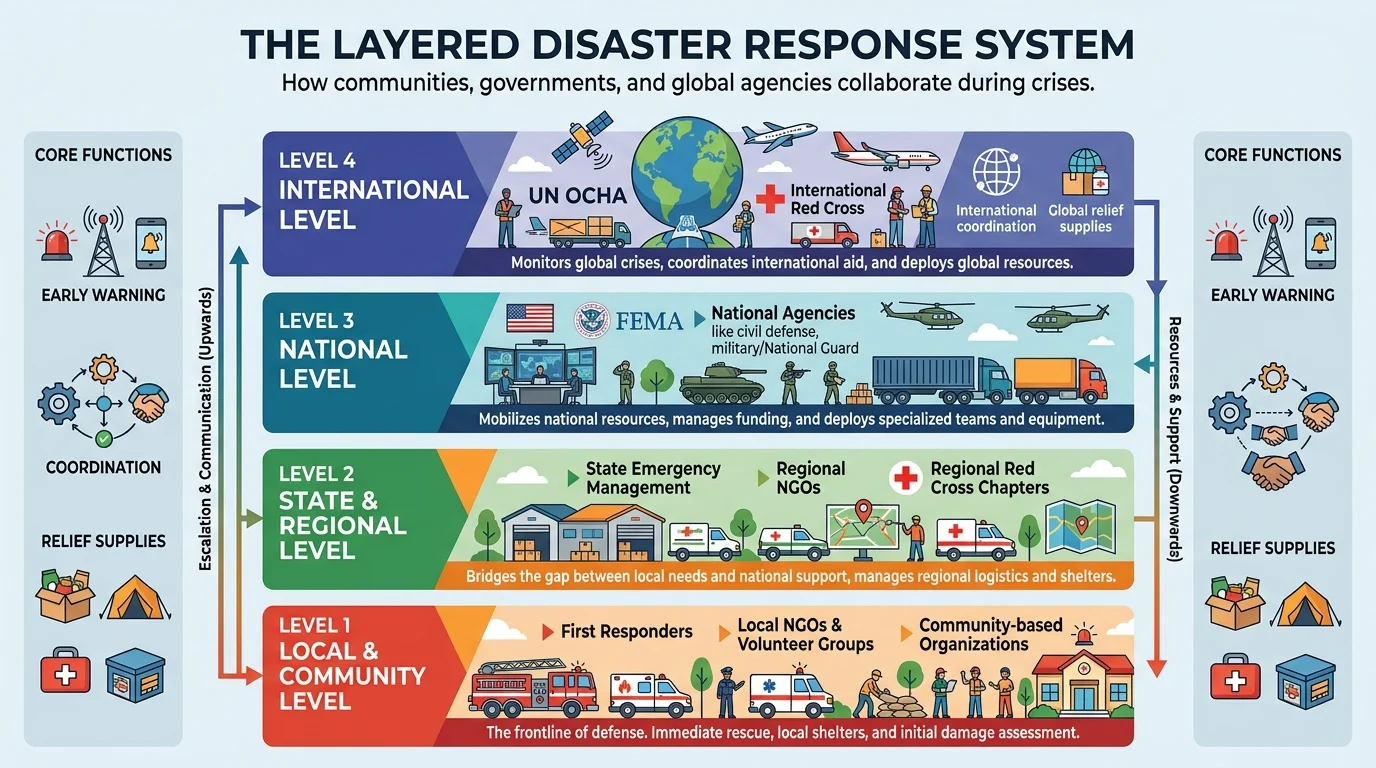
Quick Ans: Disaster response organizations are the coordinated network of government agencies, nonprofits, and international bodies that prepare for, respond to, and recover from emergencies worldwide. Key players include FEMA (U.S. federal coordination), the United Nations Office for the Coordination of Humanitarian Affairs (OCHA), the Red Cross and Red Crescent Societies, and NGOs like Doctors Without Borders and Mercy Corps. Effective response depends on layered coordination across local, state, national, and international levels.
When disaster strikes, chaos can follow. But behind the scenes, a vast network of organizations springs into action. From the local fire department to international humanitarian agencies, disaster response organizations form a coordinated system designed to save lives and rebuild communities.
Disaster response organizations are the government agencies, nonprofit groups, and international bodies responsible for preparing for, responding to, and recovering from emergencies. These range from FEMA, which coordinates federal response in the United States, to the United Nations Office for the Coordination of Humanitarian Affairs (OCHA), which oversees global humanitarian efforts. Nonprofits like the Red Cross, Doctors Without Borders, and Mercy Corps fill critical gaps with medical care, shelter, and supplies.
Understanding how these organizations work together matters because effective coordination is often the difference between chaos and recovery. When Hurricane Melissa struck Jamaica, the difference came down to one word: coordination . Let’s explore the key players and how they work together.
Government Disaster Response Organizations
1. FEMA (Federal Emergency Management Agency)
FEMA coordinates the federal response to disasters in the United States that receive a Presidential disaster declaration .
2. State and Tribal Governments
States and tribal governments are the main players in coordinating resources and obtaining support from other states and the federal government .
3. Local Government
Responsibility for responding to incidents begins at the local level with individuals and public officials in the affected county, city, or town .
4. National Emergency Management Organizations
Countries maintain national agencies like NEMO in Belize and NADMO in Ghana to coordinate domestic disaster response .
5. National Guard State Partnership Program
The National Guard partners with foreign nations to strengthen disaster response capabilities through training and exchanges .
6. FEMA’s Disaster Declaration Process
Local officials assess damage, states request federal assistance, and the President approves declarations under the Stafford Act .
7. Emergency Declarations
The President can declare an emergency when federal assistance is needed to supplement state and local emergency services .
8. Major Disaster Declarations
Declared for events causing damage beyond the combined response capabilities of state and local governments .
9. Federal Coordinating Officer (FCO)
For Stafford Act events, the FCO is the primary federal representative interfacing with state and local response officials .
10. Principal Federal Official (PFO)
The Secretary of Homeland Security’s primary representative ensures consistency of federal support and overall effectiveness of incident management .
11. National Incident Management System (NIMS)
NIMS provides a consistent approach for the whole community to work together and manage incidents involving all threats and hazards .
12. National Response Framework (NRF)
The NRF is the guiding document for how the nation responds to disasters, built on layered, mutually supporting capabilities .
13. FEMA’s Preparedness Mission
FEMA works across the country before disasters to help communities understand and prepare for risks through training and education .
Nonprofit and NGO Disaster Response Organizations
1. American Red Cross and Red Crescent Societies
The Red Cross provides sheltering, emergency food supplies, counseling, and other vital services during disasters .
2. Doctors Without Borders (MSF)
Teams of medical, logistics, and water and sanitation staff provide independent, impartial medical assistance to those who need it most .
3. International Rescue Committee (IRC)
IRC mobile medical teams provide life-saving support and respond to needs on the ground working with field offices and local partners .
4. Mercy Corps
A global team of humanitarians working on the front lines of today’s biggest crises to create a future of possibility .
5. Save the Children
Works with children in countries impacted by disaster to provide food, shelter, water, and health care .
6. CARE (Cooperative for Assistance and Relief Everywhere)
CARE works to meet urgent needs for health and medical services, food, shelter, and clean water .
7. Direct Relief
Provides grant funding to local nonprofits specializing in emergency medical care during disasters .
8. UNICEF USA
Delivers urgent, lifesaving support including clean drinking water and critical medical supplies to children in crisis .
9. UMCOR (United Methodist Committee on Relief)
Partners with organizations to bring food and water rations to families in refugee and displacement camps .
10. Episcopal Relief & Development
Partners with local organizations to restore critical infrastructure like water systems after disasters .
11. Iceland’s Landsbjörg and ICESAR
In countries without military forces, nonprofit rescue teams play a critical role in disaster preparedness, response, and recovery .
12. NGO Roles in the National Response Framework
NGOs perform vital service missions, assist individuals with functional needs, and interface with government response officials at all levels .
13. Local and Community-Based Organizations
Working in project form can be advantageous, but maintaining community-based organizations after funding ends is challenging .
International and UN Disaster Response Organizations
1. UN Office for the Coordination of Humanitarian Affairs (OCHA)
OCHA oversees and facilitates humanitarian and disaster-relief efforts of the UN system .
2. World Food Programme (WFP)
WFP provides food assistance to those who might otherwise starve during disasters .
3. UNICEF
Provides education, water, nutrition, and medical supplies to children uprooted by calamity .
4. World Health Organization (WHO)
Helps protect those displaced by disasters from the ravages of disease .
5. UNHCR (UN High Commissioner for Refugees)
Sets up and maintains camps for those forced to leave their homes .
6. International Organization for Migration (IOM)
Works with governments and NGOs to secure shelters for displaced communities .
7. Pan American Health Organization (PAHO)
Deploys field hospitals and mobile medical teams to support overstretched local facilities .
8. UN Development Programme (UNDP)
Ensures recovery has a firm and stable footing, focusing on debris management and livelihood support .
9. Food and Agriculture Organization (FAO)
Works with governments to address food security and agricultural recovery .
10. UN Central Emergency Relief Fund (CERF)
Provides financing to scale urgent interventions during disasters .
11. UNOCHA’s Coordination Role
Documents humanitarian interventions to ensure complementary actions and avoid gaps .
12. Consolidated Appeals
OCHA launches international appeals to mobilize financing for emergency assistance .
13. UN Multi-Country Sustainable Development Cooperation Framework
Five-year blueprints integrate lessons learned from disasters for Small Island Developing States .
14. Antigua and Barbuda Agenda for SIDS
A decade-long plan emphasizing regional cooperation, renewable energy, and climate adaptation .
15. UN Peacekeepers
Protect the delivery of humanitarian aid provided by UN system members and organizations like the Red Cross .
How Disaster Response Organizations Coordinate
1. Coordination Is Lifesaving, Not Optional
Without coordination, resources get duplicated in some areas while others are forgotten .
2. Layered, Mutually Supporting Capabilities
Effective, unified national response requires capabilities at local, state, tribal, and federal levels .
3. Local Leadership First
Responsibility for responding to incidents begins at the local level .
4. State and Tribal Supplementation
States supplement and facilitate local efforts before, during, and after incidents .
5. Federal Support When Requested
FEMA coordinates federal response when disasters receive a Presidential declaration .
6. Whole-of-Society Approach
Interoperability extends beyond military-to-military cooperation to include civilian agencies, law enforcement, and emergency responders .
7. Nightly Coordination Meetings
During Hurricane Melissa response, nightly meetings grew from a handful of responders to over 140 humanitarian actors .
8. Actor Matrix in National Plans
El Salvador’s plan maps responsibilities across government ministries and humanitarian partners .
9. Pre-Positioned Equipment
WFP pre-positions equipment at national warehouses to establish Emergency Logistics Staging Areas .
10. Memorandums of Understanding
MOUs streamline distribution of emergency relief and define partner roles .
11. Joint Exercises
Countries conduct bilateral and multilateral exercises to practice coordinated response .
12. State Partnership Program
The National Guard partners with foreign nations to strengthen disaster response capabilities .
13. Anticipatory Action
El Salvador embedded anticipatory action in its national contingency plan with thresholds, triggers, and time windows .
14. Early Warning Systems
Ghana’s NADMO uses AI-powered chatbots to deliver warnings in multiple languages .
15. Build Back Better
Recovery focuses not just on restoring what was lost but on enhancing future resilience .
Key Trends Shaping Disaster Response in 2026
1. AI-Powered Early Warning
Ghana’s NADMO deployed an AI chatbot to answer questions on floods, fires, storms, and other hazards in multiple languages .
2. Anticipatory Action Embedded in National Plans
El Salvador became the first country in the Americas to formally embed anticipatory action within a national contingency plan .
3. Increasing Frequency and Complexity
FEMA has been called upon to support an increasing number of incidents, from pandemics to non-Stafford Act events .
4. Climate Adaptation Focus
Small Island Developing States are emphasizing regional cooperation, renewable energy, and climate adaptation .
5. Digital Transformation
Governments are integrating AI and digital tools into disaster response and early warning systems .
6. Whole-of-Society Exercises
Training increasingly involves military, civilian agencies, law enforcement, and emergency responders .
7. Multi-Year Training Approaches
Exercises follow an “educate, train, demonstrate” model similar to crawl-walk-run .
8. Local Knowledge Integration
Decentralized decision-making, volunteer engagement, and culturally embedded improvisation contribute to effective response .
9. Nonprofits Filling Critical Gaps
In countries without military forces, nonprofits like Iceland’s Landsbjörg play essential roles .
10. Pre-Positioning Resources
WFP and national agencies are pre-positioning equipment and supplies before disasters occur .
What to Do Before, During, and After a Disaster
1. Know Your Local Emergency Management Agency
Local government is the first line of response. Know how to contact them .
2. Sign Up for Early Warnings
Many national and local agencies offer alert systems. Register for them .
3. Build a Preparedness Kit
FEMA’s Ready campaign provides tools and information to prepare for emergencies .
4. Know Your Flood Risk
Floods are the most common disaster. FEMA provides flood maps and risk tools .
5. Follow Official Guidance
During a disaster, follow instructions from local officials and emergency responders .
6. Apply for Assistance if Eligible
Visit DisasterAssistance.gov to apply for Individual Assistance after a major disaster declaration .
7. Seek In-Person Support
FEMA may set up Disaster Recovery Centers to help survivors apply for assistance .
8. Document Damage
Take photos and keep records of damage for insurance and assistance applications.
9. Check on Neighbors
Community members are often the first responders. Check on vulnerable neighbors.
10. Support Recovery Organizations
Donate to or volunteer with reputable disaster response organizations .
11. Stay Informed During Recovery
Recovery takes time. Monitor official channels for updates on assistance programs.
12. Participate in Preparedness Efforts
Join community preparedness programs and exercises before disasters occur .
13. Understand the Stafford Act Process
Knowing how declarations work helps you understand when federal assistance becomes available .
14. Connect with Local Nonprofits
Local organizations often know community needs best and can direct resources effectively .
15. Build Back Better
When rebuilding, consider hazard mitigation to reduce future disaster loss .
Frequently Asked Questions
What is FEMA and what does it do?
FEMA coordinates the federal response to disasters in the United States that receive a Presidential disaster declaration. It works before, during, and after disasters to help people and communities .
How does a disaster get declared?
Local officials assess damage, states request federal assistance, and the President approves declarations under the Stafford Act .
What is the National Response Framework?
The NRF is the guiding document for how the nation responds to disasters, built on layered, mutually supporting capabilities .
What role do NGOs play in disaster response?
NGOs perform vital service missions including sheltering, emergency food supplies, counseling, and assisting individuals with functional needs .
What is OCHA?
The UN Office for the Coordination of Humanitarian Affairs oversees and facilitates humanitarian and disaster-relief efforts of the UN system .
What is the difference between an emergency and major disaster declaration?
Emergency declarations supplement state and local emergency services. Major disaster declarations provide a wider range of federal assistance programs for individuals and public infrastructure .
How does anticipatory action work?
Anticipatory action uses thresholds, triggers, and time windows to activate pre-agreed measures before a disaster causes harm .
What is the State Partnership Program?
The National Guard partners with foreign nations to strengthen disaster response capabilities through training and exchanges .
What is an Emergency Logistics Staging Area?
An ESA is a logistics hub that can be rapidly set up during an emergency to support storage, coordination, and movement of relief supplies .
How can I help after a disaster?
Donate to reputable organizations, volunteer, and support local recovery efforts. Check on neighbors and share official information .
What is a Disaster Recovery Center?
FEMA may set up centers where survivors can apply for assistance, check application status, and get referrals to other programs .
Conclusion
Disaster response organizations form a vast, coordinated network that saves lives and rebuilds communities when crises strike. From FEMA and the National Guard to the Red Cross, Doctors Without Borders, and UN agencies, each plays a critical role in the layered system of preparedness, response, and recovery.
Effective coordination is the difference between chaos and recovery. When Hurricane Melissa struck Jamaica, nightly coordination meetings grew from a handful of responders to over 140 humanitarian actors working together . This is what effective disaster response looks like: government agencies, nonprofits, and international partners aligned around a shared mission.
Understanding these organizations matters because they are the safety net that catches communities when disaster strikes. Whether you work in emergency management, volunteer with a nonprofit, or simply want to be prepared, knowing who does what helps you navigate the system when it matters most. Share this guide, bookmark it, and stay prepared. The next disaster won’t wait, and neither should your knowledge.
Discover More:
- Canned Response Examples: 150+ Ready-to-Use Templates for Every Situation 2026
- Security Incident Response Team: Complete Guide to Building and Managing Your SIRT 2026
