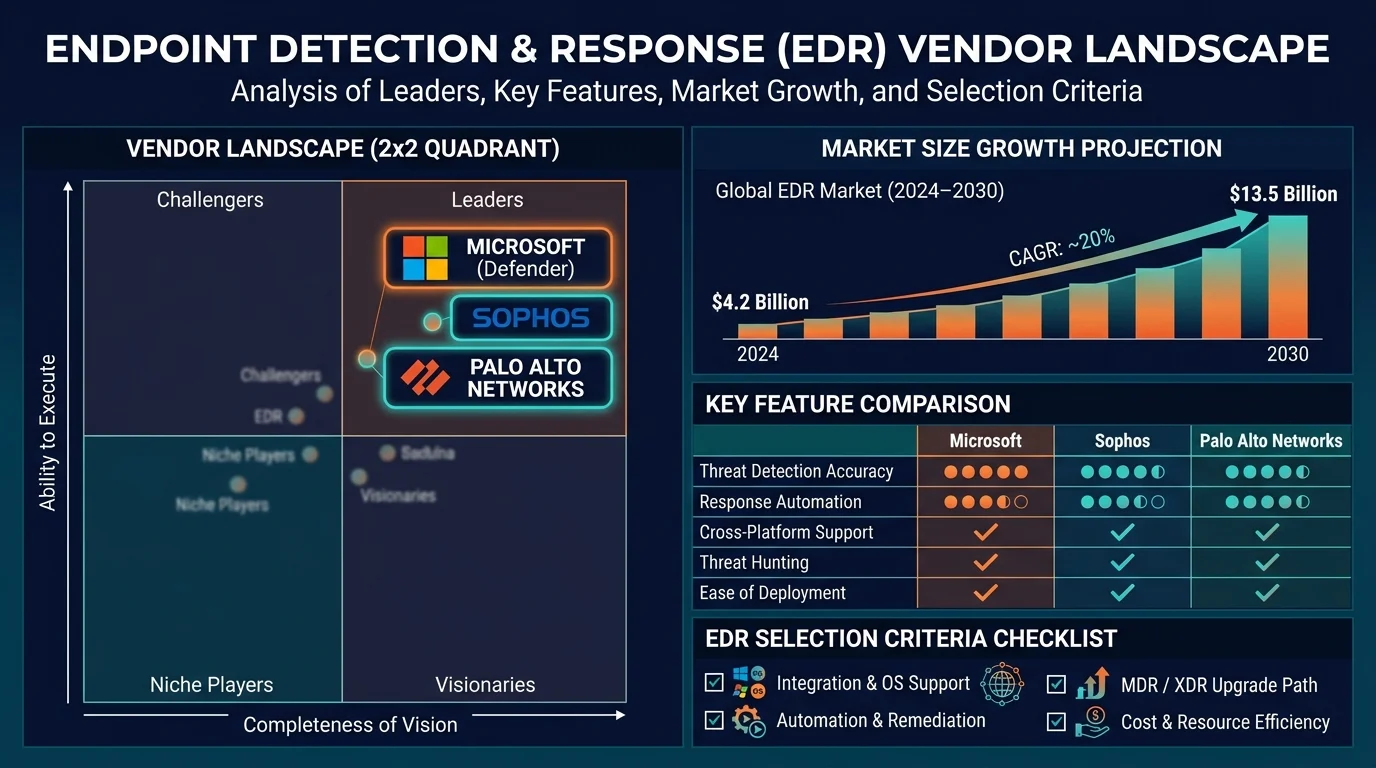
Quick Ans: Endpoint detection and response (EDR) vendors provide platforms that continuously monitor endpoint activity, detect malicious behavior, and automate response actions. The top three overall leaders for 2026 are Microsoft, Sophos, and Palo Alto Networks, according to ISG research . Other major vendors include CrowdStrike, SentinelOne, Cybereason, ESET, Trend Micro, Fortinet, and Bitdefender. The global EDR market was valued at $6.5 billion in 2025 and is projected to reach $68 billion by 2035 .
Your organization has hundreds of endpoints: employee laptops, servers, mobile devices, cloud workloads. Traditional antivirus only catches known threats. Modern attackers use fileless malware, credential theft, and living-off-the-land techniques that slip past signature-based defenses. This is where endpoint detection and response vendors step in.
EDR vendors provide the technology that monitors every process, login, and network connection on your endpoints. They use behavioral analytics and machine learning to spot abnormal activity. When something malicious appears, their platforms can isolate the endpoint, kill the process, or roll back changes automatically .
Choosing the right EDR vendor matters because it affects your security posture, your team’s workload, and your budget. The market has evolved rapidly, with vendors now offering integrated XDR platforms, managed services, and identity threat detection alongside core EDR capabilities . This guide covers the leading vendors, their strengths, and how to select the right one for your organization.
What EDR Vendors Provide
1. Behavioral Analytics and Threat Detection
EDR vendors use machine learning to baseline normal endpoint activity and flag anomalies that indicate compromise .
2. Automated Remediation
Platforms can automatically isolate endpoints, quarantine files, kill processes, and roll back changes without human intervention .
3. Threat Hunting and Investigation
Analysts can proactively search telemetry data to uncover hidden threats and reconstruct attack chains .
4. Vulnerability Management
EDR vendors monitor endpoints for outdated software, misconfigurations, and exploitable weaknesses .
5. Device Control
Platforms manage USB devices and other removable media to prevent malware introduction .
6. Threat Intelligence Integration
Vendors feed indicators of compromise and threat data into their platforms for broader detection coverage .
7. Alert Triage and Prioritization
Solutions prioritize alerts so security teams focus on critical threats first, reducing mean-time-to-respond .
8. Forensic Investigation Tools
EDR provides complete attack trails showing how an attacker entered, moved laterally, and attempted persistence .
9. Cloud Workload Protection
Modern EDR extends to cloud servers, containers, and serverless workloads .
10. Identity Threat Detection
Leading vendors now correlate endpoint activity with identity systems to detect credential-based attacks .
11. Managed Detection and Response
Many vendors offer MDR services where their analysts monitor and respond to threats on your behalf .
12. Compliance Reporting
EDR platforms generate reports needed for HIPAA, PCI DSS, GDPR, and other regulatory requirements .
13. API and Integration Support
Vendors provide APIs for SIEM, SOAR, and other security tool integration .
14. Multi-Tenant Management
Vendors serving MSPs offer multi-tenant consoles with policy inheritance .
15. Centralized Policy Management
Administrators control security policies across all endpoints from a single console .
Top EDR Vendors for 2026
1. Microsoft Defender for Endpoint
Microsoft is the overall leader in ISG’s 2026 Buyers Guide, processing 78 trillion daily signals across the Microsoft stack . It offers the best value for Microsoft 365 and Azure environments, with deep integration into Defender XDR, Sentinel, and Intune.
2. Sophos
Sophos ranks second overall and was rated Exemplary by ISG . Its Intercept X platform combines endpoint protection with EDR/XDR capabilities, available as a managed service through Sophos MDR .
3. Palo Alto Networks Cortex XDR
Palo Alto ranks third overall and leads in cross-domain threat detection . Cortex XDR excels at alert grouping and visual attack chain analysis for enterprise teams with dedicated forensics capability .
4. CrowdStrike Falcon Insight XDR
CrowdStrike is rated Assurance by ISG and excels in advanced threat hunting . Its Falcon platform is known for lightweight agents and cloud-native architecture.
5. SentinelOne Singularity
SentinelOne is rated Innovative and stands out for autonomous remediation and ransomware recovery . Its one-click rollback feature restores endpoints to pre-attack state.
6. Cybereason Defense Platform
Cybereason offers strong threat visualization through its MalOp approach, correlating activity across endpoints to present unified attack views . It is rated Merit by ISG .
7. ESET Protect
ESET provides unified security management with EDR/XDR capabilities, available in cloud and on-prem deployments . It appeals to organizations wanting a gradual path from traditional antivirus.
8. Trend Micro Vision One
Trend Micro is rated Assurance and was a Leader in Customer Experience by ISG . Its Vision One platform integrates endpoint, email, cloud, and network security.
9. Fortinet FortiEDR
Fortinet is rated Innovative and offers strong integration with the Fortinet Security Fabric . It suits organizations already invested in Fortinet’s ecosystem.
10. Bitdefender GravityZone
Bitdefender is rated Merit and provides XDR capabilities with a focus on ease of use . It serves both SMBs and enterprises.
How to Choose the Right EDR Vendor
1. Assess Your Environment
Determine your endpoint types, operating systems, cloud workloads, and remote workforce needs .
2. Evaluate Detection Quality
Test behavioral analytics, MITRE ATT&CK coverage, and false positive rates in a proof of concept .
3. Check Response Capabilities
Look for automated remediation, endpoint isolation, process termination, and rollback features .
4. Consider Integration Needs
Evaluate compatibility with your SIEM, SOAR, identity, email, and cloud security tools .
5. Evaluate Management Overhead
Assess whether your team can manage the platform or if you need MDR services .
6. Review Pricing Transparency
Check for public pricing, licensing models, and total cost of ownership .
7. Test in Your Environment
Run a proof of concept with real telemetry to evaluate detection, performance impact, and usability .
8. Check Compliance Support
Ensure the vendor provides reporting for your regulatory requirements .
9. Assess Scalability
Verify the platform can grow with your endpoint count and geographic expansion .
10. Evaluate Customer Support
Review support channels, implementation resources, and managed service options .
11. Consider Ecosystem Fit
Vendors with broader security portfolios may simplify operations or create unwanted dependency .
12. Review Analyst Ratings
Consult ISG, Gartner, and other analyst evaluations for vendor comparisons .
Market Trends and Vendor Evolution
1. EDR to XDR Evolution
Vendors are expanding from endpoint-only detection to cross-domain XDR platforms covering network, cloud, email, and identity .
2. Identity Threat Detection Integration
Leading vendors now correlate endpoint activity with Active Directory and identity systems to detect credential attacks .
3. Cloud-Native EDR Growth
Cloud-delivered EDR is growing at 24.93% CAGR as remote work normalizes .
4. Managed Detection and Response Expansion
MDR channels bring enterprise-grade coverage to resource-constrained organizations .
5. EDR-Killer Toolkits
Attackers use tools like EDRKillShifter to bypass endpoint agents, forcing vendors into tamper-proof engineering .
6. Unified Agent Platforms
Organizations are consolidating overlapping point solutions into unified agents that handle prevention, detection, and response .
7. AI-Powered Automation
Vendors are adding AI for alert summarization, investigation guidance, and response automation .
8. Regulatory-Driven Adoption
NIS2, HIPAA updates, and CISA performance goals are driving mandatory EDR adoption .
9. North America Market Dominance
North America held 37.02% of EDR market share in 2025, driven by federal mandates .
10. Asia-Pacific Rapid Growth
Asia-Pacific is projected to grow at 26.10% CAGR through 2031 .
Frequently Asked Questions
What are EDR vendors?
Companies that provide endpoint detection and response platforms, which monitor endpoints, detect malicious behavior, and automate response actions .
Who are the top EDR vendors in 2026?
ISG ranks Microsoft, Sophos, and Palo Alto Networks as the top three overall leaders, with Acronis, Broadcom, Microsoft, Palo Alto Networks, and Sophos rated Exemplary .
What is the difference between EDR and XDR vendors?
EDR vendors focus on endpoint telemetry, while XDR vendors extend detection across network, cloud, email, and identity systems .
Should I choose MDR instead of EDR?
If you lack 24/7 security staff, MDR is often more cost-effective than building an internal SOC .
How much does EDR cost?
Pricing varies by vendor and endpoint count. WatchGuard offers tiered licensing with enterprise features in all tiers . Microsoft Defender offers value for Microsoft-centric organizations .
What is the best EDR vendor for small businesses?
Huntress Managed EDR and WatchGuard are designed for lean teams and MSPs .
What is the best EDR vendor for enterprises?
Microsoft, Palo Alto Networks, and CrowdStrike are top choices for large enterprises with dedicated security teams .
How do I evaluate EDR vendors?
Run a proof of concept with real telemetry, test detection quality, response capabilities, and integration with your existing stack .
What is the EDR market size?
The global EDR market was valued at $6.5 billion in 2025 and is projected to reach $68 billion by 2035 .
Do EDR vendors offer free trials?
Some vendors offer free trials, but availability varies. ESET Protect lacks a free trial, while others may offer limited evaluations .
Conclusion
Endpoint detection and response vendors provide the technology that modern security teams need to detect and stop sophisticated attacks. The market has matured significantly, with Microsoft, Sophos, and Palo Alto Networks leading according to ISG’s 2026 evaluation .
Your choice of EDR vendor depends on your environment, team capabilities, and budget. Microsoft-centric organizations benefit from Defender’s deep integration. Enterprises with dedicated SOC teams may prefer CrowdStrike or Cortex XDR for advanced threat hunting. Smaller teams and MSPs often choose MDR-enabled platforms or vendors like WatchGuard and Huntress .
The EDR market is evolving toward XDR platforms that integrate endpoint, cloud, identity, and network telemetry . Vendors are adding AI-powered automation to reduce analyst workload . As attackers develop new evasion techniques, EDR vendors continue to innovate with tamper-proof agents and behavioral detection.
Evaluate vendors through proof of concept testing in your own environment. No single vendor is best for every organization. The right choice depends on your specific needs, existing stack, and security maturity.
Discover More:
- 200+ Best Out of Office Replies for Every Situation in 2026
- AI Text Response Generator: Complete Guide for 2026
