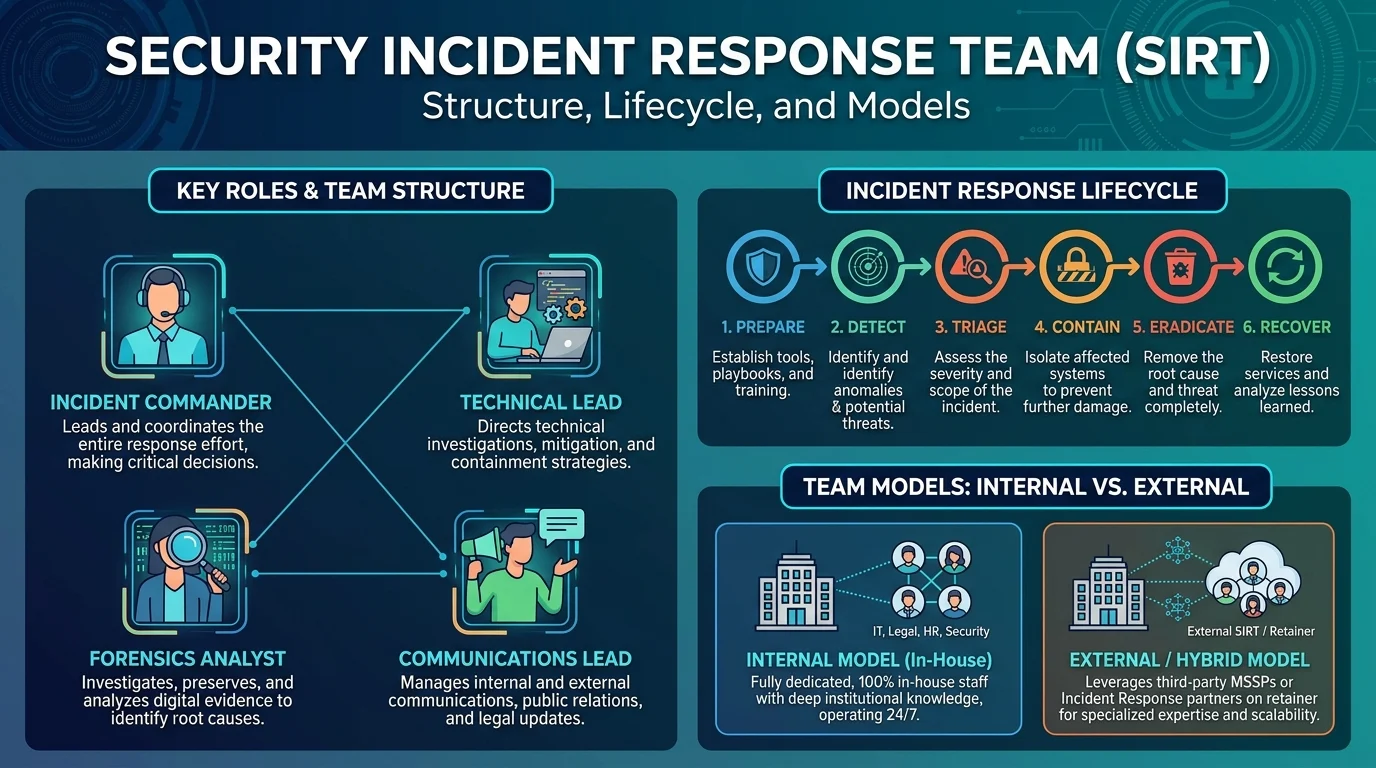
Quick Ans: A Security Incident Response Team (SIRT) is a dedicated group of cybersecurity professionals who detect, investigate, and respond to security incidents . Key responsibilities include incident triage, investigation, containment, eradication, and recovery . Essential roles include Incident Commander, Technical Lead, Forensics Analyst, and Communications Lead . The team operates under a formal charter with authority from senior leadership, follows documented procedures, and uses frameworks like the incident lifecycle (Prepare, Protect, Detect, Triage, Respond) .
Your organization just received a ransomware alert. Systems are locking up across three departments. Panic spreads. Who do you call? The security incident response team kicks into action. These are the people who turn chaos into controlled response.
A Security Incident Response Team (often called SIRT or CSIRT) is a specialized group of cybersecurity professionals who handle security incidents from detection through resolution . They serve as the frontline defense against cyber threats, responding to everything from phishing attempts to full-scale data breaches.
The difference between a minor disruption and a catastrophic breach often comes down to one factor: how quickly and effectively your SIRT responds . Organizations with well-prepared teams recover faster, contain damage more effectively, and protect their reputation. This guide covers everything from team structure to key roles to the incident response lifecycle.
What Is a Security Incident Response Team?
1. A Dedicated Cybersecurity Team
A SIRT is a group of IT security experts whose main business is to respond to computer security incidents affecting their constituents .
2. Serves a Defined Constituency
Every SIRT serves a specific customer base – the people and/or organizations the team was established to protect .
3. Provides a Single Point of Contact
The team acts as the central reporting point for all security incidents within its constituency .
4. Coordinates Incident Response
SIRT coordinates the entire response effort, from detection through recovery .
5. Operates Under Formal Authority
The team receives its authority directly from senior leadership – Board of Directors, Corporate Office, or Senior Management .
6. Follows Documented Procedures
Clear policies and procedures guide all response activities and ensure proper evidence handling .
7. Different from a SOC
While a Security Operations Center (SOC) focuses on monitoring, a SIRT focuses on response actions .
8. Various Names Exist
Teams may be called CSIRT, CERT, CIRT, or IRT – they perform similar functions .
9. Can Be Internal or External
Teams may be internal to an organization, commercial service providers, or national-level teams .
10. Stakeholders Include Legal and HR
SIRT works with legal counsel, human resources, and public relations during incidents .
11. Funded Based on Risk Profile
Budget and resources align with organizational risk assessment and critical assets .
12. Requires Executive Buy-In
A SIRT cannot succeed without leadership support and clear understanding of its business case .
13. Operates Under Charter
A formal charter defines mission, objectives, authority level, and team composition .
14. Manages Incident Lifecycle
The team guides incidents through detection, triage, containment, eradication, and recovery .
15. Continuously Improves
Post-incident reviews feed lessons learned back into detection and response improvements .
Key Roles and Responsibilities
1. Incident Commander (The Decision-Maker)
Oversees the entire response effort, sets priorities, ensures team coordination, and serves as liaison to senior leadership . This is the central coordinator who makes critical decisions under pressure.
2. Technical Lead (The Hands-On Strategist)
Manages containment, eradication, and recovery efforts while guiding security analysts on next steps . Responsible for technical strategy and execution.
3. Incident Analysts (The Detectives)
Detect and analyze security events, investigate threats, and guide remediation . They typically identify 75% of initial threats before escalation .
4. Forensics Analyst (The Evidence Expert)
Collects and analyzes digital evidence, traces how attacks happened, and preserves data for legal proceedings . Forensic analysis can increase post-incident recovery speed by 40% .
5. Threat Intelligence Specialist (The Lookout)
Tracks emerging threats, monitors cyber trends, and updates the team on attacker tactics . Proactive threat intelligence can reduce attack success rates by 50% .
6. Communications Lead (The Messenger)
Handles internal and external messaging during incidents . Ensures employees, executives, partners, and sometimes customers receive accurate updates without causing unnecessary panic .
7. Legal and Compliance Officer (The Protector)
Ensures incident responses align with regulations like GDPR, CCPA, or HIPAA . Manages legal liabilities and compliance reporting . Non-compliance can result in fines exceeding $10M .
8. IT Support and System Administrators (The Fixers)
Assist in securing and restoring affected systems during an incident . Coordinate closely with the SIRT to implement technical controls . Effective IT collaboration can cut recovery time by 50% .
9. CISO or Designee (The Authority)
Provides final accountability and authority over SIRT activities . Charters the team and appoints permanent members .
10. Human Resources Representative
Handles personnel-related issues that may arise during incidents, especially insider threat cases .
11. Public Relations Staff
Manages public-facing statements and media relations during high-profile incidents .
12. External Incident Response Partners
Specialized third-party responders who can surge resources when expertise is needed .
Team Structure Models
1. Internal Team Model
Team members are employees who know the environment deeply . Can be costly to build and retain but provides deep institutional knowledge .
2. External Service Model
Specialist expertise and scalability through third-party incident response services . Useful for organizations without full-time capacity .
3. Hybrid Model
Combines internal staff for daily readiness with external experts for large-scale events . Offers flexibility and specialized surge capacity .
4. Centralized Model
A single team serves the entire organization. Common in smaller to medium-sized organizations .
5. Distributed Model
Multiple teams serve different business units or regions. Appropriate for large, decentralized organizations .
6. Virtual Model
Team members remain in their normal roles but activate during incidents. Common in organizations with limited resources .
7. Tiered Model
Three levels: L1 Triage, L2 Investigation, L3 Advanced Analysis . Clear handoff criteria between tiers ensures efficient escalation .
8. National CSIRT
Serves as security point of contact for a country . Plays an intermediary role for the whole nation .
9. Governmental Sector CSIRT
Provides services to government agencies and in some cases to citizens .
10. Academic Sector CSIRT
Serves academic and educational institutions .
11. Commercial CSIRT
Provides CSIRT services commercially to paying constituents .
12. Military Sector CSIRT
Provides services to military organizations .
13. Vendor CSIRT
Focuses on vendor-specific products, developing solutions for vulnerabilities .
14. Internal CSIRT
Serves only the hosting organization’s internal staff and IT department .
15. CIP/CIIP Sector CSIRT
Focuses on critical information and infrastructure protection .
The Incident Response Lifecycle
1. Preparation Phase
Build and test response playbooks, assess vulnerabilities, and align with compliance requirements . The best teams run simulations so response feels routine, not improvised .
2. Detection and Identification
Monitor networks and cloud environments to catch early warning signs . Clear roles ensure incidents are classified quickly and escalated to the right decision-makers .
3. Triage Phase
Sort, categorize, and prioritize incoming incident reports . Initial assessment includes severity validation, false positive identification, and scope determination .
4. Investigation Phase
Analyze the incident to understand scope and impact . Collect evidence, trace attack paths, and preserve data for possible legal action .
5. Containment Phase
Quarantine affected systems and block attacker access . Strong coordination between roles is critical to keep disruption from spreading .
6. Eradication Phase
Remove malicious files, code, and attacker persistence mechanisms . Document removal procedures with rollback options .
7. Recovery Phase
Restore business systems from trusted sources and validate integrity . Minimize downtime while confirming threat elimination .
8. Post-Incident Review
Review what happened and capture lessons learned . Update playbooks and detection rules based on findings .
9. Documentation and Reporting
Track and document all investigations and resolutions . Report findings to leadership and stakeholders .
10. Communication Management
Provide accurate updates to employees, executives, partners, and when necessary, customers .
11. Evidence Preservation
Collect and preserve forensic evidence for internal use and potential legal proceedings .
12. Threat Intelligence Integration
Feed incident findings back into threat intelligence to improve future detection .
13. Recovery Validation
Confirm threat elimination before returning to normal operations .
14. Metrics Tracking
Track KPIs like Mean Time to Detect (MTTD), Mean Time to Respond (MTTR), and SLA adherence .
15. Continuous Improvement
Embed lessons learned into training, playbooks, and detection capabilities .
Essential SIRT Capabilities
1. Incident Analysis
Analyze reported incidents to determine scope, impact, and appropriate response .
2. Incident Response Coordination
Coordinate response efforts across teams and stakeholders .
3. Vulnerability Handling
Report, analyze, and respond to vulnerabilities in systems .
4. Artifact Handling
Collect and analyze artifacts – remnants of attacker activity .
5. Security Quality Management
Provide risk analysis, security consulting, and awareness building .
6. Technology Watching
Stay up to date with the latest threat landscape and security developments .
7. Threat Intelligence
Consume, process, and operationalize threat data from commercial feeds, open sources, and ISACs .
8. Proactive Services
Announce intrusion alerts and advisories to protect systems against newly found problems .
9. Awareness Building
Educate the constituency about security best practices and incident reporting .
10. Secure Communication
Establish trusted, secure channels for coordinating response activities .
11. Out-of-Band Communication
Maintain pre-arranged communication channels that remain available if the main network is down .
12. Forensic Readiness
Maintain capabilities to collect and preserve forensic evidence .
13. Lessons Learned
Conduct structured post-incident reviews that feed back into improvements .
14. Threat Hunting
Proactively search for threats that evade automated detection .
15. Third-Party Coordination
Collaborate with law enforcement, other CSIRTs, and incident response retainers .
Frequently Asked Questions
What is a Security Incident Response Team (SIRT)?
A dedicated group of cybersecurity professionals who detect, investigate, and respond to security incidents on behalf of an organization or constituency .
What is the difference between a SIRT and a CSIRT?
They are essentially the same. SIRT stands for Security Incident Response Team, while CSIRT stands for Computer Security Incident Response Team. Different organizations use different names .
What are the key roles in a SIRT?
Core roles include Incident Commander, Technical Lead, Incident Analysts, Forensics Analyst, Threat Intelligence Specialist, Communications Lead, and Legal/Compliance Officer .
How is a SIRT structured?
Teams can be internal, external, or hybrid; centralized or distributed; and organized in tiers (L1/L2/L3) . The structure depends on organizational needs and resources .
What does the incident response lifecycle include?
The lifecycle covers preparation, detection and identification, triage, investigation, containment, eradication, recovery, and post-incident review .
How fast should a SIRT respond?
Response time targets depend on incident severity. Organizations should define time-based SLAs aligned with business impact .
What authority does a SIRT have?
A SIRT typically receives its authority directly from senior leadership (Board of Directors or Senior Management) and can override other corporate decisions during incident response .
Why is a SIRT important?
A SIRT provides a single point of contact for incident reporting, coordinates focused response efforts, ensures proper evidence handling, and helps organizations recover faster from security incidents .
What is the constituency of a SIRT?
The constituency is the specific group of people and/or organizations the SIRT was established to serve . This could be internal staff, government agencies, academic institutions, or commercial customers .
How do I build a SIRT?
Assess organizational needs and risk profile, obtain leadership support and budget, choose the right team structure, select tools, define roles and responsibilities, and implement ongoing training programs .
Conclusion
A Security Incident Response Team is your organization’s frontline defense against cyber threats. When a breach happens, this team transforms chaos into coordinated action, protecting assets, reputation, and business continuity. Understanding the SIRT structure, key roles, and incident lifecycle helps organizations prepare effectively.
The best teams don’t wait for incidents to happen. They train regularly through tabletop exercises and red team drills . And they update playbooks as threats evolve . They practice communication protocols so responses feel routine, not improvised . Your SIRT’s performance under pressure depends entirely on the preparation done before the pressure arrives.
Start building or strengthening your SIRT today. Assess your risk profile. Secure leadership buy-in. Define roles clearly. Train continuously. When the next alert comes, you’ll be ready.
Discover More:
- 150+ Best First Response Question Mark Replies for Every Situation 2026
- Understanding Trauma Responses: Fight, Flight, Freeze, and Fawn 2026

2 thoughts on “Security Incident Response Team: Complete Guide to Building and Managing Your SIRT 2026”