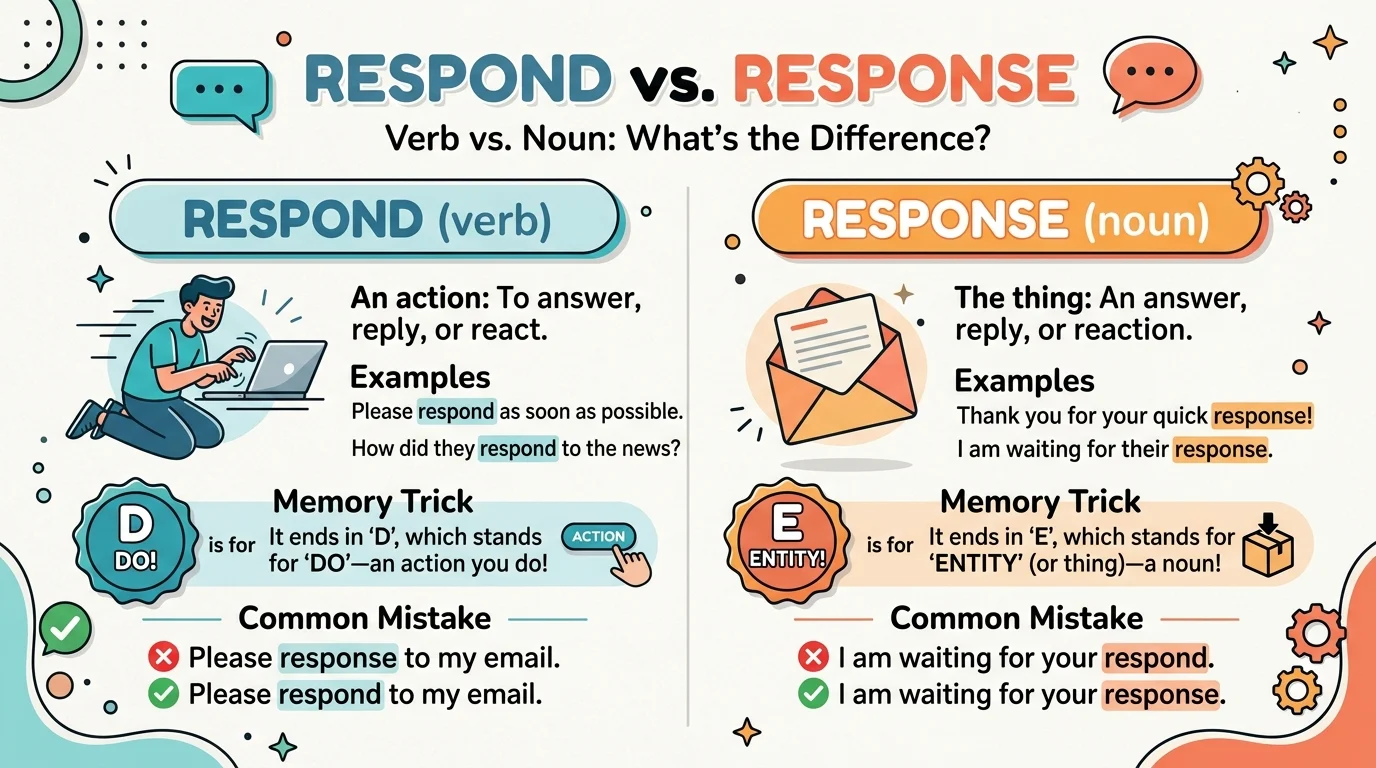
Quick Ans: Respond is a verb meaning “to answer or react to something.” Response is a noun meaning “the answer or reaction itself.” Use respond when describing the action: “Please respond to my email.” Use response when naming the thing: “Her response was quick.” Quick memory trick: respond ends in “d” like “do” (action), response ends in “e” like “entity” (thing). Mixing them up is one of the most common grammar errors in professional writing.
You type a work email and pause. Should you write “thank you for your quick respond” or “thank you for your quick response”? One is correct. One makes you look like you slept through English class. Yet millions of people mix these up every single day.
Respond vs response is a classic grammar trap. They sound similar, they look similar, and they mean almost the same thing. The difference comes down to one simple concept: parts of speech. Respond is a verb, an action word. Response is a noun, a naming word. That’s it. That’s the whole rule.
But knowing the rule and applying it under pressure are two different skills. This guide breaks down exactly when to use each word, with clear examples for emails, essays, text messages, and professional documents. By the end, you’ll never second-guess yourself again. Let’s settle this once and for all.
What Is the Difference Between Respond and Response?
1. Respond Is a Verb
Respond describes the action of answering or reacting to something.
2. Response Is a Noun
Response names the answer or reaction itself.
3. Respond Answers “What Did You Do?”
If the answer is an action, use respond.
4. Response Answers “What Is It?”
If the answer is a thing, use response.
5. Respond Is Always an Action
You cannot “have a respond.” You can only “respond.”
6. Response Is Always a Thing
You cannot “response to an email.” You can only “send a response.”
7. Respond Functions as a Predicate
It tells what the subject does: “She responded quickly.”
8. Response Functions as a Subject or Object
It names something: “The response was overwhelming.”
9. Respond Never Takes an Article
You don’t say “a respond.” That’s a dead giveaway.
10. Response Often Takes an Article
You say “a response,” “the response,” or “my response.”
11. Respond Can Stand Alone as a Command
“Respond immediately!” works as a complete instruction.
12. Response Needs a Verb to Make a Sentence
“The response” alone is incomplete. It needs action.
13. Respond Has No Plural Form
There’s no “responds” as a noun. Responds is only third-person singular verb.
14. Response Has a Clear Plural
Responses is the plural noun form.
15. One Letter Changes Everything
The “d” vs “se” ending signals verb vs noun. Train your eye to catch it.
When to Use Respond
1. When Describing an Action
Use respond when someone does the act of answering. “He responded to the text.”
2. In Imperative Sentences
Commands use verbs. “Respond to the invitation by Friday.”
3. After Subject Pronouns
“I respond,” “you respond,” “they respond.” Verb position confirmed.
4. With Helping Verbs
“Will respond,” “should respond,” “must respond.” All verb constructions.
5. In Formal Requests
“We kindly ask that you respond within 48 hours.”
6. In Customer Service Scripts
“Please respond to the survey to share your feedback.”
7. In Medical Contexts
“Patients responded well to the treatment.”
8. In Emergency Situations
“First responders respond within minutes.”
9. In Email Subject Lines
“Please Respond: Meeting Time Change.”
10. In Academic Writing
“Participants responded to the questionnaire anonymously.”
11. In Technical Documentation
“The server will respond with a 200 status code.”
12. In Everyday Conversation
“I texted him but he hasn’t responded yet.”
13. In Business Communication
“Kindly respond at your earliest convenience.”
14. In Legal Documents
“The defendant must respond to the complaint within 30 days.”
15. In Social Media
“She responded to the comment with grace.”
When to Use Response
1. When Naming the Answer
Use response when referring to the thing itself. “Her response was perfect.”
2. After Adjectives
“Quick response,” “positive response,” “angry response.” Adjectives modify nouns.
3. After Possessive Pronouns
“My response,” “your response,” “their response.” Possessives signal nouns.
4. With Articles
“A response,” “the response,” “an appropriate response.”
5. As a Subject
“The response exceeded all expectations.”
6. As a Direct Object
“We received a response within hours.”
7. In Compound Nouns
“Response rate,” “response time,” “response team.” Noun + noun combinations.
8. In Statistical Contexts
“The survey response rate was 85%.”
9. In Medical Writing
“The patient’s response to therapy was encouraging.”
10. In Emergency Management
“The emergency response team arrived in six minutes.”
11. In Customer Feedback
“Customer responses were overwhelmingly positive.”
12. In Marketing
“The ad campaign generated a strong response.”
13. In Psychology
“Fight or flight is a stress response.”
14. In Technology
“Error response codes help developers debug issues.”
15. In Everyday Speech
“I’m still waiting for his response to my message.”
Common Mistakes and How to Fix Them
1. Writing “Your Respond” Instead of “Your Response”
Wrong: “Thank you for your quick respond.”
Right: “Thank you for your quick response.”
2. Writing “Please Response” Instead of “Please Respond”
Wrong: “Please response to this email.”
Right: “Please respond to this email.”
3. Writing “I Will Response” Instead of “I Will Respond”
Wrong: “I will response tomorrow.”
Right: “I will respond tomorrow.”
4. Writing “No Respond” Instead of “No Response”
Wrong: “There was no respond from the team.”
Right: “There was no response from the team.”
5. Writing “Respond Rate” Instead of “Response Rate”
Wrong: “The respond rate was high.”
Right: “The response rate was high.”
6. Writing “Respond Time” Instead of “Response Time”
Wrong: “The respond time was under an hour.”
Right: “The response time was under an hour.”
7. Writing “He Response” Instead of “He Responds”
Wrong: “He response to every email.”
Right: “He responds to every email.”
8. Writing “A Respond” Instead of “A Response”
Wrong: “She gave a respond.”
Right: “She gave a response.”
9. Writing “Response to the Question” as a Verb
Wrong: “I will response to the question.”
Right: “I will respond to the question.”
10. Writing “Responds” as a Noun
Wrong: “We got many responds.”
Right: “We got many responses.”
11. Writing “Response Back” Redundantly
Wrong: “Please response back.”
Right: “Please respond.”
12. Writing “Respond Me” Instead of “Respond to Me”
Wrong: “Please respond me.”
Right: “Please respond to me.”
13. Writing “Response Of” Instead of “Response To”
Wrong: “His response of the question was good.”
Right: “His response to the question was good.”
14. Confusing “Responsible” With Both
Wrong: “He is response for the project.”
Right: “He is responsible for the project.”
15. Auto-Correct Errors
Phone autocorrect often swaps these. Always proofread before sending.
Memory Tricks That Actually Work
1. The “D” for “Do” Trick
Respond has a “d.” Do is an action. Respond is an action.
2. The “E” for “Entity” Trick
Response has an “e.” Entity is a thing. Response is a thing.
3. The Substitute Test
If you can replace the word with “answer” as an action, use respond. If you can replace it with “answer” as a thing, use response.
4. The “To Respond” Test
If “to respond” fits, use respond. “I want to respond.” Correct. “I want to response.” Clearly wrong.
5. The Article Test
If you can put “a” or “the” before it, use response. “The response.” Works. “The respond.” Broken.
6. The Possessive Test
If “my,” “your,” or “their” fits before it, use response.
7. The Adjective Test
If an adjective like “quick” or “positive” fits before it, use response.
8. The Tense Test
Can you change the tense? “Responded,” “responding.” Verbs change tense. Response becomes “responses” only for plural.
9. The Sentence Position Test
After a subject, use respond. As a subject, use response.
10. The Sound-Alike Warning
Because they sound similar, slow down when writing these words under pressure.
11. The Email Template Trick
Memorize “Thank you for your response” as a fixed phrase. It’s always correct.
12. The Autocorrect Guard
Turn off aggressive autocorrect for professional writing, or proofread twice.
13. Read It Out Loud
If it sounds wrong when spoken, it’s probably wrong on paper.
14. The Part-of-Speech Label
Label each sentence component in your head: noun or verb? Then choose.
15. Practice With Flashcards
Write sentences with blanks and fill in respond or response until it’s automatic.
Examples in Real Contexts
1. Email: Thank You
“Thank you for your prompt response to my inquiry.”
2. Email: Request
“Please respond to this email by end of day Friday.”
3. Text Message
“Hey, did you ever respond to that group chat?”
4. Text Message Reply
“Still waiting on his response, honestly.”
5. Work Report
“The team’s response to the crisis was swift and effective.”
6. Customer Service
“We aim to respond to all tickets within four hours.”
7. Survey Results
“Survey responses exceeded our initial projections.”
8. Medical Notes
“The patient responded positively to the new medication.”
9. Emergency Services
“Emergency response teams were dispatched immediately.”
10. Technical Support
“The server responded with an error code.”
11. Academic Paper
“Participant responses were coded and analyzed.”
12. Social Media
“Her response to the criticism went viral.”
13. Legal Document
“The plaintiff must respond to the motion within 14 days.”
14. Job Interview
“Tell me about a time you responded to a difficult client.”
15. Casual Conversation
“I sent a long message, and his response was just a thumbs up.”
Frequently Asked Questions
What is the difference between respond and response?
Respond is a verb (action). Response is a noun (thing). Use respond when describing the act of answering. Use response when naming the answer itself.
Is it “thank you for your respond” or “thank you for your response”?
“Thank you for your response” is correct. “Your” is a possessive pronoun, which requires a noun.
Is it “please respond” or “please response”?
“Please respond” is correct. “Please” followed by a verb forms a polite command.
Can respond ever be a noun?
No. Respond is always a verb. The noun form is response.
Can response ever be a verb?
No. Response is always a noun. The verb form is respond.
What is the plural of response?
Responses. There is no plural form of respond as a noun.
What is the past tense of respond?
Responded. “She responded to the email yesterday.”
What is the adjective form?
Responsive. “She is very responsive to client needs.”
What is the adverb form?
Responsively. “He answered responsively and thoughtfully.”
Is “response rate” correct?
Yes. Response rate is a compound noun. “Respond rate” is incorrect.
Is “response time” correct?
Yes. Response time is a compound noun. “Respond time” is incorrect.
Why do people confuse these words?
They share the same root and sound similar. The part-of-speech difference is easy to overlook under pressure.
Does British English differ from American English?
No. The respond vs response rule is the same in both.
What about “responds”?
Responds is the third-person singular verb form: “He responds quickly.”
What about “responded”?
Responded is the past tense verb form: “They responded to the emergency.”
Conclusion
Respond vs response comes down to one simple distinction: verb versus noun. Respond is what you do. Response is what you give. Once you internalize that, you’ll never mix them up again.
The fastest way to master this is to memorize the fixed phrases. “Thank you for your response.” “Please respond.” “The response was positive.” “They responded quickly.” These templates cover 90% of real-world usage.
Grammar matters because it shapes how people perceive your competence. A single wrong word in a professional email can undermine an otherwise perfect message. Getting respond and response right is a small win that pays off every single day. Share this guide with anyone who needs it, and bookmark it for your next writing session. Your credibility is worth the extra second of proofreading.
Discover More:
- Security Incident Response Team: Complete Guide to Building and Managing Your SIRT 2026
- SAML Response Decoder: Complete Guide for 2026
