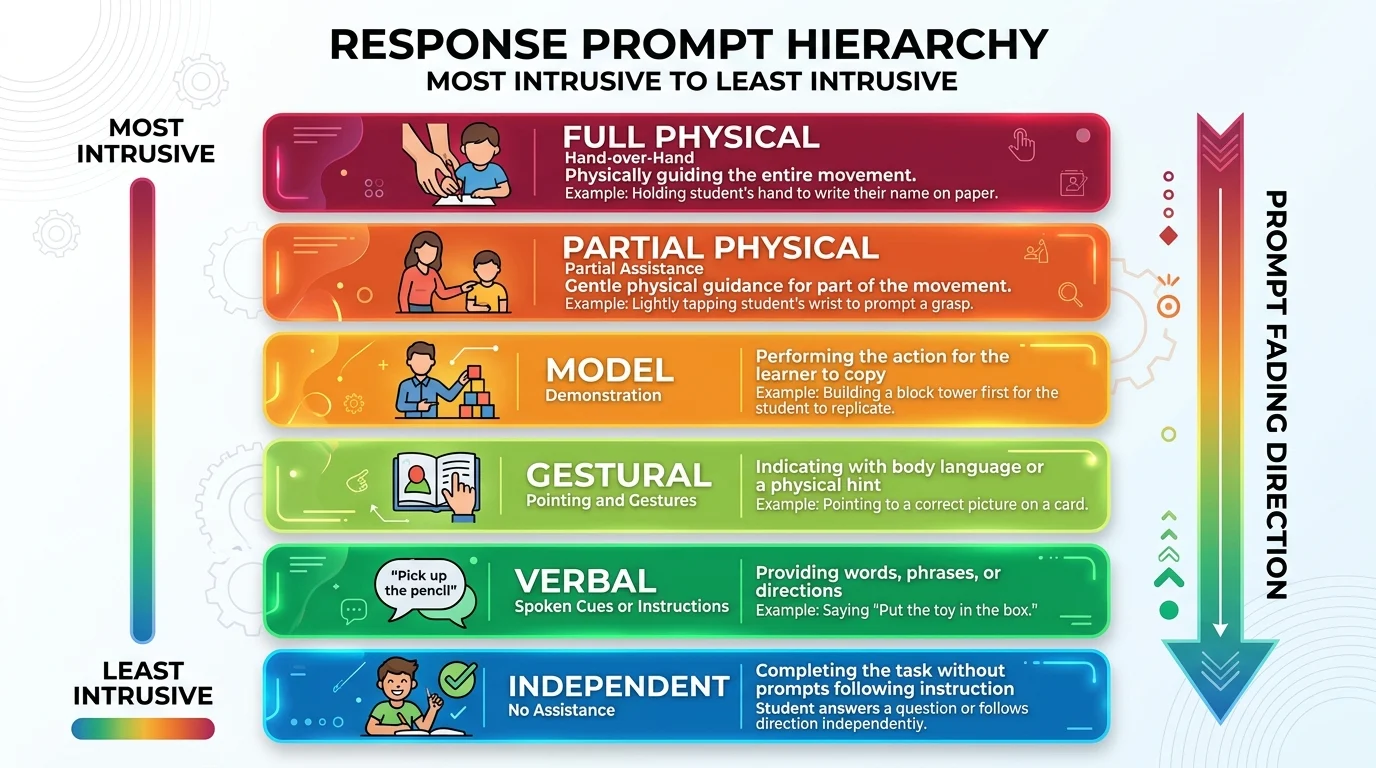
Quick Ans: Response prompts in ABA are assistance strategies that act directly on the learner to evoke a correct response. The four main types are physical (hand-over-hand guidance), model (demonstrating the behavior), gestural (pointing or signaling), and verbal (spoken instructions or hints). These prompts are systematically faded using procedures like most-to-least prompting, least-to-most prompting, time delay, and graduated guidance. Response prompting is an evidence-based practice supported by over 50 years of research across all disabilities, ages, and settings.
Every ABA therapist faces the same challenge: how do you help a learner succeed without creating dependence? The answer lies in response prompts.
Response prompts are the backbone of effective ABA instruction. They are the physical guidance, models, gestures, and verbal cues that help learners perform skills correctly from the very first trial . Without prompts, learners might struggle through repeated errors, become frustrated, and miss out on valuable reinforcement. With prompts, they experience success early and often, building momentum toward independence.
The science behind response prompting is robust. These procedures have been validated across more than five decades of research, spanning all types of disabilities, age groups, skills, and instructional settings . Whether you’re teaching a child to brush their teeth, a student to read sight words, or an adult to complete a vocational task, response prompting provides the structure for nearly errorless learning.
Understanding the distinction between response prompts and stimulus prompts matters. Response prompts act on the learner’s behavior directly. Stimulus prompts change the materials or environment. Both are valuable, but response prompts are the workhorses of skill acquisition. Let’s explore exactly how they work.
What Are Response Prompts in ABA?
1. Assistance That Evokes Correct Responses
Response prompts are extra antecedent stimuli used to occasion a correct response in the presence of the natural discriminative stimulus .
2. They Act Directly on the Learner
Unlike stimulus prompts that change materials, response prompts operate on the learner’s behavior to guide the response .
3. Temporary Supports
Every response prompt is designed to be faded. The goal is always independent responding to the natural cue .
4. Evidence-Based Practice
Response prompting procedures are recognized as a high-leverage practice supported by extensive research .
5. Error-Reducing Intervention
Prompts prevent errors from occurring, reducing frustration and allowing reinforcement of correct responses .
6. Based on ABA Principles
Response prompting is grounded in applied behavior analysis, using the antecedent-behavior-consequence framework .
7. Individualized to the Learner
The choice of prompt depends on the learner’s needs, the target behavior, and the setting .
8. Four Major Types
The primary response prompts are physical, model, gestural, and verbal .
9. Systematic Fading Required
Prompts must be faded systematically to transfer stimulus control to the natural cue .
10. Used Across All Skill Domains
Response prompting works for daily living skills, academic skills, communication, and vocational tasks .
11. Applicable in Any Setting
These procedures can be used in one-to-one, group, inclusive, and virtual settings .
12. Delivered by Any Trained Instructor
Teachers, paraprofessionals, peers, caregivers, and related service personnel can all deliver response prompts .
The Four Main Types of Response Prompts
1. Physical Prompts
Physical prompts involve another person physically assisting the learner to perform the target behavior .
2. Full Physical Prompt
Hand-over-hand guidance through the entire response provides maximum assistance .
3. Partial Physical Prompt
A lighter touch or nudge to guide the movement provides less intrusive assistance .
4. Model Prompts
The instructor demonstrates the entire target behavior for the learner to imitate .
5. Gestural Prompts
Pointing, tapping, or making a motion toward the correct response guides the learner nonverbally .
6. Verbal Prompts
Spoken words, instructions, hints, or partial words guide the learner toward the correct response .
7. Direct Verbal Prompt
Giving the answer straight out, such as saying “red” when holding up a red card .
8. Indirect Verbal Prompt
A hint that allows the learner to figure out the answer, like asking “What animal goes moo?” .
9. Echoic Prompts
A verbal prompt where the instructor models the exact response for the learner to repeat .
10. Text Prompts
A written or printed cue that tells the learner what to say or do .
11. Prompt Hierarchy Ordering
Prompts are ordered by intrusiveness from most to least: full physical, partial physical, model, gestural, verbal, independent .
12. Choosing the Right Prompt
Start with the least intrusive prompt that will evoke the correct response .
Response Prompting Procedures and Strategies
1. Most-to-Least Prompting
Starts with the most intrusive prompt, fading to less intrusive prompts across sessions as criterion is met .
2. Least-to-Most Prompting
Starts with the least intrusive prompt, adding more assistance within a trial until the correct response occurs .
3. System of Least Prompts
A hierarchy where the instructor moves through prompts from least to most intrusive within a single trial .
4. Time Delay
The instructor presents the cue, waits a set number of seconds, then provides a prompt if needed .
5. Constant Time Delay
The delay interval stays fixed across all trials once established .
6. Progressive Time Delay
The delay interval gradually increases over time to encourage independent responding .
7. Simultaneous Prompting
Daily probe trials assess independent responses, followed by training trials with immediate prompts .
8. Graduated Guidance
The instructor shadows the learner’s movement, providing physical guidance only as needed .
9. Fading Physical Prompts
Contact is reduced from hand-over-hand to wrist, elbow, shadowing, and finally no contact .
10. Prompt Fading by Magnitude
The same prompt is reduced in intensity, such as fading from “blueberry” to “blue” to “b” .
11. Prompt Fading by Hierarchy
Prompts change from more intrusive to less intrusive according to a predetermined sequence .
12. Transfer of Stimulus Control
The process of fading prompts so behavior occurs to the natural discriminative stimulus alone .
Prompt Fading and Transfer of Stimulus Control
1. Why Fading Is Essential
Without fading, learners become prompt-dependent and cannot perform skills independently .
2. Plan the Fade from the Start
Decide how prompts will be reduced before introducing them .
3. Size of Fading Steps Matters
Too large a step causes errors; too small a step causes dependency .
4. Errorless Learning Goal
At each fading step, provide just enough prompt so the learner makes no errors .
5. Reinforce Prompted Responses
Correct responses, even when prompted, should be reinforced to strengthen the behavior .
6. Differentially Reinforce Independence
When the learner responds independently, provide stronger reinforcement .
7. Watch for Prompt Dependency
If the learner waits for a prompt before responding, the fade is happening too slowly .
8. Criteria for Moving Down the Hierarchy
Set clear criteria, such as three consecutive correct responses, before reducing prompt intensity .
9. Data Collection During Fading
Record prompt levels during each session to track progress toward independence .
10. Generalization Checks
Test whether the skill occurs with different instructors, settings, and materials .
11. Avoid Fading Too Quickly
Rushing the fade can result in errors and frustration, undermining the learning process .
12. Avoid Fading Too Slowly
Delaying the fade creates prompt dependence that is difficult to break .
When and How to Use Response Prompts
1. Use Prompts When Teaching New Skills
Prompts help learners succeed from the first trial when a skill is brand new .
2. Use Prompts When Errors Are Likely
If the learner is unlikely to respond correctly without help, prompting prevents error patterns .
3. Use Prompts for Multi-Step Tasks
Response prompts help learners complete chained behaviors like hand-washing or tooth-brushing .
4. Use Prompts When Frustration Is High
Prompts allow learners to contact reinforcement even when frustration tolerance is low .
5. Always Present the Discriminative Stimulus
The natural cue must be present before delivering the prompt .
6. Get the Learner’s Attention First
Ensure the learner is attending before presenting the cue and prompt .
7. Deliver the Prompt Before the Response
Prompts are antecedent interventions delivered before the learner responds .
8. Use the Least Intrusive Effective Prompt
Start with the smallest prompt needed to produce a correct response .
9. Choose Prompts Based on Learner Needs
Consider the learner’s skill level, communication abilities, and learning style .
10. Be Consistent Across Instructors
All team members should use the same prompt levels for consistency .
11. Train Caregivers and Paraprofessionals
Parents, teachers, and aides should be trained to deliver prompts correctly .
12. Prompt Only When Necessary
Do not prompt when the learner can perform the behavior independently .
Common Mistakes and How to Avoid Them
1. Failing to Fade Prompts
This is the most common error, leading to prompt-dependent learners .
2. Fading Too Quickly
Rushing the fade causes errors, frustration, and loss of motivation .
3. Fading Too Slowly
Delaying the fade unnecessarily prolongs dependence on assistance .
4. Using the Wrong Prompt Type
Some learners respond better to visual or gestural prompts than verbal ones .
5. Not Reinforcing Prompted Responses
Prompted correct responses must be reinforced to strengthen the behavior .
6. Forgetting the Discriminative Stimulus
The natural cue must be present when the prompt is delivered .
7. Inconsistent Prompting Across Instructors
Different prompt levels confuse the learner and slow progress .
8. Ignoring Data Collection
Without data, you cannot know when to fade or whether the plan is working .
9. Using Physical Prompts When Verbal Would Work
Always start with the least intrusive prompt that will be effective .
10. Neglecting Generalization
Skills must transfer to new settings, people, and materials to be truly learned .
11. Prompting When the Learner Is Not Attending
Prompts delivered without attention are wasted .
12. Not Planning for Maintenance
Even after independence, periodic checks ensure the skill is maintained .
Frequently Asked Questions
What is a response prompt in ABA?
A response prompt is assistance delivered to help a learner perform a correct response. It acts directly on the learner’s behavior and includes physical, model, gestural, and verbal prompts .
What is the difference between response prompts and stimulus prompts?
Response prompts act on the learner to evoke behavior. Stimulus prompts change the materials or environment to make the correct response more likely .
What are the four main types of response prompts?
Physical, model, gestural, and verbal prompts are the four primary types of response prompts .
What is prompt fading?
Prompt fading is the systematic process of reducing assistance so the learner eventually responds independently to the natural cue alone .
What is most-to-least prompting?
A procedure that starts with the most intrusive prompt and fades to less intrusive prompts across sessions as the learner meets criteria .
What is least-to-most prompting?
A procedure that starts with the least intrusive prompt and adds more assistance within a trial only if needed .
What is time delay prompting?
A procedure where the instructor waits a set number of seconds before delivering a prompt, giving the learner a chance to respond independently .
What is simultaneous prompting?
A procedure using daily probe trials to assess independence, followed by training trials with immediate prompts .
What is graduated guidance?
A procedure where the instructor shadows the learner’s movement and provides physical guidance only when necessary .
How do I know when to fade prompts?
Set clear criteria, such as three consecutive independent responses, before moving down the prompt hierarchy .
What is prompt dependency?
Prompt dependency occurs when a learner waits for a prompt before responding because prompts were not faded systematically .
Can response prompting be used in inclusive classrooms?
Yes. Response prompting procedures can be embedded in general education lessons and routines .
Who can deliver response prompts?
Teachers, paraprofessionals, peers, caregivers, and related service personnel can all be trained to deliver response prompts .
Conclusion
Response prompts are the foundation of effective skill instruction in ABA. They provide the assistance learners need to succeed from the first trial, preventing errors and building momentum toward independence. From physical guidance to verbal hints, each prompt type serves a specific purpose and is matched to the learner’s needs.
The power of response prompting lies in systematic fading. Without fading, prompts become crutches. With fading, they become stepping stones to independence. Procedures like most-to-least prompting, least-to-most prompting, time delay, and simultaneous prompting provide structured pathways for transferring stimulus control from prompts to natural cues.
Whether you’re a behavior technician, teacher, parent, or caregiver, understanding response prompts helps you teach more effectively. Start with the least intrusive prompt that works, reinforce every correct response, collect data diligently, and fade systematically. Your learners will thank you with their independence. Share this guide with your team, and bookmark it for quick reference during sessions.
Discover More:
- Auto Response Email Templates: Complete Guide for 2026
- Incident Response Service Provider: Complete Guide for 2026

4 thoughts on “Response Prompts ABA: Complete Guide for 2026”