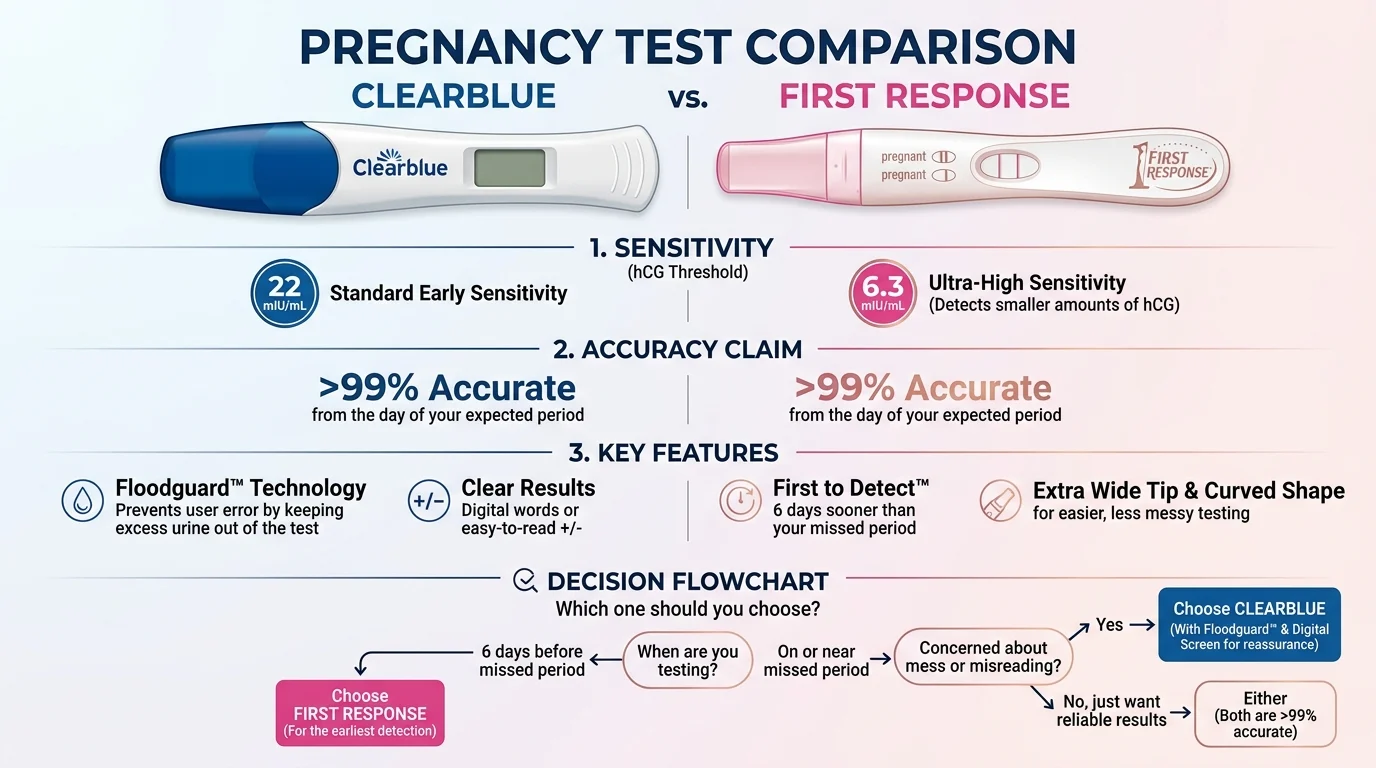
Quick Ans: Clearblue and First Response are both over 99% accurate from the day of your missed period. Clearblue wins for ease of use with its wide tip, Floodguard technology, and digital “Pregnant/Not Pregnant” readouts. First Response wins for early detection sensitivity, with a threshold of 6.3 mIU/mL compared to Clearblue’s 22 mIU/mL. If you want to test early, choose First Response. If you want zero confusion reading results, choose Clearblue Digital.
You’re standing in the pharmacy aisle, staring at two boxes. Clearblue or First Response. Both promise over 99% accuracy. Both claim you can test six days early. So which one actually gives you the answer you need?
The truth is, both brands are reliable. But they excel in different areas. Clearblue is the world’s bestselling pregnancy test brand, known for its user-friendly design and digital readouts that leave no room for misinterpretation . First Response is the go-to choice for early testing, with the lowest hCG detection threshold on the consumer market .
The choice comes down to your priorities. Do you want to test as early as possible? First Response is your best bet. Do you want a result that’s impossible to misread? Clearblue Digital eliminates the guesswork.
This guide breaks down the key differences so you can walk out of the pharmacy with confidence.
Brand Overview: Clearblue and First Response
1. Clearblue: The Global Bestseller
Clearblue is the bestselling home pregnancy test brand worldwide, with over 40 years of innovation and 23,000+ volunteers in clinical research .
2. Clearblue’s Core Strength: Ease of Use
The brand pioneered digital pregnancy tests in 2003 and continues to lead in user-friendly design .
3. First Response: The Early Detection Specialist
First Response is trusted by couples trying to conceive for its ultra-sensitive hCG detection technology .
4. First Response’s Core Strength: Sensitivity
Its Early Result test detects hCG at concentrations as low as 6.3 mIU/mL, roughly half the threshold of most competitors .
5. Both Brands Claim 99% Accuracy
Both Clearblue and First Response claim over 99% accuracy when used from the day of your missed period .
6. Both Offer Early Testing
Both brands offer tests that can detect pregnancy up to six days before your missed period .
7. Digital Options Available
Clearblue and First Response both offer digital tests with “Pregnant/Not Pregnant” or “YES+/NO-” readouts .
8. Price Points Are Similar
Clearblue digital tests are about $2 cheaper per test than First Response’s digital option .
9. Wide Availability
Both brands are sold globally in pharmacies, grocery stores, and online retailers .
10. Trusted by Millions
Both brands are household names with decades of consumer trust .
Accuracy and Sensitivity Compared
1. Both Are 99% Accurate From Missed Period
When used correctly from the day of your expected period, both brands deliver over 99% accuracy .
2. First Response Is More Sensitive
First Response Early Result detects hCG at 6.3 mIU/mL, the lowest threshold on the consumer market .
3. Clearblue’s Threshold Is Higher
Clearblue’s manual and digital tests have been measured at around 22 mIU/mL sensitivity .
4. What This Means for Early Testing
At 6.3 mIU/mL, First Response can detect pregnancy one to two days sooner than tests requiring 25 mIU/mL .
5. Clearblue Early Detection Is 10 mIU/mL
Clearblue’s Early Detection test has a sensitivity of 10 mIU/mL, closer to First Response but still not as low .
6. First Response’s Early Detection Rates
First Response Early Result detects 76% of pregnancies 5 days before expected period, 96% at 4 days, and >99% at 3 days .
7. Clearblue’s Early Detection Rates
Clearblue Early Detection detects 77% of pregnancies 6 days before missed period .
8. Digital Tests Have Higher Thresholds
Digital tests generally have slightly higher sensitivity thresholds than line-based tests, meaning they may turn positive a day later .
9. Interpretation Errors Affect Accuracy
Studies show 1 in 3 women can misread line-based pregnancy tests, making digital readouts more reliable .
10. Both Brands Are Reliable on Missed Period
If you wait until your missed period, both brands deliver near-perfect accuracy .
Ease of Use and Design
1. Clearblue’s Wide Tip
Clearblue tests feature an extra-wide absorbent tip that makes urine collection simpler .
2. Clearblue’s Long Handle
The longer handle provides a more comfortable grip during testing .
3. First Response’s Slimmer Tip
First Response tests have a skinnier tip compared to Clearblue’s wider design .
4. Clearblue’s Floodguard Technology
This patented feature collects excess urine and returns it to the test, reducing errors .
5. Clearblue’s Stop Light Feature
The Early Digital test flashes red to tell you when you’ve sampled enough urine .
6. Clearblue’s DualSense Technology
May prevent false positive results in a very small number of women with naturally low hCG levels .
7. First Response’s Comfortable Handle
Users report the First Response handle is comfortable to hold .
8. Clearblue’s Smart Countdown
Digital tests feature a countdown that shows the test is progressing .
9. First Response’s Test Is Working Indicator
Digital tests include a “test is working” feature to confirm hCG measurement is happening .
10. Both Are Simple to Use
Neither brand requires complex steps. Follow the instructions and you’ll get accurate results .
Early Detection Capabilities
1. Both Claim Six Days Early
Clearblue and First Response both advertise testing up to six days before your missed period .
2. First Response Is More Sensitive
The lower detection threshold means First Response can catch pregnancy earlier in real-world use .
3. First Response’s First to Detect Technology
This technology detects scant amounts of hCG that other tests might miss .
4. Clearblue’s Early Detection Test
Clearblue’s most sensitive test detects hCG at 10 mIU/mL .
5. Real-World Sensitivity Difference
Many women report getting faint positives on First Response one to two days before Clearblue turns positive .
6. Early Testing Reliability Varies
A negative result before your missed period is not reliable with either brand. Retest in 48 hours .
7. First Morning Urine Is Critical
Both brands recommend using first morning urine for early testing to maximize hCG concentration .
8. HCG Doubles Every 48 Hours
Since hCG doubles rapidly in early pregnancy, even a one-day difference in sensitivity matters .
9. Digital Tests May Lag Behind
Digital tests tend to have slightly higher thresholds, so they may turn positive later than line-based tests .
10. Test Again If Negative
If you get a negative result but your period doesn’t arrive, retest in a few days with either brand .
Digital vs Line-Based Tests
1. Digital Tests Eliminate Guesswork
Digital readouts display “Pregnant” or “Not Pregnant” in words, removing interpretation errors .
2. Line Tests Require Interpretation
Line-based tests show one line (not pregnant) or two lines (pregnant), and faint lines cause confusion .
3. Digital Tests Score Higher in Studies
In one study, digital tests achieved 100% accuracy at low hCG concentrations, while line-based tests ranged from 66% to 88% .
4. Clearblue Digital Offers Weeks Indicator
Some Clearblue digital tests also tell you how many weeks since conception (1-2, 2-3, or 3+) .
5. First Response Digital Says “YES+” or “NO-“
First Response digital tests provide clear yes/no results .
6. Line Tests Are More Sensitive
Line-based tests generally have lower detection thresholds than digital tests .
7. Digital Tests Cost More
Digital options are more expensive than standard line tests .
8. Both Brands Offer Digital Options
Clearblue and First Response both have digital tests in their lineup .
9. First Response Line Tests Are Popular
The Early Result test is First Response’s #1 bestselling pregnancy test .
10. Clearblue Line Tests Also Available
Clearblue offers traditional line-based tests with clear +/- results .
Pricing and Value
1. Clearblue Digital Is Cheaper
Clearblue digital tests are about $2 cheaper per test than First Response digital .
2. First Response Offers Great Value
At around $6 for a single Early Result test, First Response is affordable for repeat testing .
3. Clearblue Plus Costs $15.99 for 3
The Clearblue Plus Pregnancy Test costs $15.99 for a three-pack .
4. Clearblue Digital Costs $25.50 for 2
The Clearblue Digital Pregnancy Test costs $25.50 for a two-pack .
5. Multi-Packs Save Money
Both brands offer multi-packs that reduce the cost per test .
6. First Response Test and Confirm Pack
A 2-pack with both Early Result and Digital tests is available .
7. Clearblue Early Combo Pack
A 7-test combo pack with 6 Early Detection and 1 Early Digital test is available .
8. Store Brand Alternatives Cost Less
Store-brand tests are cheaper but may have higher thresholds and less reliable results .
9. Price Reflects Technology
Digital tests cost more due to their electronic components .
10. Value Depends on Your Needs
If testing early matters most, First Response delivers more value. If clarity matters most, Clearblue Digital is worth the premium .
Frequently Asked Questions
Is Clearblue or First Response more accurate?
Both are over 99% accurate from the day of your missed period. First Response is more sensitive for early testing, while Clearblue Digital eliminates interpretation errors .
Which test detects pregnancy earlier?
First Response Early Result is the most sensitive test available, detecting hCG at 6.3 mIU/mL compared to Clearblue’s 22 mIU/mL .
Can I use either test before my missed period?
Yes, both brands offer tests that can be used up to six days before your missed period. Use first morning urine for best results .
Is Clearblue easier to use?
Clearblue is generally considered easier to use due to its wide tip, long handle, and Floodguard technology .
Do digital tests work as well as line tests?
Digital tests eliminate reading errors but may have slightly higher detection thresholds than the most sensitive line tests .
What if I get a faint line on First Response?
Any second line with color indicates a positive result. Faint lines are common with early testing. Retest in 48 hours or see your doctor .
How long should I wait for results?
First Response Rapid Result gives results in 1 minute. First Response Early Result takes 3 minutes. Clearblue Early Detection takes 5 minutes .
Can medications affect the results?
Fertility drugs containing hCG can cause false positives. Other medications like antibiotics and contraceptive pills do not affect results .
When should I see a doctor?
See your doctor to confirm any positive result. If you get negative results but your period doesn’t arrive, consult your doctor .
Do pregnancy tests expire?
Yes. Check the expiration date on the wrapper or box. Expired tests may give unreliable results .
Conclusion
Clearblue and First Response are both excellent choices, but they shine in different scenarios. If your priority is testing as early as possible, First Response Early Result is the most sensitive test on the market, with a detection threshold of 6.3 mIU/mL . If you want a result you can read without squinting or second-guessing, Clearblue Digital delivers unmistakable “Pregnant” or “Not Pregnant” readouts .
Many women use both: First Response for early testing and Clearblue Digital for confirmation. Whichever you choose, remember that early negative results aren’t definitive. If your period doesn’t arrive, retest in a few days. And always see your doctor to confirm a positive result.
Share this guide with anyone navigating the pregnancy test aisle. A little knowledge makes a stressful moment a little easier.
Discover More:
- Auto Response Email Templates: Complete Guide for 2026
- Audience Response Software: Complete Guide for 2026

1 thought on “Clearblue vs First Response: Which Pregnancy Test Is Better in 2026?”