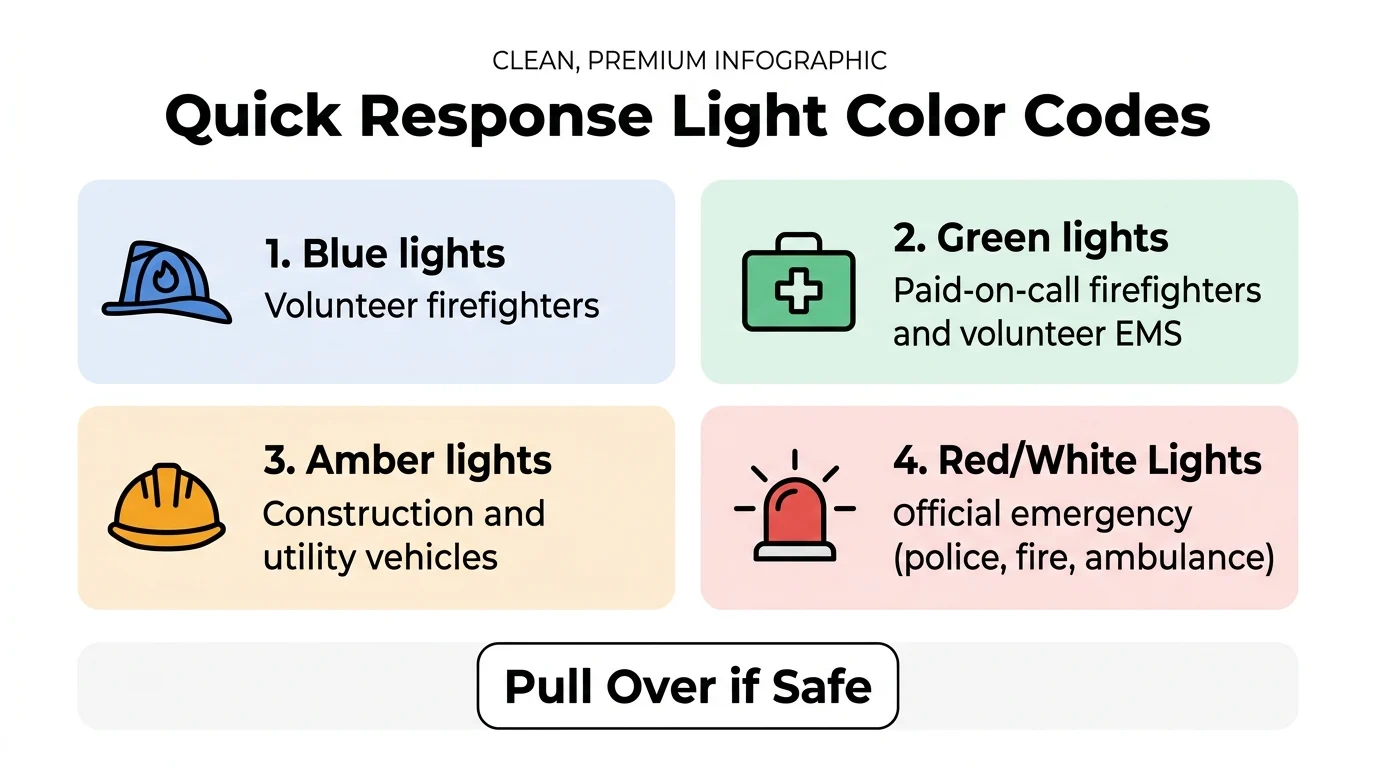
Quick Ans: Quick response lights are emergency and courtesy warning lights used by first responders, volunteer firefighters, and roadside workers to signal their presence and request right-of-way. Common colors include blue (volunteer firefighters), green (volunteer EMS and paid-on-call firefighters), amber (construction and maintenance vehicles), and red/white (official emergency vehicles). These lights are courtesy signals in most jurisdictions, meaning other drivers are not legally required to yield, but doing so improves emergency response times and saves lives.
When you see flashing lights in your rearview mirror, your reaction matters. For professional emergency vehicles with red and white lights and sirens, the law requires you to pull over. But what about the blue or green lights you occasionally spot on a regular car? Those are quick response lights, and understanding what they mean can help you respond appropriately.
Quick response lights are warning lights used by volunteer first responders and certain authorized personnel to alert other drivers that they are responding to an emergency. In Ontario, paid-on-call firefighters use flashing green lights on their personal vehicles while responding to emergencies . In New York, volunteer firefighters use blue lights for the same purpose . These lights are courtesy signals, not legal mandates, but pulling over when safe can make a real difference.
The landscape of quick response lights also extends to roadway operations, where amber warning lights alert motorists to construction and maintenance vehicles . Understanding the color code and legal framework behind these lights helps everyone share the road safely. Let’s break down everything you need to know.
What Are Quick Response Lights?
1. Warning Lights for First Responders
Quick response lights are visual warning devices used by first responders to signal their emergency response status while driving personal vehicles .
2. Courtesy Signals, Not Legal Mandates
In most jurisdictions, these lights do not grant special privileges. They ask other drivers to yield as a courtesy .
3. Used by Volunteer Personnel
Volunteer firefighters, paid-on-call firefighters, and volunteer EMS personnel commonly use quick response lights .
4. Color-Coded by Role
Different colors indicate different responder types: blue for volunteer firefighters, green for volunteer EMS and paid-on-call firefighters .
5. Amber for Roadway Operations
Amber warning lights are used on construction, maintenance, and utility vehicles to alert motorists to potential hazards .
6. Red and White for Official Emergency Vehicles
Fire trucks, ambulances, and police vehicles use red and white lights and sirens with full legal authority .
7. Regulated by State and Provincial Laws
Each jurisdiction has specific regulations governing who may use quick response lights and what colors are permitted .
8. Designed to Improve Response Times
The primary purpose is to alert other drivers so responders can reach the station or emergency scene faster .
9. Not the Same as Emergency Vehicle Lights
Quick response lights do not make the vehicle an authorized emergency vehicle under the law .
10. Voluntary Compliance Expected
Other drivers are encouraged but not legally required to pull over for courtesy lights .
11. Requires Authorization
Personnel must receive authorization from their department or agency to use quick response lights .
12. Subject to Equipment Standards
Lights must meet specific performance standards set by state regulations or industry guidelines .
13. Used in Both Urban and Rural Areas
Quick response lights are particularly important in areas with volunteer-based emergency services.
14. Increasing Focus on Standardization
Guidelines like AASHTO’s warning light standards aim to improve consistency and effectiveness .
Types of Quick Response Lights by Color
1. Blue Lights for Volunteer Firefighters
In many states including New York, volunteer firefighters use blue lights on personal vehicles while responding to emergencies .
2. Green Lights for Paid-On-Call Firefighters
Ontario permits paid-on-call firefighters to use flashing green lights on personal vehicles when responding to emergencies .
3. Green Lights for Volunteer EMS
Volunteer emergency medical services personnel may also use green courtesy lights in some jurisdictions .
4. Amber Lights for Construction Vehicles
Amber warning lights are standard on construction, maintenance, and utility vehicles operating on roadways .
5. Amber Lights for Tow Trucks
Tow trucks and service vehicles use flashing yellow warning lamps as required by law in many states .
6. Red and White for Authorized Emergency Vehicles
Official emergency vehicles use red and white lights with full legal right-of-way authority .
7. Blue Lights for Police Vehicles
Police vehicles may display blue warning lamps in addition to red lights .
8. Green for Mobile Command Units
In Maryland, stationary emergency vehicles serving as mobile command units may display a flashing green light to designate the command post .
9. Amber for Snow Removal Equipment
Snow plows and other winter maintenance vehicles use amber warning lights .
10. White Strobes for Special Vehicles
Some jurisdictions permit white flashing strobe lights on specific vehicle types like school buses .
11. Purple for Funeral Processions
Some states permit purple lights for funeral processions, though this is not a quick response application.
12. Color Combinations
Some vehicles use combinations like amber and green for specific identification purposes .
13. LED and Strobe Options
Modern quick response lights use LED or strobe technology for greater visibility and energy efficiency .
Legal Framework and Regulations
1. State and Provincial Authority
Quick response light regulations are set at the state or provincial level, creating variations across jurisdictions .
2. Ontario’s Green Light Program
Ontario’s Highway Traffic Act permits paid-on-call firefighters to use flashing green lights on personal vehicles .
3. California Warning Lamp Classes
California regulations classify warning lamps into Class A, B, C, D, and E based on performance standards .
4. Maryland Emergency Vehicle Signal Rules
Maryland law specifies which vehicles may display red, white, blue, and green lights .
5. Wisconsin Amber Lamp Requirements
Wisconsin requires amber flashing warning lamps on certain agricultural implements .
6. West Virginia Color Restrictions
West Virginia restricts yellow or amber flashing warning lights to specified vehicle categories .
7. Authorization Requirements
Personnel must receive authorization from their department or agency to use quick response lights .
8. No Special Privileges Granted
Courtesy lights do not give volunteers any special privileges under the law .
9. Yield Right-of-Way Laws
Laws regarding yielding apply to official emergency vehicles, not courtesy light users .
10. Equipment Standards Required
Lights must meet SAE or equivalent performance standards .
11. Mounting Requirements
Regulations specify where lights may be mounted on vehicles .
12. Visibility Distance Requirements
Lights must be visible from specified distances, often 500 feet in normal sunlight .
13. Flash Rate Specifications
Some jurisdictions specify flash rates for warning lights .
14. Annual Review of Regulations
Laws and regulations are periodically updated to reflect new technology and safety research .
15. Local Ordinances May Apply
Some municipalities have additional rules about warning lights within their jurisdiction.
How to Respond to Quick Response Lights
1. Recognize the Color Code
Blue means volunteer firefighter, green means paid-on-call firefighter or volunteer EMS, amber means construction or service vehicle .
2. Check for Sirens and Red/White Lights
If the vehicle has red and white lights plus a siren, it’s an official emergency vehicle and you must yield .
3. Pull Over if Safe
When you see blue or green courtesy lights, pull over to the right when it is safe to do so .
4. Don’t Brake Suddenly
Slow down gradually and signal your intention to pull over.
5. Stay Alert for Multiple Responders
Where there’s one volunteer responder, there may be others heading to the same station or scene.
6. Don’t Block Intersections
If you’re in an intersection when you see courtesy lights, clear the intersection first.
7. Use Your Turn Signal
Signal your intention to pull over to communicate with the responder and other drivers.
8. Don’t Stop in Traffic Lanes
Pull completely off the roadway if possible.
9. Watch for Responders Entering Traffic
Volunteers may be entering the roadway from driveways or side streets.
10. Give Them Space to Work
If you see a vehicle with quick response lights stopped at an emergency scene, give responders room.
11. Be Patient
The few seconds you lose pulling over could save a life .
12. Teach New Drivers
Help new drivers understand what different light colors mean.
13. Report Misuse
If you observe someone misusing quick response lights, report it to local authorities.
14. Stay Informed
Laws vary by location. Know the rules where you drive.
15. Spread Awareness
Share information about quick response lights with friends and family.
New Technologies in Quick Response Lights
1. QR Code Identification Systems
New technology embeds QR codes in vehicle windshields that first responders can scan to get critical vehicle information .
2. LED Illumination for Emergency Signaling
Some QR code systems include LED backing that can flash patterns to signal emergencies like vehicle failure mode .
3. Color-Coded EV and Hybrid Identification
Proposed systems use flashing light patterns to identify electric and hybrid vehicles for firefighter safety .
4. Three Green Flashes for EVs
One proposed pattern uses three flashing greens to indicate an electric vehicle .
5. Green-Pink-Red for Hybrids
Flashing green, then pink, then red could identify hybrid vehicles for first responders .
6. Enhanced Visibility LED Technology
Modern warning lights use high-intensity LEDs for greater visibility .
7. Alternating Flash Patterns
Research has studied alternating flash patterns for attention-getting effectiveness .
8. Light Bar Innovations
Light bar assemblies now offer more configurations and control options .
9. Smart Activation Systems
Some systems automatically activate warning lights when the vehicle is in use for emergency response.
10. Integration with Vehicle Systems
Newer vehicles may have factory-integrated warning light options.
11. Reflective and Illuminated Markings
Warning lights complement reflective strips and illuminated markings for maximum visibility.
12. Performance Standards Evolution
SAE and other standards bodies continue updating performance requirements .
13. Research on Driver Response
Studies examine how different lighting configurations affect driver awareness and response .
14. Battery Technology Improvements
LED lights require less power, making them easier to operate on personal vehicles.
15. Future of Smart Warning Systems
Connected vehicle technology may eventually enable automatic alerting for approaching emergency vehicles.
Common Misconceptions About Quick Response Lights
1. They Don’t Give Legal Right-of-Way
Courtesy lights do not grant volunteers any special privileges under the law .
2. You’re Not Legally Required to Pull Over
While it’s a courtesy, pulling over for blue or green lights is not legally mandated in most jurisdictions .
3. They’re Not the Same as Emergency Lights
Official emergency vehicles use red and white lights with full legal authority .
4. Not Everyone with Lights is Authorized
Only personnel who have received proper authorization may use quick response lights .
5. Volunteers Aren’t Going Directly to the Scene
Paid-on-call firefighters must first travel to the fire station to get their gear and respond in a fire truck .
6. The Lights Are for Your Safety Too
The system works by alerting you to a responder who may be driving with urgency.
7. More Lights Don’t Mean More Authority
Different colors have different meanings, not different levels of legal privilege.
8. Quick Response Lights Aren’t Universal
Not all jurisdictions permit courtesy lights, and rules vary widely.
9. They’re Not Just for Rural Areas
Volunteer and paid-on-call systems exist in suburban and urban areas too.
10. Not All First Responders Use Them
Many professional responders drive official vehicles directly from stations.
11. The Lights Don’t Guarantee Faster Response
They improve the odds, but traffic and other factors still affect response times.
12. They’re Not a Replacement for Sirens
Courtesy lights are visual only. Official emergency vehicles add audible warnings.
13. You Shouldn’t Follow Them
Don’t follow a vehicle with quick response lights. Let them proceed independently.
14. They’re Not for Personal Convenience
Using quick response lights for non-emergency purposes is prohibited.
15. Misuse Has Consequences
Unauthorized use of emergency or courtesy lights can result in penalties.
Frequently Asked Questions
What are quick response lights?
They’re warning lights used by volunteer first responders and certain authorized personnel to signal they’re responding to an emergency .
What does a flashing blue light on a car mean?
It typically indicates a volunteer firefighter responding to an emergency .
What does a flashing green light mean?
In Ontario, it means a paid-on-call firefighter is responding to an emergency . In other areas, it may indicate volunteer EMS personnel .
Do I have to pull over for blue or green lights?
In most jurisdictions, pulling over for courtesy lights is voluntary, not legally required .
What’s the difference between courtesy lights and emergency lights?
Courtesy lights don’t grant special privileges. Emergency vehicles with red and white lights plus sirens have legal right-of-way authority .
Why should I pull over for courtesy lights?
Doing so improves emergency response times and could help save lives .
What color lights do volunteer firefighters use?
Blue lights in many states including New York .
What color lights do paid-on-call firefighters use?
Green lights in Ontario .
Are amber lights also quick response lights?
Amber lights are warning lights used on construction, maintenance, and service vehicles .
Can anyone use quick response lights?
No. Only authorized personnel who have received proper authorization may use them .
What is the green light program in Ontario?
It permits paid-on-call firefighters to use flashing green lights on personal vehicles while responding to emergencies .
Do quick response lights give volunteers special privileges?
No. They are courtesy signals only and do not grant any special privileges .
What should I do when I see quick response lights?
Pull over to the right when it is safe to do so .
Conclusion
Quick response lights are an important part of the emergency response system in many communities. Whether it’s a volunteer firefighter with a blue light, a paid-on-call firefighter with a green light, or a construction vehicle with amber warning lights, understanding what these signals mean helps everyone share the road safely.
The key takeaway is simple: when you see blue or green courtesy lights, pull over when it is safe to do so. You’re not legally required to yield, but that few seconds of courtesy could mean the difference between a fast response and a tragedy . For amber lights on work vehicles, slow down and give them space to operate.
As technology evolves, new systems like QR code identification and LED signaling are making emergency response even more effective . But the fundamental principle remains: awareness and cooperation on the road save lives. Share this guide with friends and family, and remember to practice courtesy when you see quick response lights. Your small act of yielding could help a responder save a life.
Discover More:
- Automated Text Message Response: Complete Guide for 2026
- Adidas Response Running Shoes: Complete Guide for 2026

1 thought on “Quick Response Lights: Complete Guide for 2026”