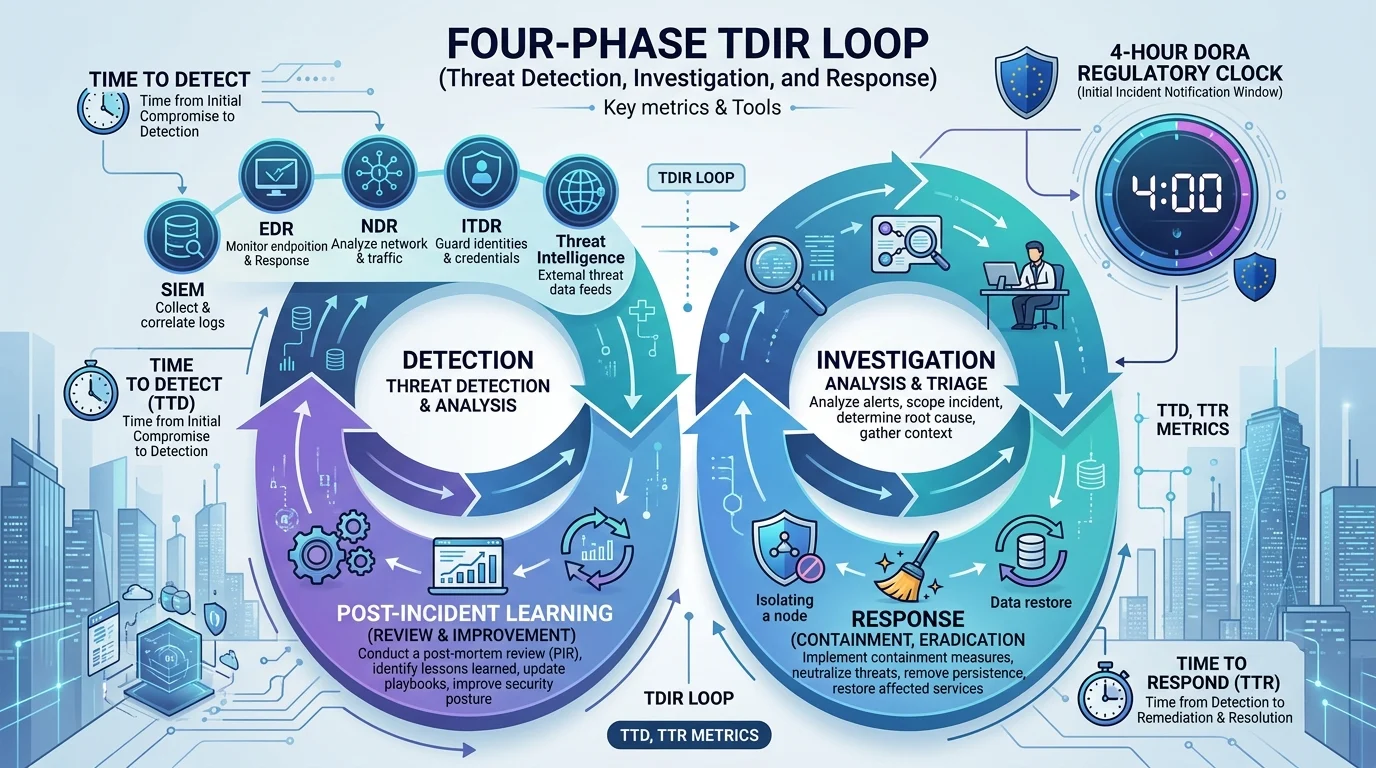
Quick Ans: Threat Detection, Investigation, and Response (TDIR) is the cybersecurity discipline that combines continuous monitoring, threat analysis, and coordinated action to find and stop attacks. The TDIR workflow has four phases: detection (identifying suspicious activity), investigation (understanding scope and impact), response (containing and remediating), and post-incident learning (improving future defenses). Key components include SIEM, EDR, NDR, ITDR, threat intelligence, and automated playbooks. The global SIEM market is projected to reach $13.67 billion by 2031, with TDIR as the largest application segment.
Every security operations center faces the same problem: too many alerts, too little time. A single phishing email, an unusual login from a foreign IP, a new process running on a server. Each signal could be nothing or everything. The difference between a minor incident and a catastrophic breach often comes down to how quickly and effectively your team can detect, investigate, and respond.
Threat Detection, Investigation, and Response (TDIR) is the discipline that solves this problem. It’s a structured workflow that transforms raw alerts into validated threats and coordinated action . TDIR integrates detection capabilities with thorough investigation and swift response, ensuring threats are managed before they cause significant harm .
The stakes are high. In 2024, government organizations took an average of 180 days to detect cybersecurity incidents . Identity-based attacks now account for 79% to 80% of all attacks, making traditional endpoint-only detection insufficient . TDIR provides the framework to close these gaps. Let’s explore how it works.
What Is Threat Detection, Investigation, and Response?
1. A Unified Security Operations Discipline
TDIR is the method by which security operations center teams handle cybersecurity incidents to prevent financial or reputational damage .
2. Four Interconnected Phases
The workflow includes detection, investigation, response, and post-incident learning, with each phase feeding into the next .
3. Beyond Simple Alerting
TDIR elevates investigation as a distinct phase between detection and response, ensuring alerts become properly validated incidents .
4. A Regulatory Imperative
Frameworks like DORA, NIS2, and SEC disclosure rules require demonstrable response workflows with tight notification clocks .
5. Platform-Agnostic by Nature
TDIR can be implemented through SIEM, XDR, MDR, or custom-built stacks. The discipline matters more than the product .
6. Identity-First in Modern Environments
With 79% of attacks being malware-free and identity-driven, ITDR coverage is now table stakes .
7. Network Detection Remains Critical
East-west visibility through NDR is irreplaceable for detecting lateral movement and encrypted-channel attacks .
8. A Continuous Improvement Loop
Post-incident learning feeds back into detection rules, playbooks, and hunting hypotheses .
9. Designed for Scale
AI and automation enable TDIR programs to handle alert volumes that overwhelm manual analysis .
10. Measured by Time to Detect and Respond
Modern KPIs focus on TTD, TTR, and hypothesis-led hunting throughput, not vanity metrics .
The Four Phases of TDIR
1. Detection: Identifying Suspicious Activity
Detection involves continuous monitoring of systems, users, networks, endpoints, cloud environments, and applications for signs of malicious or unusual behavior .
2. Detection Data Sources
Telemetry comes from EDR, NDR, ITDR, SIEM, email gateways, firewalls, cloud control planes, and identity providers .
3. Detection Methods
Signature-based, anomaly-based, heuristic, and ML-driven methods each catch different threat types .
4. High-Fidelity Alerting
The goal is generating high-confidence alerts and continuously refining detection logic to reduce false positives .
5. Investigation: Understanding Scope and Impact
Investigation is the decision-making layer where analysts review alerts, gather evidence, and determine whether activity is benign, suspicious, or confirmed malicious .
6. Alert Triage
Prioritize and contextualize alerts to ensure high-risk incidents are addressed promptly .
7. Event Enrichment
Collect and correlate data points like user details, location, and asset information to build a complete picture .
8. Root Cause Analysis
Trace attacks back to their entry point and identify exploited vulnerabilities to prevent recurrence .
9. Threat Modeling
Map attacker behaviors to frameworks like MITRE ATT&CK and the Cyber Kill Chain .
10. Forensic Analysis
Reveal hidden details about the attack, including tools used and data compromised .
11. Response: Containing and Remediating
The action phase involves neutralizing threats, recovering systems, and strengthening defenses .
12. Containment Actions
Isolate endpoints, reset user sessions, revoke credentials, or disable accounts to stop spread .
13. Remediation Steps
Eliminate malware, apply patches, recover compromised accounts, and secure affected systems .
14. Recovery Procedures
Restore systems from clean backups and validate effectiveness before resuming operations .
15. Post-Incident Learning
Analyze incidents after resolution to identify gaps and improve future detection and response .
Core Components of TDIR
1. Telemetry Collection
Data from endpoints, networks, cloud services, identities, applications, and security tools form the foundation .
2. Detection Logic
Rules, analytics, signatures, and behavior models that identify suspicious activity .
3. Alert Triage Process
A structured method for ranking alerts by severity, confidence, affected asset, and business impact .
4. Threat Intelligence Integration
Context about attacker tactics, known indicators, malware behavior, and active campaigns .
5. Investigation Workflows
Standardized steps analysts use to validate alerts, gather evidence, and determine scope .
6. Response Playbooks
Documented actions for common incident types like phishing, malware, credential theft, and cloud compromise .
7. Continuous Improvement
Tuning, reporting, lessons learned, and updates to detection content .
8. Identity Threat Detection and Response (ITDR)
Continuous monitoring of identity activities to detect compromised credentials and unusual access patterns .
9. Network Detection and Response (NDR)
Behavioral analytics for east-west visibility and encrypted-channel threat detection .
10. Endpoint Detection and Response (EDR)
Monitoring endpoint behavior to detect and remediate threats at the device level .
How TDIR Works: A Real-World Example
1. The Initial Alert
A user reports a suspicious email, and the security team sees a login from an unusual location .
2. Detection Triggers
The login generates an alert based on anomaly detection rules .
3. Investigation Begins
Analysts check mailbox rules, recent authentication events, and whether the account accessed sensitive systems .
4. Context Enrichment
User details, device information, and threat intelligence are correlated to build the full picture .
5. Scope Determination
The team discovers the account was accessed from multiple unusual locations, confirming compromise .
6. Containment Actions
Credentials are reset, active sessions are revoked, and multifactor authentication is enforced .
7. Remediation Steps
Phishing emails are removed, and the sender domain is blocked .
8. Recovery Validation
The team confirms the threat is eliminated and operations can resume safely .
9. Post-Incident Review
The team documents what happened and what helped or slowed the investigation .
10. Detection Tuning
New detection rules are created based on lessons learned .
TDIR Tools and Technologies
1. Security Information and Event Management (SIEM)
SIEM aggregates and correlates events across the environment, supporting TDIR by providing centralized visibility .
2. SIEM Market Growth
The global SIEM market is projected to grow from $8.39 billion in 2026 to $13.67 billion by 2031, with TDIR as the largest application segment .
3. Extended Detection and Response (XDR)
XDR unifies detection across endpoints, networks, identities, and cloud for correlated threat visibility .
4. Managed Detection and Response (MDR)
MDR provides 24/7 threat detection and response through expert teams monitoring alerts .
5. Endpoint Detection and Response (EDR)
EDR focuses on endpoint behavior, with the market projected to reach $45.95 billion by 2034 .
6. Identity Threat Detection and Response (ITDR)
ITDR monitors identity activities and infrastructure for threats, compromises, and vulnerabilities .
7. Network Detection and Response (NDR)
NDR provides network-level behavioral analytics for east-west visibility and encrypted-channel attacks .
8. Security Orchestration, Automation, and Response (SOAR)
SOAR platforms orchestrate and automate response actions across security tools .
9. Threat Intelligence Platforms
These aggregate and distribute threat intelligence for enriched detection and investigation .
10. Automated Investigation and Response (AIR)
Microsoft Defender XDR’s AIR feature acts as a virtual analyst, investigating and remediating threats automatically .
Regulatory and Compliance Considerations
1. DORA Enforcement
The Digital Operational Resilience Act enforcement matures through 2026 and 2027, requiring 4-hour classification thresholds .
2. NIS2 Expansion
NIS2 enforcement expands as member states finalize transpositions, tightening response clocks .
3. SEC Disclosure Rule
The SEC rule continues generating case law that refines the materiality threshold for incident disclosure .
4. Sector-Specific Rules
Energy, healthcare, and financial market infrastructure are seeing new rules with clocks at or below 4 hours .
5. TDIR Platform Requirements
Platforms that cannot demonstrate a 4-hour materiality determination workflow will lose competitive ground .
6. Compliance-Driven SIEM Adoption
Compliance is a key application segment driving SIEM market growth alongside TDIR .
7. Data Lineage and Encryption
Compliance requires tracking data provenance end-to-end and adopting quantum-resistant algorithms .
8. Incident Documentation
Regulatory frameworks require structured documentation of detection, investigation, and response activities .
9. External Communication Workflows
Templates and approval workflows for stakeholder communication during incidents are essential .
10. KPI Frameworks
NCSC-aligned KPI frameworks retire vanity metrics in favor of TTD, TTR, and hunting throughput .
Building and Improving Your TDIR Practice
1. Detection Engineering as a Named Function
Organizations should establish detection engineering with dedicated budget and ownership .
2. Close Identity and Network Blind Spots
ITDR coverage where missing and NDR coverage for east-west blind spots are investment priorities .
3. Scoped Agentic AI Pilots
Pilot AI agents for specific playbook families (phishing triage, credential reset, isolation) before broad rollout .
4. Structured AI Evaluation
Adopt agentic AI with structured evaluation rather than vendor-supplied scorecards .
5. Risk-Based Prioritization
Focus resources on threats posing the greatest risk to specific business objectives and critical assets .
6. Continuous Evolution
Implement feedback loops and regular assessments to keep TDIR strategy ahead of emerging threats .
7. Flexible Scaling
Design processes that grow with the organization and adapt to increasing threat complexity .
8. Real-World Testing
Validate TDIR effectiveness through adversary emulation and red-team exercises .
9. Layered Response Model
Design escalation paths between SOC tiers (L1 triage, L2 investigation, L3 advanced analysis) with clear handoff criteria .
10. Time-Based SLAs
Define response time targets by incident severity aligned with business impact .
11. Automation Boundaries
Determine which response actions can be automated and which require human judgment .
12. Documentation Requirements
Specify what evidence and records analysts must collect at each workflow stage .
13. Post-Incident Review Process
Include structured lessons-learned processes that improve detection and response .
14. Threat Hunting Workflows
Balance structured hunting cadence with threat intelligence-triggered reactive hunting .
15. Knowledge Sharing
Design processes for hunters to share techniques and findings across the team .
Frequently Asked Questions
What is TDIR?
Threat Detection, Investigation, and Response (TDIR) is a cybersecurity discipline for finding, analyzing, and mitigating threats through a structured four-phase workflow .
How does TDIR differ from TDR?
TDR (Threat Detection and Response) predates TDIR. TDIR elevates investigation as a distinct phase and explicitly bakes in regulatory notification clocks .
What are the four phases of TDIR?
Detection, investigation, response, and post-incident learning form the durable structure of the TDIR loop .
Why is investigation important in TDIR?
Investigation is the decision-making layer that validates alerts, gathers evidence, and determines scope before response actions are taken .
What tools support TDIR?
SIEM, EDR, NDR, ITDR, XDR, SOAR, threat intelligence platforms, and MDR services all support TDIR workflows .
How large is the TDIR market?
TDIR is the largest application segment in the SIEM market, which is projected to reach $13.67 billion by 2031 .
What is ITDR?
Identity Threat Detection and Response monitors identity activities and infrastructure to detect threats, compromises, and vulnerabilities .
Why is identity important in TDIR?
79% to 80% of attacks are now malware-free, rooted in account compromise, making ITDR coverage table stakes .
What is automated investigation and response?
AIR uses AI and automation to investigate and remediate threats, acting as a virtual analyst that works 24/7 .
How do regulatory frameworks affect TDIR?
DORA, NIS2, and SEC rules require demonstrable response workflows with tight notification clocks, some at or below 4 hours .
What metrics should TDIR programs track?
Time to Detect (TTD), Time to Respond (TTR), and hypothesis-led hunting throughput are more valuable than ticket closure or rule count .
How does threat hunting fit into TDIR?
Proactive hunting identifies threats that evade automated detection, feeding findings back into detection rules and playbooks .
Conclusion
Threat Detection, Investigation, and Response is the discipline that turns alert noise into coordinated action. In a landscape where attacks are increasingly identity-driven, malware-free, and automated, TDIR provides the structured workflow that security teams need to detect threats faster, investigate them thoroughly, and respond decisively.
The four-phase loop of detection, investigation, response, and post-incident learning is the durable structure. Everything else, whether you use SIEM or XDR, whether you self-manage or buy MDR, whether you adopt agentic AI now or later, is a delivery decision . Get the discipline right, and the technology becomes an enabler rather than a crutch.
The 2026 board conversation should focus on closing identity and network blind spots, building regulatory clocks into response playbooks, and adopting AI with structured evaluation . The composite outcome of roughly 40% efficiency gains is real, but only for programs that earn it through discipline .
Start with the fundamentals. Build detection engineering as a named function. Close your blind spots. Test your playbooks before the first incident tests them. Share this guide with your security team, and bookmark it for your next TDIR strategy session.
Discover More:

1 thought on “Threat Detection Investigation and Response: Complete Guide for 2026”