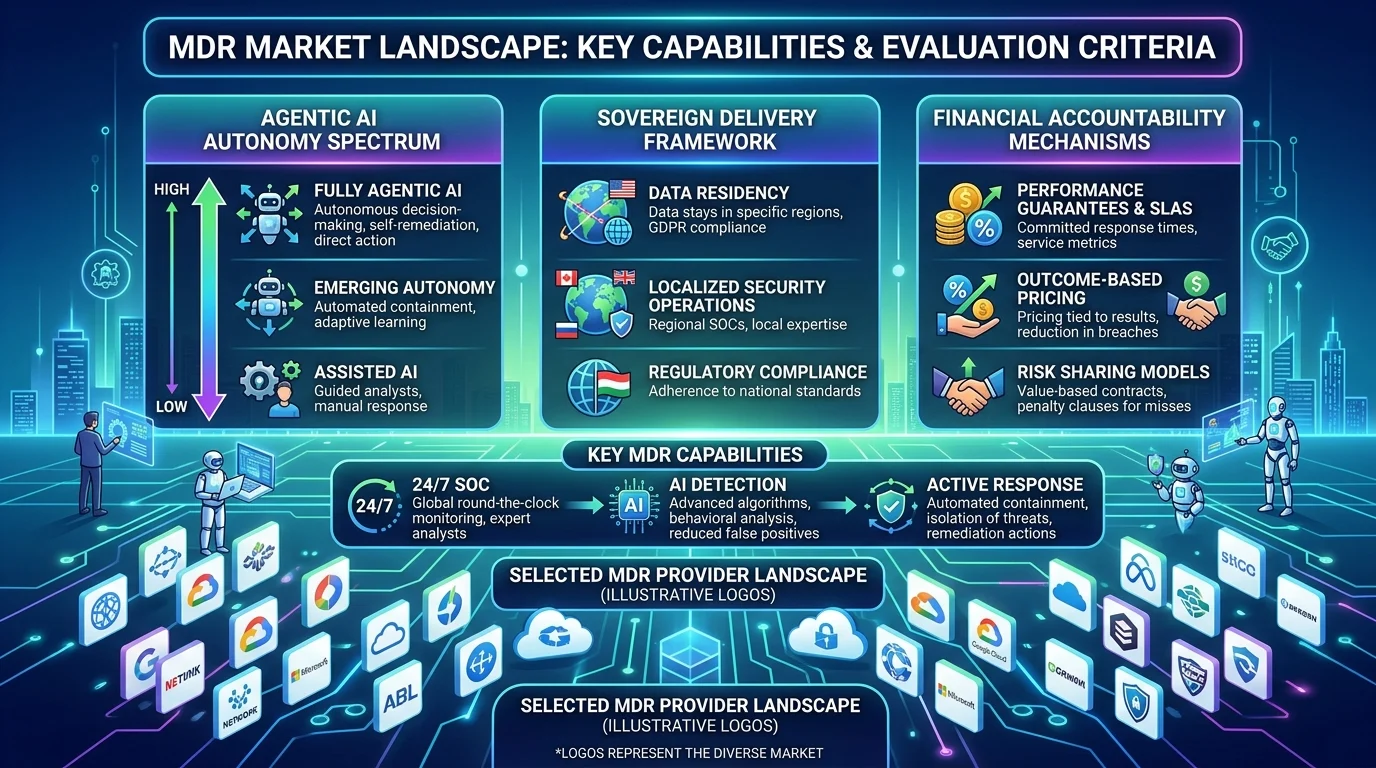
Quick Ans: Managed Detection and Response (MDR) solutions are cybersecurity services that combine human expertise, AI-driven analytics, and advanced technology to monitor, detect, investigate, and respond to threats 24/7. Key providers include CrowdStrike Falcon Complete (Overall Leader), ESET PROTECT MDR (Market Leader for SMBs), Sophos MDR (40,000+ customers), Arctic Wolf, eSentire, and Expel. Enterprise buyers should evaluate agentic AI autonomy, sovereign delivery, and financial accountability mechanisms before signing multiyear contracts.
Modern cyber threats don’t wait for business hours. Attackers move fast, exploit identity gaps, and operate as automated, professional organizations . Prevention alone isn’t enough. Alert-only monitoring doesn’t stop attacks. Organizations need detection AND response, delivered 24/7 by expert analysts who can act before damage spreads.
Managed Detection and Response (MDR) has emerged as one of the most compelling security investments available. It offers access to SOC capabilities, threat intelligence programs, and incident response expertise operating at a scale most enterprises cannot replicate internally . The market has entered a new phase of maturity, defined less by whether providers can detect threats and more by how they govern the AI doing the detecting and where they can deliver it from .
For buyers, the gap between leaders and the broader field is widening. Those who treat MDR as a commodity purchase will find that details of automation, governance, and delivery determine whether the service meets their risk tolerance . From SMBs seeking outsourced security operations to enterprises managing multinational attack surfaces, choosing the right MDR partner is a critical decision that shapes security posture for years.
What Are Managed Detection and Response Solutions?
1. Round-the-Clock Threat Monitoring
MDR provides 24/7 monitoring, detection, investigation, and response to cyber threats through dedicated SOC analysts .
2. Human Expertise Plus Technology
The service combines human analysts with AI-driven automation and threat intelligence .
3. Detection AND Response
Unlike alert-only services, MDR includes active containment and remediation capabilities .
4. End-to-End Incident Lifecycle Management
MDR covers detection, investigation, containment, and recovery across the full incident lifecycle .
5. Built on XDR, SIEM, and SOAR
Modern MDR leverages extended detection and response, security information and event management, and orchestration platforms .
6. Scalable for All Organization Sizes
MDR serves SMBs, midmarket, and large enterprises with tailored service levels .
7. Agentic AI Integration Growing
Leading providers are deploying AI agents that autonomously gather evidence, form hypotheses, and execute containment actions .
8. Financial Accountability Emerging
Some providers offer tiered breach warranties and service credits tied to outcomes .
9. Vendor-Agnostic Options Available
Providers like Red Canary and Expel support existing EDR investments without requiring platform replacement .
10. Compliance and Cyber Insurance Alignment
MDR services help organizations meet regulatory requirements and insurance obligations .
Top MDR Providers and Solutions
1. CrowdStrike Falcon Complete MDR
Named Overall Leader and Market Leader in KuppingerCole Leadership Compass for MDR 2026, with a single flat “Fire Team” running each incident from detection to remediation .
2. ESET PROTECT MDR
Recognized as Market Leader, combining endpoint protection, XDR, SIEM, and SOAR with continuous SOC supervision, ransomware rollback, and transparent pricing starting at approximately £86 per user annually .
3. Sophos MDR
Secures more than 40,000 customers worldwide with a globally distributed security operations model, agentic SOC capabilities, and vendor-agnostic telemetry support .
4. Arctic Wolf
Built to monitor existing EDR deployments, with a named Concierge Security Team model and Aurora Platform ingesting trillions of security events weekly .
5. eSentire
Publishes specific metrics including 15-minute mean time to contain (MTTC) and 99.99% initial host compromise prevention rate, with Essentials tier bundling endpoint protection for SMBs .
6. Expel
Named Leader in Forrester Wave for MDR Services, offering 100% transparency through Workbench with full visibility of all analyst actions and MTTR of approximately 17 minutes for critical incidents .
7. Red Canary
Vendor-independent MDR with “detection as code” workflows, 99%+ true positive rate, and MITRE ATT&CK coverage visualization .
8. Bitdefender MDR
Vertically integrated GravityZone platform with Cyber Intelligence Fusion Cell for dark web intelligence and tiered breach warranty coverage .
9. LevelBlue and SentinelOne Partnership
Combines SentinelOne’s Purple AI and Singularity Platform with LevelBlue’s 300+ digital forensics and incident response professionals .
10. Deloitte MXDR
Named Leader in IDC MarketScape for enterprise, connecting MXDR to business transformation, regulatory obligations, and enterprise resilience .
How MDR Solutions Work
1. Telemetry Ingestion and Normalization
MDR platforms collect data from endpoints, cloud, identity, email, and network sources .
2. AI-Powered Detection and Triage
Machine learning and agentic AI prioritize alerts, enrich context, and generate investigative hypotheses .
3. Human Analyst Validation
SOC analysts review AI-generated findings, validate threats, and make disposition decisions .
4. Threat Hunting and Proactive Investigation
Analysts proactively hunt for threats that automated tools may miss .
5. Active Containment and Response
MDR can isolate endpoints, revoke credentials, and execute remediation actions .
6. Continuous Improvement and Tuning
Detections improve over time based on live investigations and threat intelligence .
7. Incident Response Escalation
When needed, MDR escalates to dedicated DFIR teams for hands-on breach response .
8. Reporting and Transparency
Providers deliver investigation reports, performance metrics, and audit trails .
9. Integration with Existing Tools
Modern MDR works alongside existing security investments through API-based connectivity .
10. Co-Management Models
Some providers offer collaborative investigation options ranging from notification-only to full response authorization .
Key Evaluation Criteria for MDR Buyers
1. Agentic AI Autonomy Spectrum
Understand where each provider sits between fully autonomous response and human-in-the-loop control .
2. Which Actions Are Fully Autonomous
Ask exactly which response actions execute without human sign-off and how that boundary is governed .
3. Regional and Sovereign Delivery Consistency
Enterprise buyers should not assume uniform service quality across regions; demand region-specific SLA data .
4. Detection and Response Metrics Specificity
Push past MTTD and MTTR to ask about containment precision and automated disposition accuracy .
5. Financial Accountability Mechanisms
Examine whether breach warranties and service credits scale with enterprise-sized environments .
6. Roadmap Durability
Separate what you need today from what a multiyear contract will require in 24 months .
7. Analyst Expertise and Ratio
Evaluate the provider’s analyst-to-customer ratio and SOC access .
8. Transparency and Investigation Visibility
Look for real-time investigation visibility, comprehensive reporting, and full audit trail access .
9. Technology Coverage
Ensure support for your full security stack including endpoint, cloud, identity, and SaaS .
10. Partnership Model
Assess whether the provider owns the experience end-to-end or brokers through third parties .
Benefits of MDR Solutions
1. Access to Enterprise-Grade SOC Capabilities
MDR provides SOC expertise that most organizations cannot replicate internally .
2. 24/7/365 Coverage
Round-the-clock monitoring ensures threats are detected and addressed at any hour .
3. Faster Response Times
Automated containment within seconds to minutes dramatically reduces dwell time .
4. Reduced Alert Fatigue
AI-driven triage and human validation reduce false positives and alert volume .
5. Proactive Threat Hunting
Managed threat hunting identifies threats that automated tools miss .
6. Compliance Support
MDR helps meet regulatory requirements and cyber insurance obligations .
7. Cost Efficiency
Outsourced security operations cost less than building an in-house SOC .
8. Scalability
MDR services scale with organizational growth without proportional cost increases .
9. Threat Intelligence Integration
Access to proprietary and commercial threat feeds enriches detection and response .
10. Continuous Improvement
Detection logic improves over time based on real-world investigations .
Frequently Asked Questions
What is MDR?
Managed Detection and Response is a cybersecurity service providing 24/7 threat monitoring, detection, investigation, and response through SOC analysts, combining automation with expert review .
How is MDR different from MSSP?
MDR includes active response and containment, while traditional MSSPs often focus on alerting and monitoring without remediation .
What is MXDR?
Managed Extended Detection and Response extends MDR capabilities across endpoints, networks, cloud, email, and identity environments .
Who needs MDR?
Organizations of all sizes benefit, from SMBs without security teams to enterprises needing to augment internal SOC capabilities .
How much does MDR cost?
Pricing varies widely. ESET PROTECT MDR starts at approximately £86 per user annually, falling below £53 at higher volumes . Enterprise contracts are custom-priced.
What’s a good MTTD/MTTR benchmark?
There’s no universal benchmark, but MTTD and MTTR are critical metrics to compare across vendors . eSentire reports 15-minute MTTC; Expel reports 17-minute MTTR for critical incidents .
Can I keep my existing security tools?
Yes. Many providers like Expel, Red Canary, and Arctic Wolf support vendor-agnostic deployments with existing EDR tools .
What is agentic AI in MDR?
Agentic AI refers to AI systems that autonomously gather evidence, form hypotheses, and in some cases execute containment actions without human intervention .
Should I choose fully autonomous or human-in-the-loop response?
Match the autonomy level to your risk tolerance. Organizations with complex, interdependent environments should weigh human validation discipline heavily .
What is a breach warranty?
Some providers offer financial protection covering ransomware, business email compromise, compliance breaches, and legal liability .
How long are MDR contracts?
Enterprise contracts typically run multiyear, while SMB agreements may be annual or monthly .
What should I ask during MDR evaluation?
Ask which response actions are autonomous, request region-specific SLA data, and demand specificity on detection and response metrics .
Conclusion
Managed Detection and Response solutions have become essential for organizations facing increasingly sophisticated cyber threats. The market has matured beyond basic detection, with agentic AI architecture, human governance discipline, and sovereign delivery footprint now defining the leaders .
Choosing the right MDR partner is not a tooling exercise. It is a partnership decision that shapes how your security operates over time . The best providers understand your existing environment, work holistically with your team, and deliver continuous improvement rather than static coverage.
From CrowdStrike’s Fire Team model to ESET’s SME-focused simplicity to Expel’s radical transparency, the options range from fully managed to collaborative co-management. Match the autonomy level to your risk tolerance, demand specificity on metrics, and verify regional delivery consistency before signing multiyear commitments .
Your MDR partner becomes part of your operating model. Choose one that reduces risk over time and strengthens how your team operates when the environment becomes noisy, complex, or difficult to manage . Share this guide with your security team, and bookmark it for your next vendor evaluation.
Discover More:
- Threat Detection Investigation and Response: Complete Guide for 2026
- Server Response Codes: Complete Guide for 2026
