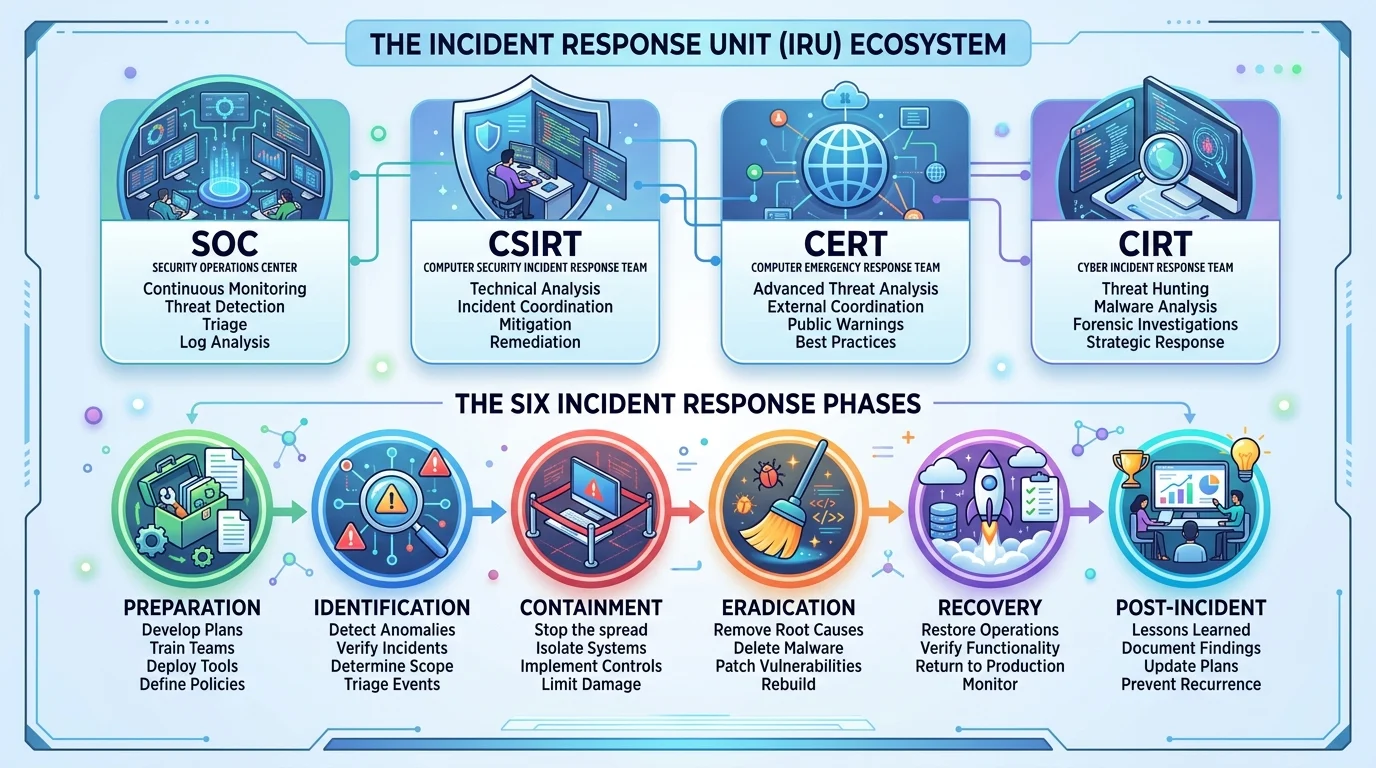
Quick Ans: An Incident Response Unit (IRU) is a dedicated team responsible for detecting, analyzing, containing, eradicating, and recovering from cybersecurity incidents. Key team types include CSIRTs (Computer Security Incident Response Teams), SOCs (Security Operations Centers), CIRTs (Computer Incident Response Teams), and CERTs (Computer Emergency Response Teams). These units minimize damage, restore operations, and ensure compliance. Effective IRUs combine technical expertise, clear communication, and continuous improvement through post-incident reviews.
When a cyberattack hits, chaos follows. Systems lock up. Data disappears. Panic spreads. But behind the scenes, a specialized team springs into action. This is the Incident Response Unit, the frontline defense against digital threats.
An Incident Response Unit is a dedicated team of cybersecurity professionals responsible for detecting, analyzing, and responding to security incidents . These units go by many names: CSIRT, CERT, CIRT, CIRC, or SOC. Each acronym represents a slightly different focus, but the core mission remains the same: stop the attack, minimize damage, and get systems back online .
Why does this matter? Because the true test of an organization often happens after something goes wrong . A well-practiced incident response program doesn’t just reduce damage. It accelerates recovery, restores confidence, ensures compliance, and strengthens long-term resilience . Whether you’re a small business or a global enterprise, understanding how incident response units work is essential for protecting your digital assets.
What Is an Incident Response Unit?
1. A Dedicated Cybersecurity Team
An Incident Response Unit is a team of professionals responsible for detecting, preventing, responding to, and remediating cyber incidents .
2. Multiple Names, Same Mission
These teams are known as CSIRTs, CERTs, CIRTs, CIRCs, or SOCs depending on their focus and organizational structure .
3. Focused on Incident Management
Their primary role is managing security incidents from detection through recovery .
4. Distinct From General IT
IRUs specialize in cybersecurity, not general IT support or infrastructure management .
5. May Be Internal or External
Units can be in-house teams, outsourced providers, or hybrid models .
6. Organized Around Response Phases
Most units follow structured phases: preparation, identification, containment, eradication, recovery, and post-incident assessment .
7. Empowered to Take Action
IRUs have the authority to isolate systems, block traffic, and take other defensive measures .
8. Trained for High-Pressure Situations
Members practice crisis management before real incidents occur .
9. Integrated With Business Functions
IRUs coordinate with legal, communications, HR, and leadership teams .
10. Measured by Speed and Effectiveness
Key metrics include Mean Time to Acknowledge (MTTA) and Mean Time to Remediate (MTTR) .
11. Built on Standardized Processes
Playbooks provide step-by-step guidance for common attack scenarios .
12. Continuously Improving
Post-incident reviews identify gaps and strengthen future response .
13. Cross-Functional by Nature
Teams may include IT, legal, HR, PR, and management representatives .
14. Critical for Compliance
IRUs help organizations meet regulatory reporting requirements .
15. Essential for Business Continuity
Effective IRUs sustain mission-critical services during attacks .
Types of Incident Response Units
1. Computer Security Incident Response Team (CSIRT)
A centralized function for information security incident management and response .
2. Computer Emergency Response Team (CERT)
A registered trademark of Carnegie Mellon University, often used for authorized incident response teams .
3. Computer Incident Response Team (CIRT)
An alternative name for the same entity, focusing on incident response .
4. Computer Incident Response Center (CIRC)
Another term for a team responsible for detection, prevention, response, and remediation .
5. Security Operations Center (SOC)
A broader team focused on monitoring, detection, analysis, and response to threats .
6. Product Security Incident Response Team (PSIRT)
Handles security vulnerabilities reported in products after release .
7. Information Sharing and Analysis Center (ISAC)
Facilitates threat intelligence sharing within specific industries .
8. Cyber Defense Center (CDC)
A combined team providing both CSIRT and SOC capabilities .
9. Cyber Security Center (CSC)
Another name for combined incident response and security operations teams .
10. Managed Security Service Provider (MSSP)
External provider offering incident response and monitoring services .
11. Ad Hoc Incident Response Team
Assembled from existing staff when an incident occurs .
12. Dedicated Incident Response Team
Full-time staff focused exclusively on incident handling .
13. Internal Organizational CSIRT
Handles incidents affecting the organization’s own systems and data .
14. Product or Vendor CSIRT
Handles customer reports of vulnerabilities in developed software .
15. Hybrid Teams
Combine internal staff with external partners or consultants .
Core Responsibilities of Incident Response Units
1. Detection and Monitoring
Continuously monitor networks and systems for unusual, anomalous, or suspicious activity .
2. Initial Triage and Analysis
Evaluate reported incidents to determine severity, scope, and priority .
3. Incident Investigation
Conduct deeper forensics to understand the attack vector and impact .
4. Containment
Stop the attack from spreading and prevent further damage .
5. Evidence Preservation
Securely collect and preserve digital evidence for analysis and potential legal action .
6. Eradication
Remove malware, close vulnerabilities, and eliminate the attacker’s presence .
7. Recovery
Restore affected systems and data from backups .
8. Communication
Inform stakeholders, including management, legal, customers, and the public .
9. Coordination With External Parties
Work with law enforcement, vendors, and industry experts when needed .
10. Documentation
Maintain detailed records of all actions taken during an incident .
11. Root Cause Analysis
Determine what allowed the incident to occur .
12. Post-Incident Review
Identify strengths and weaknesses of the response effort .
13. Reporting
Prepare executive reports and regulatory notifications as required .
14. Security Improvement Recommendations
Provide input on policy, technology, and training improvements .
15. Awareness and Training
Conduct security awareness training for the organization .
The Incident Response Process
1. Preparation
Establish the team, develop response plans, and train staff before incidents occur .
2. Identification
Detect events and incidents through monitoring systems and reports .
3. Triage
Assess the severity and scope of the incident to prioritize response .
4. Containment
Take immediate measures to stop the attack and prevent further damage .
5. Evidence Collection
Preserve volatile and non-volatile evidence without tampering .
6. Analysis
Conduct forensic examination to understand the attack .
7. Eradication
Remove the cause of the incident and eliminate attacker presence .
8. Recovery
Restore systems and data to normal operations .
9. Communication
Inform relevant parties according to the communication plan .
10. Post-Incident Assessment
Review the response and identify improvements .
11. Documentation
Record all actions, findings, and lessons learned .
12. Reporting
Prepare incident reports for management and regulators .
13. Remediation
Implement new controls and measures identified during investigation .
14. Training Updates
Revise training based on lessons learned .
15. Plan Updates
Update incident response plans to reflect new threats and lessons .
Building an Effective Incident Response Unit
1. Define Clear Roles and Responsibilities
Establish who owns what before a crisis hits .
2. Secure Executive Support
Management must commit resources and support the cause .
3. Establish Communication Channels
Create clear guidance for information flow between leaders and stakeholders .
4. Engage Legal Early
Legal guidance is critical for law enforcement involvement and regulatory notifications .
5. Develop Playbooks
Create step-by-step guides for common attack scenarios .
6. Practice Crisis Management
Treat every minor issue and drill as a rep that builds muscle for the big one .
7. Test and Update Regularly
Review incident response programs at least once a year .
8. Consider Outsourced Partners
Large or sophisticated attacks may require external expertise .
9. Document Everything
Maintain logs, timelines, and reports for future reference .
10. Build a Knowledge Base
Track incidents and responses to correlate patterns and reduce research time .
11. Train Beyond Technical Skills
Include communication, crisis management, and legal awareness .
12. Establish Escalation Paths
Define when to bring in experts, vendors, or law enforcement .
13. Measure Performance
Track MTTA and MTTR to assess and improve responsiveness .
14. Learn From Every Incident
Conduct postmortems after major incidents .
15. Foster a Security Culture
Raise expectations and commit resources to security .
Common Challenges for Incident Response Units
1. Limited Resources
Small organizations may lack dedicated cybersecurity staff .
2. Evolving Threat Landscape
Attackers continuously develop new techniques .
3. Information Overload
Large amounts of data must be analyzed to identify real threats .
4. Communication Breakdowns
Poor communication causes confusion, delayed response, and lost confidence .
5. Balancing Urgency and Accuracy
Acting quickly without causing unintended damage is difficult .
6. Evidence Preservation
Collecting evidence without tampering requires training .
7. Legal and Regulatory Complexity
Compliance requirements vary by industry and jurisdiction .
8. Insider Threats
Internal actors may require HR and legal involvement .
9. Conflict of Interest
Teams tasked with recommendations may also implement them .
10. Tool and Skill Gaps
New tools require training and expertise .
11. Adversary Adaptation
Attackers may monitor communications and adapt .
12. Scope Creep
Response operations can expand beyond initial estimates .
13. Burnout
High-stress incidents can exhaust team members.
14. Vendor Dependencies
Reliance on external providers creates coordination challenges .
15. Measuring Effectiveness
Quantifying incident response success is difficult .
Frequently Asked Questions
What is an Incident Response Unit?
It’s a dedicated team of cybersecurity professionals responsible for detecting, analyzing, and responding to security incidents .
What’s the difference between a CSIRT and a SOC?
A SOC focuses on monitoring and detection, while a CSIRT focuses on incident management and response .
What does a CSIRT do?
A CSIRT investigates, analyzes, and conducts forensics on incidents, develops communication plans, and coordinates response strategies .
What is the difference between a SOC and a CSIRT?
SOCs focus on security measures and threat detection to prevent incidents. CSIRTs focus on recovery measures after an incident has occurred .
What are the key metrics for incident response?
Mean Time to Acknowledge (MTTA) and Mean Time to Remediate (MTTR) are critical metrics .
What is an incident response playbook?
A step-by-step guide for responding to specific attack scenarios, developed before incidents occur .
What are the phases of incident response?
Preparation, identification, containment, eradication, recovery, and post-incident assessment .
How do IRUs preserve evidence?
By following forensic procedures, maintaining chain of custody, and documenting all actions .
When should an organization call law enforcement?
Legal guidance should be sought early to determine when law enforcement involvement is appropriate .
What is a postmortem in incident response?
A review after major incidents that identifies strengths, weaknesses, and areas for improvement .
Can a SOC handle incident response without a CSIRT?
Yes, but many organizations implement CSIRT-like capabilities when a dedicated CSIRT doesn’t exist .
What is the difference between a CERT and a CSIRT?
CERT is a registered trademark of Carnegie Mellon University. CSIRT is the generic term for incident response teams .
How often should incident response plans be updated?
At least once a year, and more often for global organizations or when threats change .
Conclusion
Incident Response Units are the unsung heroes of cybersecurity. When attacks happen, these teams step into the chaos and restore order. From CSIRTs and SOCs to CIRCs and CERTs, each unit type plays a vital role in detecting, containing, and recovering from security incidents.
The true measure of an incident response program is speed and effectiveness: how quickly you can contain, communicate, and manage everything that comes after the initial alert . A well-practiced IRU doesn’t just reduce damage. It accelerates recovery, restores confidence, ensures compliance, and strengthens long-term resilience .
Building an effective unit requires clear roles, executive support, communication channels, legal engagement, playbooks, and continuous testing. The little incidents prepare you for the big one . Every drill, every minor issue, every exercise builds the muscle you’ll need when the stakes are real.
Whether you’re building an IRU from scratch or improving an existing program, the principles remain the same: prepare, practice, communicate, and continuously improve. Share this guide with your security team, and bookmark it for your next planning session.
Discover More:
- ERR_BLOCKED_BY_RESPONSE: Complete Guide for 2026
- Respond vs Response: Complete Grammar Guide for 2026

1 thought on “Incident Response Unit: Complete Guide for 2026”