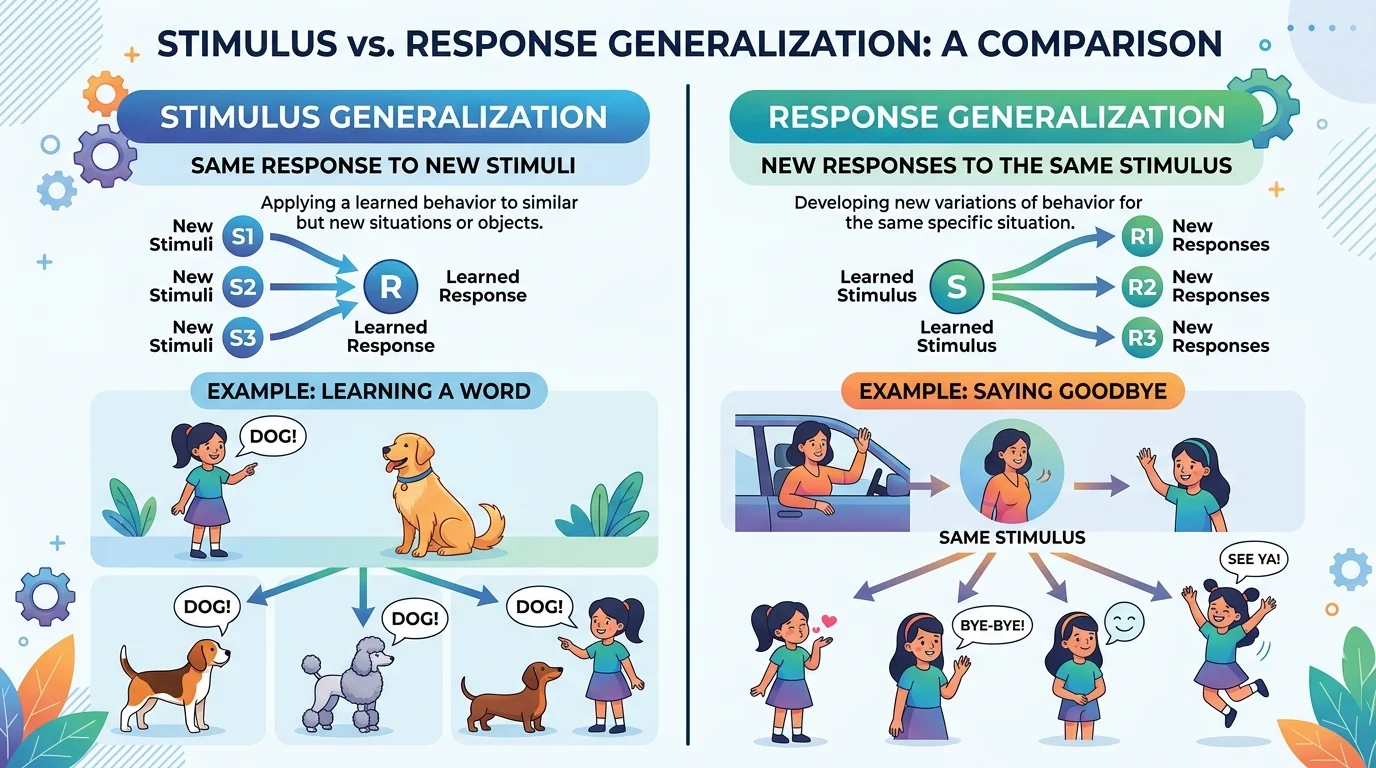
Quick Ans: Stimulus generalization happens when a learned response transfers to a new but similar stimulus. Response generalization happens when a learned behavior leads to new, untrained variations of that response. Key difference: stimulus generalization is about the trigger changing, response generalization is about the action changing. Both are essential for learning transfer, but response generalization is often considered a weaker concept in behavior therapy literature.
You teach a child to say “dog” when they see the family pet. A week later, they point at a neighbor’s cat and say “dog.” That’s stimulus generalization in action. Or you teach a student to raise their hand to ask for help. Then they start asking for help by tapping your shoulder or using a help card. That’s response generalization.
These two concepts sit at the heart of how learning transfers beyond the training room. Stimulus generalization asks: does the response happen with new triggers? Response generalization asks: does the original trigger produce new responses? Understanding the difference matters for teachers, therapists, parents, and anyone designing behavior interventions.
The research shows that stimulus generalization occurs along a single stimulus dimension in learning theory research, while behavior therapists often attempt to produce generalization across many dimensions simultaneously, which can lead to poor outcomes . Response generalization, meanwhile, is sometimes viewed as a weak explanation for behavior change, with some researchers suggesting it may be more useful to consider behaviors as functionally related instead .
Whether you’re working in applied behavior analysis, education, or organizational training, knowing how these two types of generalization work helps you design interventions that actually stick. Let’s break down the key differences.
What Is Stimulus Generalization?
1. The Core Definition
Stimulus generalization occurs when a response that was reinforced in the presence of a specific stimulus is evoked by other similar but different stimuli .
2. Pavlov’s Classic Example
A dog trained to salivate to a bell also salivates to similar sounds like a chime or beep .
3. The Generalization Gradient
Response strength decreases in a regular fashion as test stimuli become more different from the training stimulus .
4. Single Dimension Research
In learning theory research, stimulus generalization is shown to occur along a single stimulus dimension .
5. The Quail Study
Male quail trained to approach female cues also approach male cues, demonstrating strong stimulus generalization .
6. Discrimination Learning Follows
With sufficient experience and differential reinforcement, organisms learn to respond differently to similar stimuli .
7. ABA Definition
In applied behavior analysis, stimulus generalization is when a response reinforced in the presence of a specific person, instruction, material, or setting is evoked by similar but different stimuli .
8. The Child and Cars Example
A child who learns to identify one car can typically identify other cars because most have wheels, windows, and steering wheels .
9. Across Settings and People
Stimulus generalization includes responding to new instructors, environments, and materials .
10. Multiple Exemplar Training
Teaching with diverse examples helps learners generalize across stimulus dimensions .
11. Naturalistic Teaching Helps
Embedding learning in everyday activities promotes stimulus generalization .
12. Common Stimuli Strategy
Programming common stimuli in training and target settings increases generalization .
13. The Gradient Shift
Generalization gradients can shift over time as learners master tasks initially associated with requesting help .
14. Measurement Approach
Generalization gradients are used to assess whether and at what point responding switches between behaviors .
15. Clinical Relevance
Poor stimulus generalization means skills stay stuck in the training room, limiting real-world usefulness .
What Is Response Generalization?
1. The Core Definition
Response generalization occurs when a specific response is reinforced in the presence of a stimulus, and other similar but different responses are evoked by that same stimulus .
2. The Child and Goodbye Example
A child learns to wave goodbye, then starts using thumbs-up or high-fives in similar farewell contexts .
3. New Behaviors Emerge
Training leads to the development of new behaviors that were not specifically trained .
4. Functional Relatedness
Changes in behavior A can produce changes in behavior B when behaviors are functionally related .
5. Covert Responses May Explain Change
Some researchers suggest covert responses may account for changes in untreated behaviors .
6. The Swear Word Example
A child reinforced for one swear word may begin uttering additional variations, showing response generalization .
7. The Fall Example
Grandparents give attention when a child falls off a bike; the child may intentionally fall in their presence .
8. Multiple Untrained Targets
In mand training, children may request items that were never directly taught .
9. The “Honest” Behavior Example
A child taught to be honest might tell the truth, return items, and refrain from copying answers .
10. Response Covariation
When one behavior changes, related behaviors may change without direct intervention .
11. Often Weaker Than Stimulus Generalization
Response generalization is considered a weak explanation for behavior change in some literature .
12. Functional Equivalence Matters
Behaviors that serve the same function are more likely to show response generalization .
13. Multiple Exemplars Help
Training with varied responses promotes response generalization .
14. Less Predictable
Response generalization is harder to program and measure than stimulus generalization .
15. Clinical Value
Despite its challenges, response generalization explains how learners develop flexible, adaptive behavior repertoires .
Key Differences Between Stimulus and Response Generalization
1. What Changes
Stimulus generalization: the trigger changes. Response generalization: the action changes .
2. Direction of Transfer
Stimulus generalization: same response, new stimulus. Response generalization: new response, same stimulus .
3. Research Base
Stimulus generalization has a stronger research foundation with clear gradients .
4. Conceptual Strength
Response generalization is viewed as a weaker concept in behavior therapy literature .
5. Measurement
Stimulus generalization is measured with gradients. Response generalization is harder to measure .
6. Programming
Stimulus generalization is programmed by varying stimuli. Response generalization is programmed by varying responses .
7. Examples in ABA
Stimulus: child says “dog” to different dogs. Response: child uses different words to ask for help .
8. Functional Relationship
Response generalization may reflect functionally related behaviors rather than true generalization .
9. Training Implications
Train across multiple stimuli for stimulus generalization. Train multiple response forms for response generalization .
10. Maintenance Connection
Both types contribute to behavior maintenance, along with stimulus and response maintenance .
11. Natural Environment Teaching
NET promotes both types by embedding learning in varied contexts .
12. Caregiver Involvement
Involving multiple instructors supports both stimulus and response generalization .
13. Reinforcement Strategies
Variable schedules of reinforcement support both types .
14. Assessment Approach
Stimulus generalization uses probes across settings. Response generalization uses untrained response probes .
15. Practical Goal
Both aim for skills that work in real life, not just in therapy .
Real-World Examples of Both Types
1. Language Learning
Stimulus: Child says “more” with different teachers and in different rooms. Response: Child says “more,” “please,” or points to request continuation .
2. Social Skills
Stimulus: Teen uses greeting with classmates, teachers, and family. Response: Teen waves, says “hi,” or nods as different greetings .
3. Requesting Help
Stimulus: Student asks for help in math, science, and English classes. Response: Student raises hand, approaches teacher, or uses a help card .
4. Vending Machine Skills
Stimulus: Adolescent operates different vending machines in different locations. Response: Uses different button sequences for different machines .
5. Safety Skills
Stimulus: Child responds to “stop” from parents, teachers, and crossing guards. Response: Child freezes, stops walking, or puts hands up .
6. Toilet Training
Stimulus: Child uses toilet at home, school, and grandparents’ house. Response: Child initiates by pulling pants, saying “potty,” or going to bathroom .
7. Play Skills
Stimulus: Child plays with blocks, cars, and dolls. Response: Child builds, races, or feeds the doll .
8. Academic Responding
Stimulus: Student reads sight words in books, on flashcards, and on signs. Response: Student reads, spells, or defines the words .
9. Vocational Skills
Stimulus: Employee completes tasks with different supervisors and schedules. Response: Employee performs tasks in different sequences or methods .
10. Emotional Regulation
Stimulus: Child uses calming strategies at home, school, and community. Response: Child takes deep breaths, counts, or asks for a break .
How to Program for Stimulus Generalization
1. Train and Hope Isn’t Enough
Assuming generalization will happen naturally leads to failure .
2. Make Training Similar to Target
The more similar training and target situations are, the more stimulus generalization occurs .
3. Use Multiple Exemplars
Teach with diverse examples of the target stimulus .
4. Vary Settings
Practice skills in different environments like home, school, and community .
5. Vary Instructors
Involve different people in teaching and reinforcing .
6. Use Common Stimuli
Program common stimuli that exist in both training and target settings .
7. Naturalistic Teaching
Embed learning in everyday activities and routines .
8. Incidental Teaching
Capitalize on naturally occurring teaching moments .
9. Train Loosely
Vary instructions, materials, and social interactions during teaching .
10. Reinforce in Natural Contexts
Ensure reinforcement happens in the settings where you want behavior to occur .
11. Use Indiscriminable Contingencies
Make it hard to tell when reinforcement is available .
12. Delay Reinforcement
Gradually increase time between response and reinforcement .
13. Teach Self-Management
Help learners monitor and reinforce their own behavior .
14. Plan for Generalization Explicitly
Write generalization goals and strategies into intervention plans .
15. Monitor and Adjust
Track generalization data and modify strategies as needed .
How to Program for Response Generalization
1. Train Multiple Response Forms
Teach several different ways to achieve the same outcome .
2. Focus on Functional Equivalence
Ensure trained responses serve the same function .
3. Use Multiple Exemplars of Responses
Vary the responses you reinforce during training .
4. Reinforce Response Variability
Reinforce novel but appropriate response variations .
5. Teach a Repertoire, Not a Response
Build a class of functionally related behaviors .
6. Avoid Over-Training One Response
Over-practicing a single response may reduce variability .
7. Use Natural Reinforcement
Let natural consequences shape response variations .
8. Loosen Stimulus Control
Reduce dependence on specific prompts to allow response variation .
9. Use Lag Schedules
Reinforce responses that differ from previous responses .
10. Model Varied Responses
Demonstrate multiple ways to respond to the same situation .
11. Reinforce Approximations
Shape toward varied response forms .
12. Use Behavioral Momentum
Start with easy responses, then vary them .
13. Teach Self-Advocacy
Empower learners to choose how they respond .
14. Plan for Response Generalization
Include response variability goals in intervention plans .
15. Assess Untrained Responses
Probe for new responses that emerge without direct training .
Common Misconceptions
1. Generalization Happens Automatically
Many assume skills transfer naturally, but research shows explicit programming is often needed .
2. Response Generalization Is Just Stimulus Generalization
They are distinct concepts with different mechanisms .
3. More Training Always Means More Generalization
Quality of training matters more than quantity .
4. Response Generalization Is Easy to Measure
It’s actually harder to assess than stimulus generalization .
5. All Similar Behaviors Count as Response Generalization
Only functionally related behaviors qualify .
6. Stimulus Generalization Is Always Good
Overgeneralization can occur, leading to inappropriate responses .
7. Response Generalization Is Always Beneficial
Untrained responses can sometimes be undesirable, like new swear words .
8. One Size Fits All Strategies Work
Generalization strategies must be individualized .
9. Generalization Only Matters in Therapy
It matters in education, parenting, and workplace training too .
10. You Can’t Plan for Generalization
Generalization can and should be programmed explicitly .
Frequently Asked Questions
What is stimulus generalization?
Stimulus generalization occurs when a learned response transfers to new but similar stimuli. A dog trained to salivate to a bell also salivates to similar sounds .
What is response generalization?
Response generalization occurs when a learned behavior leads to new, untrained variations of that response. A child who learns to wave goodbye might start using thumbs-up or high-fives .
What’s the key difference?
Stimulus generalization: same response, new trigger. Response generalization: new response, same trigger .
Which type is stronger in research?
Stimulus generalization has a stronger research foundation with well-documented gradients .
Why is response generalization considered weak?
Some researchers suggest it’s a weak explanation for behavior change and that functionally related behaviors may better explain the phenomenon .
Can both types occur together?
Yes. A learner can generalize both the stimuli that trigger a response and the responses they emit .
How do I program for stimulus generalization?
Train across multiple settings, people, and materials. Use naturalistic teaching and vary stimuli systematically .
How do I program for response generalization?
Teach multiple response forms, reinforce variability, and focus on functional equivalence .
What is a generalization gradient?
A graph showing that response strength decreases as test stimuli become more different from the training stimulus .
Can generalization be harmful?
Yes. Overgeneralization or undesirable response generalization (like new swear words) can occur .
What is multiple exemplar training?
Teaching with diverse examples to promote generalization across stimuli and responses .
How does ABA therapy address generalization?
ABA programs include explicit generalization plans with strategies like naturalistic teaching and multiple instructors .
What is response covariation?
When changes in one behavior produce changes in related behaviors without direct intervention .
Do these concepts apply outside of therapy?
Absolutely. They apply in education, parenting, workplace training, and any skill acquisition context .
Conclusion
Stimulus generalization and response generalization are two sides of the same coin. One is about the trigger. The other is about the action. Both determine whether learning actually transfers beyond the training room.
Stimulus generalization has a clearer research base, with well-documented gradients showing how response strength decreases as stimuli become more different from the original . Response generalization is messier and sometimes dismissed as a weak concept, yet it explains how learners develop flexible, adaptive behavior repertoires .
For practitioners, the practical takeaway is simple: don’t train and hope. Program for generalization explicitly. Vary your stimuli. Vary your responses. Train across settings and people. Use multiple exemplars. Reinforce in natural contexts.
Whether you’re a teacher, therapist, parent, or trainer, understanding these two types of generalization helps you design interventions that stick. Skills that stay stuck in the training room aren’t skills at all. They’re just performances. The real goal is transfer. Share this guide with someone who designs learning experiences, and bookmark it for your next intervention plan.
Discover More:

1 thought on “Stimulus Generalization vs Response Generalization: Complete Guide for 2026”