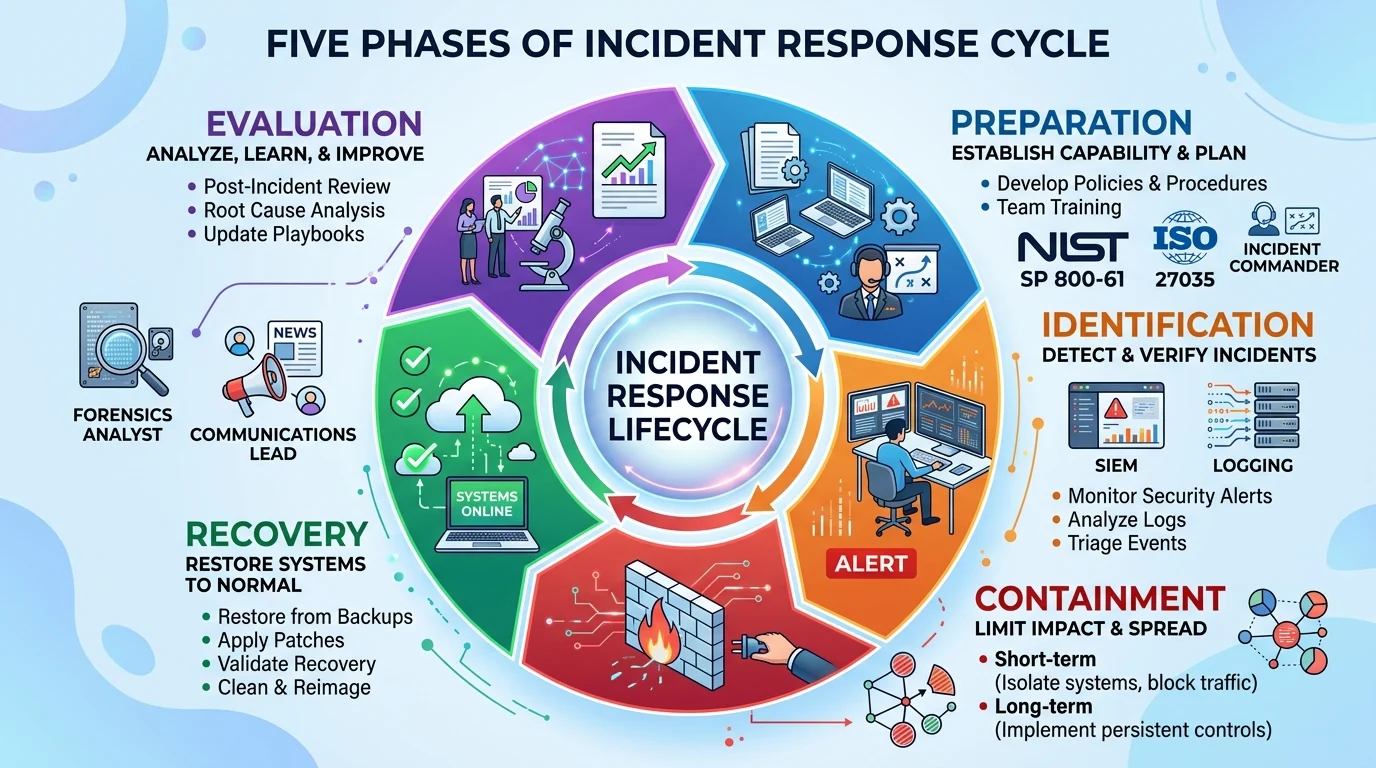
Quick Ans: Information security incident response is the structured process organizations use to prepare for, detect, contain, eradicate, and recover from cybersecurity incidents. Key frameworks include NIST SP 800-61 Rev. 3, ISO/IEC 27035, and CISA’s Cross-Sector Cybersecurity Performance Goals (CPGs). The five core phases are Preparation, Identification and Analysis, Containment and Eradication, Recovery, and Post-Incident Review. Organizations with tested IR plans reduce breach costs by an average of $1.49 million compared to those without .
A phishing email slips past your filters. An employee clicks a malicious link. Within hours, attackers are moving laterally across your network, exfiltrating data, and establishing persistence. What happens next determines whether this becomes a manageable incident or a catastrophic breach.
Information security incident response is the preparation for, handling of, and follow-up on cyber security incidents to minimize damage and prevent recurrence . It’s not just about having a plan on paper. It’s about having a trained team, tested procedures, and the tools to detect, contain, and recover from threats before they cause irreversible harm.
The stakes have never been higher. The average cost of a data breach reached $4.45 million in 2023, the highest figure recorded in the report’s 18-year history, with a mean time to identify and contain a breach of 277 days . Organizations with IR teams and regularly tested IR plans reduced breach costs by an average of $1.49 million compared to those without .
Whether you’re building an IR program from scratch or strengthening an existing one, understanding the core frameworks and phases is essential. Let’s break down everything you need to know.
What Is Information Security Incident Response?
1. A Structured Approach to Managing Cyber Incidents
Information security incident response is the organized process for preparing for, detecting, reporting, assessing, and responding to incidents, then applying lessons learned .
2. Encompasses the Full Incident Lifecycle
It spans from preparation before an incident occurs through detection, containment, eradication, recovery, and post-incident review .
3. Governed by International Standards
ISO/IEC 27035 provides a structured approach applicable to all organizations regardless of type, size, or nature .
4. Aligned with NIST Guidance
NIST SP 800-61 Rev. 3 integrates incident response recommendations throughout cybersecurity risk management activities .
5. Supports CISA’s Cross-Sector Goals
CISA’s CPGs provide a minimum set of practices and protections all organizations should implement .
6. Requires Dedicated Teams and Roles
Effective response depends on clearly defined roles including Incident Commander, Technical Lead, and Communications Lead .
7. Demands Regular Testing and Exercises
Periodic testing under real-world conditions, such as via purple team engagements and tabletop exercises, validates IR plans .
8. Includes Out-of-Band Communications
IR plans must include procedures for establishing alternative communication systems when primary systems are compromised .
9. Requires Evidence Preservation
Proper logging and evidence collection support both investigation and potential legal action .
10. Involves Regulatory Notification
Compliance with GDPR, HIPAA, CMMC, and other frameworks dictates breach notification timelines .
11. Focuses on Continuous Improvement
Post-incident evaluation identifies gaps and updates plans for future effectiveness .
12. Integrates with Business Continuity
IR works alongside disaster recovery and business continuity planning .
13. Addresses Supply Chain Incidents
ISO/IEC 27035-4 provides guidance for coordinating incidents affecting multiple partners .
14. Requires Senior Leadership Support
A written IRP policy needs senior leadership backing to succeed .
15. Aims to Minimize Damage and Prevent Recurrence
The ultimate goal is reducing impact and stopping the same incident from happening again .
The Five Phases of Incident Response
1. Preparation
Establish an IR team, formulate a Cyber Incident Response Plan, train the team, and define response processes .
2. Identification and Analysis
Detect the incident, sound the alarm, gather information about what happened, and record everything properly for potential evidence .
3. Containment and Eradication
Act quickly to limit and repair damage. Remove malicious software, close affected systems, and report to relevant authorities .
4. Recovery and Testing
Restore affected systems, test thoroughly before release, monitor for unusual behavior, and define how long extra monitoring is required .
5. Post-Incident Evaluation
Evaluate the incident and response, identify what didn’t go well, and update the plan with conclusions .
Key Frameworks and Standards
1. NIST SP 800-61 Rev. 3
Integrates incident response recommendations throughout the NIST Cybersecurity Framework (CSF) 2.0 .
2. ISO/IEC 27035-1:2025
Presents basic concepts, principles, and processes for information security incident management .
3. ISO/IEC 27035-3:2025
Provides guidelines for ICT incident response operations covering detection, reporting, triage, analysis, response, containment, eradication, and recovery .
4. ISO/IEC 27035-4:2025
Guidance for coordinating incidents affecting multiple partners, with planning, detection, assessment, response, and continual improvement stages .
5. CISA Cross-Sector Cybersecurity Performance Goals
Minimum set of practices and protections aligned with NIST frameworks .
6. CIS Controls v8.1
Provides an Incident Response Policy Template for organizations at all implementation groups .
7. MITRE ATT&CK Framework
Used to map threat behaviors and validate security controls against known adversary techniques .
8. ISO 27001
International standard for information security management systems .
Building an Incident Response Team
1. Incident Commander
The decision-maker and coordinator who oversees the entire response effort and liaises with senior leadership .
2. Technical Lead
Manages containment, eradication, and recovery efforts while guiding security analysts .
3. Forensics Analyst
Focuses on evidence collection and investigation, tracing how the attack happened .
4. Communications Lead
Handles internal and external messaging, ensuring accurate updates without causing panic .
5. Legal Counsel
Ensures compliance with breach notification requirements and manages liability risk .
6. HR Representative
Supports investigations involving employees and coordinates internal communications affecting staff .
7. Security Analysts
The first line of technical response, monitoring systems, triaging alerts, and investigating suspicious activity .
8. Extended Team Members
PR specialists, IT operations, and risk managers join depending on incident scale .
9. Executive Sponsors
Provide senior buy-in and budget support essential for IR program success .
10. External Partners
Third-party incident responders and security vendors provide surge capacity .
Detection and Monitoring Best Practices
1. Enable Comprehensive Logging
Implement large coverage and verbose logging across all environments .
2. Centralize Log Aggregation
Aggregate logs in an out-of-band, centralized location to protect against compromise .
3. Use SIEM Solutions
Security Information and Event Management platforms support log aggregation and management .
4. Identify Abnormal Network Activity
Look for scans discovering devices, commands altering admin accounts, PowerShell downloading remote programs, and unusual scripts .
5. Establish Baseline Behavior
Construct a baseline of normal cyber traffic to identify anomalies .
6. Monitor Security Appliance Health
Perform basic troubleshooting and escalate severe problems to engineers .
7. Train Staff on IOC Recognition
Employees should recognize indicators of compromise such as abnormal logins and data exfiltration attempts .
8. Incorporate Threat Intelligence
Correlate real-time alerts with contextual data to reduce false positives .
9. Implement Behavioral Analytics
Enable behavior analytics and anomaly detection for proactive hunting .
10. Alert on Abnormal Activity
Identify and investigate unusual network traffic across all phases of the attack chain .
Containment, Eradication, and Recovery
1. Immediate Containment Actions
Isolate affected systems, block attacker access, and limit the spread of malware .
2. Preserve Evidence Before Shutdown
Acquire memory images before shutdown to preserve volatile artifacts .
3. Remove Malicious Files
Eradicate malicious code and close exploited vulnerabilities .
4. Determine Data Impact
Assess whether sensitive data was stolen or corrupted .
5. Involve Legal Teams
Legal counsel examines compliance and determines if regulations apply .
6. Contact Law Enforcement
Engage authorities for potential criminal acts .
7. Restore Systems Carefully
Restore systems to pre-incident state ensuring integrity, availability, and confidentiality .
8. Test Before Full Release
Thoroughly test restored systems for unusual behavior or data anomalies .
9. Define Monitoring Duration
Specify how long extra monitoring is required in the IR plan .
10. Validate Functionality
Confirm systems function correctly before returning to production .
Incident Classification and Prioritization
1. Severity Classification
CISA’s federal Cyber Incident Severity Schema assigns levels 0-5, with Level 5 for critical infrastructure .
2. Category Classification
NIST SP 800-61 identifies categories including DoS/DDoS, malicious code, unauthorized access, and scans/probes .
3. Critical Severity
Data exfiltration, ransomware deployment, or destructive attacks targeting key systems .
4. High Severity
Malware propagation, insider threats, or third-party vendor breaches .
5. Medium Severity
Contained phishing attempts or abnormal but limited activity .
6. Low Severity
Policy violations, configuration errors, or minor security lapses .
7. Event vs. Incident Boundary
A failed login is an event; 10,000 failed attempts against privileged accounts in 60 seconds is an incident .
8. Breach vs. Incident
Under HIPAA, a breach is a specific subtype triggering statutory notification obligations .
9. Severity May Change
Classification can change as the investigation unfolds .
10. Align with Response Playbooks
Each severity level maps to specific timeframes, personnel, and workflows .
Communication and Escalation Protocols
1. Escalation Matrix
Define who is Responsible, Accountable, Consulted, and Informed for major response activities .
2. Up-to-Date Contact Lists
Maintain current contacts with alternate contacts for all IR stakeholders .
3. Multiple Communication Channels
Establish multiple channels to ensure information dissemination .
4. Out-of-Band Communications
Prepare alternative communication systems in case primary systems are compromised .
5. Internal and External Messaging
Define communication responsibilities for employees, customers, regulators, and partners .
6. Pre-Approved Templates
Create templates for data breaches, ransomware incidents, and service disruptions .
7. Regulatory Reporting Timelines
Establish timelines for GDPR, HIPAA, CMMC, and other obligations .
8. Tactical Leadership Group
Meets to identify operational challenges and discuss solutions .
9. Strategic Leadership Group
Meets to agree on objectives, align policy, and develop mitigation plans .
10. Centralized Channels
Use centralized communication to avoid conflicting updates .
Testing and Exercises
1. Tabletop Exercises
Discussion-based exercises using realistic scenarios to walk through the IR process .
2. Purple Team Engagements
Test IR plans under real-world conditions with simulated attacks .
3. Include All Stakeholders
Exercises should include all IR stakeholders to the extent possible .
4. Annual Testing Minimum
IR processes must be regularly tested at least annually .
5. Incorporate Lessons Learned
Training scenarios should include discussion points and lessons-learned .
6. Test Out-of-Band Communications
Validate alternative communication systems during exercises .
7. Engage Third-Party Responders
Include external IR providers in testing to improve coordination .
8. Update Plans After Testing
Modify IR plans based on exercise findings .
9. Use CISA Tabletop Packages
CISA provides resources designed to assist with exercises .
10. Test Escalation Procedures
Validate escalation thresholds and contact accuracy .
Frequently Asked Questions
What is information security incident response?
It’s the preparation for, handling of, and follow-up on cyber security incidents to minimize damage and prevent recurrence .
What are the five phases of incident response?
Preparation, Identification and Analysis, Containment and Eradication, Recovery and Testing, and Post-Incident Evaluation .
What is NIST SP 800-61 Rev. 3?
It’s NIST’s guidance for incorporating incident response recommendations throughout cybersecurity risk management, aligned with CSF 2.0 .
What is ISO/IEC 27035?
An international standard for information security incident management providing a structured approach applicable to all organizations .
What roles are in an incident response team?
Incident Commander, Technical Lead, Forensics Analyst, Communications Lead, Legal Counsel, HR Representative, and Security Analysts .
How often should IR plans be tested?
At least annually, using tabletop exercises and real-world simulations .
What is out-of-band communication?
Alternative communication systems used when primary systems are compromised, essential for ransomware incidents .
What is the difference between an event and an incident?
A failed login is an event; 10,000 failed attempts against privileged accounts in 60 seconds is an incident .
What is the difference between a breach and an incident?
A breach is a specific subtype of incident involving impermissible use or disclosure of protected information, triggering notification obligations .
What is CISA’s CPG?
Cross-Sector Cybersecurity Performance Goals, a minimum set of practices and protections aligned with NIST frameworks .
What is MITRE ATT&CK?
A framework of adversary tactics and techniques used to validate security controls and map threat behaviors .
How long does it take to contain a breach?
The mean time to identify and contain a breach is 277 days, according to IBM’s 2023 report .
What is the cost of a data breach?
The average cost reached $4.45 million in 2023, with IR teams reducing costs by $1.49 million .
Conclusion
Information security incident response is not a luxury. It’s a necessity. With the average breach costing $4.45 million and taking 277 days to identify and contain, the difference between a prepared organization and an unprepared one can be measured in millions of dollars and irreparable reputation damage .
The five-phase framework provides a clear roadmap: prepare, identify, contain, recover, and evaluate. International standards like ISO/IEC 27035 and NIST SP 800-61 Rev. 3 offer structured guidance applicable to organizations of all sizes . CISA’s Cross-Sector Cybersecurity Performance Goals establish minimum protections everyone should implement .
But plans on paper aren’t enough. The most effective organizations build dedicated IR teams with clearly defined roles, test their plans through regular exercises, and continuously update procedures based on lessons learned . They implement comprehensive logging, use SIEM solutions, and establish out-of-band communications for when primary systems fail .
Start where you are. Build your team. Write your plan. Test it. Update it. The next incident isn’t a matter of if, but when. Be ready.
Discover More:
- Stimulus Generalization vs Response Generalization: Complete Guide for 2026
- Incident Response Unit: Complete Guide for 2026

1 thought on “Information Security Incident Response: Complete Guide for 2026”