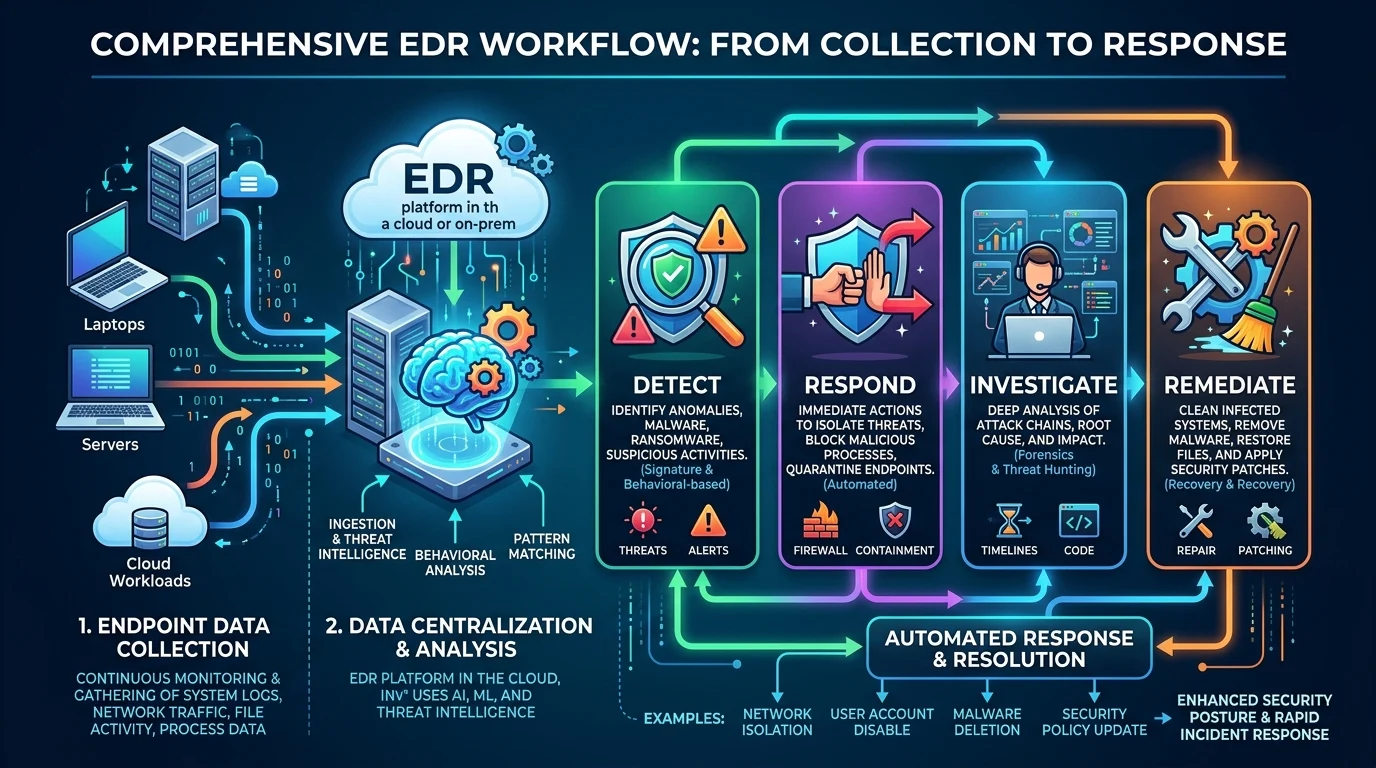
Quick Ans: Endpoint Detection and Response (EDR) is a cybersecurity technology that continuously monitors endpoints like laptops, desktops, and servers for evidence of threats, performs automatic actions to mitigate them, and helps security analysts detect and remediate threats before they spread. Key capabilities include threat detection, incident response, threat containment, and forensic investigation. The global EDR market was valued at US$483 million in 2025 and is forecast to reach US$751 million by 2032.
Your antivirus software blocks a suspicious file. But what happens when the threat doesn’t use a file at all? What if attackers are already inside your network, using stolen credentials and legitimate tools to move around undetected? This is where Endpoint Detection and Response comes in.
Endpoint Detection and Response, commonly known as EDR, is a cybersecurity technology that continuously monitors endpoints for evidence of threats, performs automatic actions to mitigate them, and helps security analysts detect and remediate threats before they spread throughout the network . Unlike traditional antivirus software that relies on known malware signatures, EDR uses behavioral analysis and machine learning to identify suspicious activities that might indicate an attack .
The importance of EDR has grown dramatically as cyberthreats have evolved. Studies estimate that as many as 90% of successful cyberattacks and 70% of successful data breaches originate at endpoint devices . Traditional endpoint security tools can’t detect or neutralize advanced threats that sneak past them, allowing those threats to lurk and roam the network for months . EDR picks up where these traditional solutions leave off, providing the visibility and response capabilities that modern organizations need.
What Is Endpoint Detection and Response?
1. A Continuous Monitoring Technology
EDR continuously monitors endpoints for evidence of threats and suspicious activities .
2. An Automated Response System
It performs automatic actions to mitigate threats, such as isolating affected endpoints .
3. A Threat Detection Platform
EDR uses behavioral analysis and machine learning to identify known and unknown threats .
4. An Incident Response Tool
It helps security analysts investigate and remediate threats before they spread .
5. A Visibility Solution
EDR provides full visibility into endpoint activity, attack timelines, and root cause analysis .
6. A Threat Hunting Enabler
It enables active threat hunting and proactive search for indicators of compromise .
7. A Four-Function System
Gartner defines EDR’s four main functions as detect, respond, investigate, and remediate .
8. A Cloud-Delivered or On-Prem Solution
EDR is available as cloud-delivered SaaS or on-premises/air-gapped deployments .
9. A Complement to Antivirus
EDR works alongside antivirus, not as a replacement, to provide layered protection .
10. A Regulatory Compliance Tool
EDR helps organizations meet mandates like NIS2 in Europe and CISA performance goals in the US .
11. A Market Growing Rapidly
The global EDR market was valued at US$483 million in 2025 and is forecast to reach US$751 million by 2032 .
12. A Strategic Control
Industry leaders should treat EDR as a strategic control rather than a standalone tool .
How EDR Works
1. Continuous Endpoint Data Collection
EDR continuously collects data on processes, network connections, file modifications, and user activities .
2. Lightweight Agent Installation
A lightweight agent is installed on every endpoint device to collect data .
3. Central Database Storage
Collected data is stored in a central database or data lake, typically hosted in the cloud .
4. Real-Time Analysis
EDR uses advanced analytics and machine learning to identify patterns indicating threats in real time .
5. Indicator of Compromise Detection
EDR looks for actions consistent with a potential attack or breach .
6. Indicator of Attack Detection
EDR identifies actions associated with known cyberthreats or cybercriminals .
7. Threat Intelligence Correlation
EDR correlates endpoint data with threat intelligence feeds for context .
8. MITRE ATT&CK Mapping
Many EDR solutions map data to MITRE ATT&CK, a global knowledge base of hacker tactics .
9. Behavioral Analysis
EDR compares real-time data to historical baselines to identify suspicious activity .
10. Automated Response Actions
EDR can automatically isolate endpoints, terminate processes, or quarantine files .
11. Alert Generation
When suspicious activity is detected, EDR generates detailed alerts with context .
12. Forensic Investigation Support
EDR retains historical data for post-incident forensic analysis .
Key EDR Capabilities
1. Threat Detection
EDR detects security incidents beyond file-based malware, including fileless attacks .
2. Incident Response
EDR enables containment of security incidents detected at the endpoint .
3. Investigation and Threat Hunting
EDR allows investigation of security incidents and hunting for risks based on timeline .
4. Remediation
EDR can treat endpoints to their pre-infection state .
5. Endpoint Isolation
EDR can disconnect an endpoint device from the network .
6. Process Termination
EDR can halt system or endpoint processes .
7. File Quarantine and Deletion
EDR can quarantine or delete suspicious files .
8. System Rollback
EDR can roll back systems to a previous clean state .
9. Track Back Reporting
EDR generates reports tracing an incident back to its root cause .
10. Automated Alert Triage
EDR prioritizes alerts according to severity .
11. Custom Detection Rules
Security teams can define and enforce advanced detection rules for proactive defense .
12. Live Forensics
EDR provides live forensic capabilities during active attacks .
EDR vs Antivirus: What’s the Difference?
1. Primary Objective
Antivirus detects and blocks known malware using signatures. EDR monitors endpoints to detect, investigate, and respond to advanced threats .
2. Detection Method
Antivirus relies on signature-based detection. EDR uses behavioral analysis and custom detection rules .
3. Response Capabilities
Antivirus blocks malware and quarantines files. EDR isolates and remediates threats with live forensics .
4. Visibility
Antivirus offers limited visibility. EDR provides full visibility into endpoint activity and attack timelines .
5. Threat Hunting
Antivirus has no active hunting. EDR enables proactive search for indicators of compromise .
6. Fileless Attack Detection
Antivirus struggles with fileless attacks. EDR excels at detecting fileless malware and stolen credentials .
7. Zero-Day Response
Antivirus responds after pattern updates. EDR provides high response to zero-day attacks .
8. False Positive Rates
Antivirus has relatively low false positives. EDR has low false positives through behavioral analysis .
9. Historical Data
Antivirus keeps limited history. EDR retains extensive historical data for forensics .
10. Complementary Roles
AV acts as first-line defense against known threats. EDR catches what AV misses .
EDR Market Overview for 2026
1. Market Size
The global EDR market was valued at US$483 million in 2025 and is forecast to reach US$751 million by 2032 .
2. Growth Rate
The market is growing at a CAGR of 6.2% during the review period .
3. Cloud-Delivered Dominance
Cloud-delivered agents controlled 68.12% of installations in 2025 .
4. Cloud Growth Rate
Cloud-delivered EDR is growing at a 24.93% CAGR through 2031 .
5. On-Premises Share
On-premises and air-gapped deployments retained 31.88% share in 2025 .
6. North America Leadership
North America generated 39.51% of global revenue in 2025 .
7. Europe Growth
Europe’s NIS2 Directive is obliging essential service operators to run continuous endpoint monitoring .
8. Middle East Momentum
The Middle East shows a 24.73% CAGR through 2031 .
9. Identity Threat Detection Growth
Identity-threat detection and response posted a 24.83% CAGR through 2031 .
10. Endpoint Prevention Platform Share
Endpoint Prevention Platform accounted for 42.62% of 2025 revenue .
11. Key Drivers
Ransomware-as-a-Service explosion and credential-stealing toolkits are driving adoption .
12. Compliance Mandates
Government mandates and cyber-insurance discounts are fueling growth .
Leading EDR Solutions
1. Microsoft Defender for Endpoint
Cloud-based EDR solution protecting organizations against threats across all devices .
2. CrowdStrike Falcon
Widely recognized EDR platform with cloud-native architecture .
3. Palo Alto Networks Cortex XDR
Unified platform integrating EPP, EDR, and extended detection capabilities .
4. FortiEDR
Real-time, automated endpoint security with kernel-level machine learning .
5. Trend Micro Vision One
EPP and EDR platform protecting endpoints, servers, and cloud workloads .
6. Sophos Intercept X
Advanced endpoint protection with EDR and deep learning capabilities .
7. Symantec Endpoint Security Complete
Comprehensive endpoint protection with multi-layer defenses .
8. Carbon Black
Cloud-native endpoint security platform .
9. Cybereason
EDR platform with automated attack analysis .
10. RSA Security (Dell EMC)
EDR solution integrated with enterprise security infrastructure .
11. Cisco Systems
EDR capabilities integrated with network security .
12. McAfee
EDR solution for enterprise endpoint protection .
EDR Deployment Best Practices
1. Assess Organizational Needs
Understand your cybersecurity needs, endpoint types, and current infrastructure .
2. Choose the Right Solution
Select EDR software that aligns with your requirements and integrates with existing systems .
3. Install on All Endpoints
Deploy EDR software on all endpoints vulnerable to attack .
4. Customize Response Plans
Configure EDR to trigger appropriate responses in case of cyberattacks .
5. Monitor and Update Regularly
Continuously monitor endpoint activity and ensure EDR is updated with latest threat intelligence .
6. Integrate with SIEM
Connect EDR telemetry with SIEM for comprehensive security operations .
7. Measure Operational Metrics
Track mean time to detect, mean time to contain, and alert fidelity .
8. Invest in MDR or Co-Managed SOC
Address talent shortages with managed detection and response .
9. Adopt AI with Governance
Implement AI-enabled EDR with explainability and data protection safeguards .
10. Conduct Regular Validation
Use tabletop exercises, red teaming, and adversary emulation .
11. Map Detections to MITRE ATT&CK
Close visibility gaps by mapping detections to the framework .
12. Plan for Integration
Improve endpoint coverage across servers, laptops, mobile, and cloud workloads .
Frequently Asked Questions
What is Endpoint Detection and Response (EDR)?
EDR is a cybersecurity technology that continuously monitors endpoints for threats, performs automatic actions to mitigate them, and helps analysts detect and remediate threats before they spread .
How does EDR differ from antivirus?
Antivirus detects known malware using signatures. EDR monitors behavior to detect, investigate, and respond to advanced threats that bypass traditional defenses .
What are the four main functions of EDR?
Gartner defines EDR’s four main functions as detect, respond, investigate, and remediate .
What is the EDR market size?
The global EDR market was valued at US$483 million in 2025 and is forecast to reach US$751 million by 2032 .
What is the difference between EDR and EPP?
EPP is a first-line threat prevention solution. EDR extends beyond EPP by allowing security teams to neutralize advanced threats and conduct incident response .
What is the difference between EDR and SIEM?
SIEM offers visibility into the entire IT environment. EDR focuses specifically on collecting endpoint data .
How does EDR detect fileless malware?
EDR uses behavioral analysis to detect malicious activities in memory without relying on file signatures .
Can EDR automatically respond to threats?
Yes. EDR can automatically isolate endpoints, terminate processes, quarantine files, and roll back systems .
What is threat hunting in EDR?
Threat hunting is the proactive search for indicators of compromise and suspicious activity on endpoints .
What are the deployment options for EDR?
EDR is available as cloud-delivered SaaS, on-premises, or air-gapped deployments .
What is the EDR growth rate?
The market is growing at a CAGR of 6.2% from 2025 to 2032 .
What industries use EDR?
EDR is used across BFSI, IT and telecom, manufacturing, healthcare, retail, and government sectors .
What is MITRE ATT&CK?
A global knowledge base of hacker tactics and techniques that EDR solutions map detections to .
Conclusion
Endpoint Detection and Response has become essential for modern cybersecurity. As attackers continuously update their methods, traditional antivirus solutions alone are no longer sufficient. EDR fills the gap by providing continuous monitoring, behavioral analysis, and automated response capabilities that catch threats traditional tools miss.
The market is growing rapidly, driven by ransomware-as-a-Service explosion, credential-stealing toolkits, and regulatory mandates across the globe. Cloud-delivered EDR dominates installations, but on-premises deployments remain critical for defense and regulated industries. From North America’s federal mandates to Europe’s NIS2 Directive to the Middle East’s critical infrastructure requirements, EDR adoption is becoming a compliance necessity, not just a security best practice.
Whether you’re evaluating EDR for your organization or simply understanding the technology, the core message is clear: EDR is now fundamental to enterprise cyber resilience. Organizations that combine high-quality telemetry, skilled analysts, automated workflows, and governance will be better positioned to reduce breach impact and maintain operational trust.
Discover More
- Information Security Incident Response: Complete Guide for 2026
- Cyber Incident Response Team: Complete Guide for 2026
