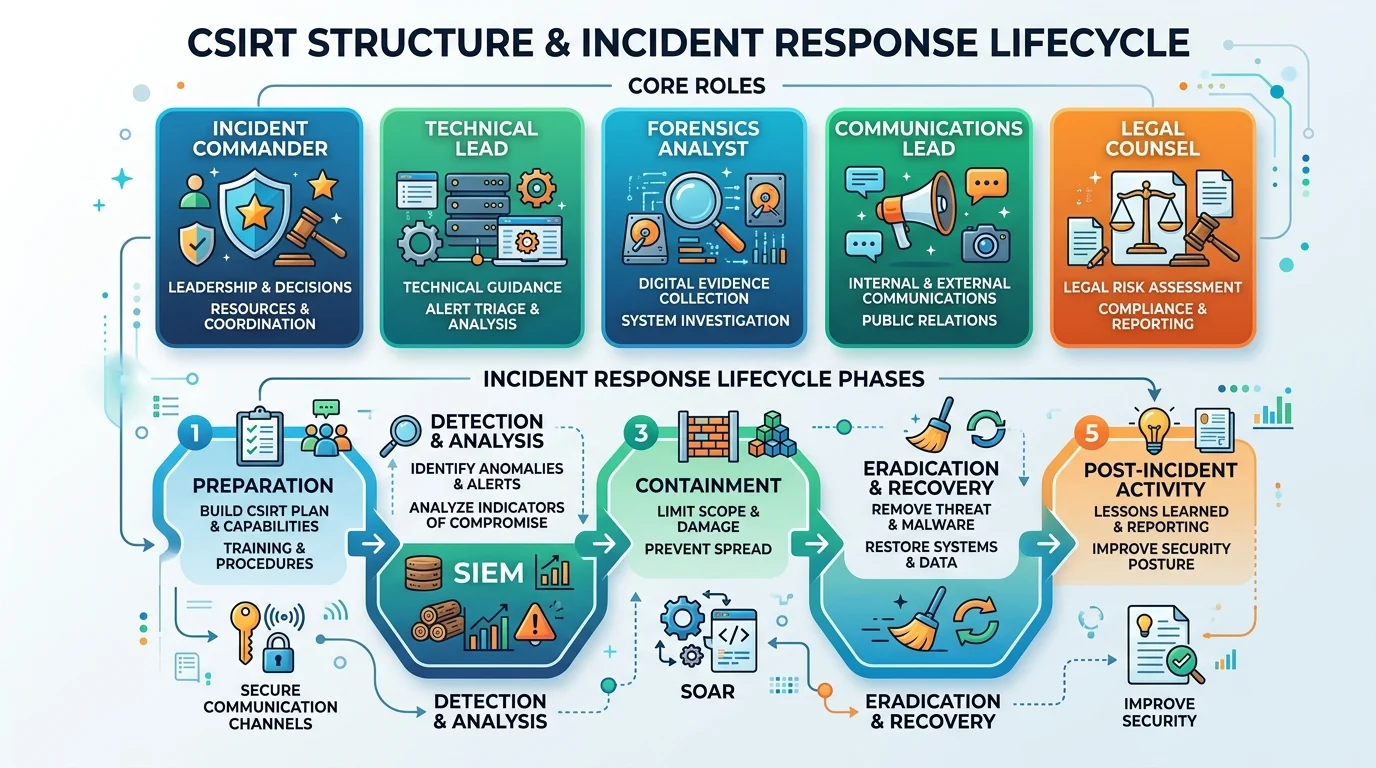
Quick Ans: A Cyber Incident Response Team (CSIRT) is a specialized group responsible for detecting, analyzing, and responding to cybersecurity incidents. Key facts: CSIRTs provide mandatory services including incident report acceptance and analysis, teams can be internal, external, or hybrid, core roles include Incident Commander and Technical Lead, and most organizations use a virtual team model pulled together when incidents occur. The NIST SP 800-61 framework defines four lifecycle phases: Preparation, Detection and Analysis, Containment/Eradication/Recovery, and Post-Incident Activity.
When a ransomware attack locks your systems, a data breach exposes customer records, or a nation-state actor infiltrates your network, who do you call? The answer is a Cyber Incident Response Team.
A Cyber Incident Response Team (CSIRT) is the group of people responsible for handling the response to a security incident. They may include both internal and external teams and may differ based on the nature of the incident . The core team will usually be IT or Cyber Security staff, while the extended team may include PR, HR, and legal .
These teams don’t have to be dedicated to incident response full time. In fact, it’s often more cost-effective to have a “virtual” CSIRT, pulled together when needed from people who have other day jobs . But when an incident hits, these individuals must be able to prioritize the response over their day-to-day work .
Understanding how CSIRTs work matters because cyber threats are evolving faster than ever. AI-enabled adversaries surged 89% year-over-year, and the fastest breakout time is now 27 seconds . The defender’s clock and the attacker’s clock are no longer measured in the same units. Let’s explore how these teams are structured, staffed, and operated.
What Is a Cyber Incident Response Team?
1. The Core Definition
A CSIRT provides services and support to a defined constituency, managing information security incidents by preventing, handling, and coordinating responses .
2. Multiple Names, Same Mission
Teams may be called CERT (Computer Emergency Response Team), CIRT (Computer Incident Response Team), CIRC (Computer Incident Response Center), or other abbreviations .
3. A Clear Mandate Is Essential
A properly deployed CSIRT has a clear mandate, governance model, tailored services framework, technologies, and processes to provide and measure defined services .
4. National CSIRTs Safeguard Nations
National CSIRTs (nCSIRTs) focus on coordinating the response to incidents, threats, and vulnerabilities across entire countries .
5. Sectorial CSIRTs Serve Industries
Government CSIRTs and sector-specific teams address the unique needs of particular industries or government functions .
6. Distinguished from SOCs
A SOC focuses on monitoring and detection, while a CSIRT specializes in incident management services .
7. Can Coexist in Larger Organizations
A large SOC might include a CSIRT as one of its divisions, or a CSIRT might include a SOC .
8. Virtual Teams Are Common
Many organizations use a “virtual” CSIRT model, pulling together staff from various departments when incidents occur .
9. Central or Distributed Models
Teams can be centrally located at headquarters or distributed across multiple locations .
10. Formal Relationships Matter
A CSIRT’s effectiveness depends on formal relationships with other organizational teams and external parties .
11. Continuous Improvement Is Required
Teams must adapt to real-time threats and emerging attack techniques .
12. Management Buy-In Is Critical
Without executive support and funding, a CSIRT cannot succeed .
13. Clear Constituency Definition
Every CSIRT must define whom it serves and what systems fall within its responsibility .
14. Incident Thresholds Guide Action
Organizations must establish thresholds differentiating between an incident and an event .
15. Measurable Quality Standards
Effective CSIRTs define quality systems with specific measurements, checks, and reporting practices .
Core Roles and Responsibilities
1. Incident Commander
The decision-maker and coordinator who oversees the entire response effort, sets priorities, and ensures the team works in sync. Often serves as liaison to senior leadership .
2. Technical Lead
The hands-on technical strategist responsible for managing containment, eradication, and recovery efforts while guiding security analysts .
3. Forensics Analyst
Focuses on evidence collection and investigation, tracing how the attack happened, gathering data for legal action, and providing insight for strengthening defenses .
4. Communications Lead
Handles both internal and external messaging, ensuring employees, executives, partners, and customers receive accurate updates without causing panic .
5. Legal Counsel
Ensures the response complies with relevant laws and regulations, advises on evidence collection, and manages liability considerations .
6. IT and Infrastructure Specialists
System and network administrators have the best understanding of the technology they manage and facilitate decisions such as whether to disconnect attacked systems .
7. Human Resources
If an employee is suspected of causing an incident, HR may be involved in disciplinary proceedings .
8. Public Relations and Media Relations
Depending on the incident’s nature, PR manages communication with the media and public .
9. Business Continuity Planners
Ensure incident response policies and business continuity processes are in sync and help minimize operational disruption .
10. Physical Security and Facilities Management
Some incidents involve coordinated logical and physical attacks, requiring facility access for evidence collection .
11. Deputies for Every Critical Role
Always provide for deputies who will cover if a critical person or persons are unavailable .
12. Cross-Training Requirements
Cross-training team members on critical functions prevents single-threading and responder burnout .
13. RACI Matrix Establishment
Define who is Responsible, Accountable, Consulted, and Informed for major response activities .
14. Escalation Thresholds
Establish thresholds based on severity and business impact to determine when to escalate .
15. Backup Decision-Makers
Identify backup decision-makers for key roles to maintain continuity .
Incident Response Lifecycle
1. Phase One: Preparation
Establishing policies, response playbooks, communication procedures, training programs, and incident response capabilities before a security event occurs .
2. Phase Two: Detection and Analysis
Security analysts monitor SIEM platforms, investigate alerts, validate threats, and identify incidents .
3. Phase Three: Containment
Isolate affected systems, limit the spread of malware, and reduce the impact of the incident .
4. Phase Four: Eradication
DFIR specialists and infrastructure teams remove malicious files, close exploited vulnerabilities, and eliminate attacker access .
5. Phase Five: Recovery
IT teams restore systems, validate functionality, return services to production, and monitor for recurring threats .
6. Phase Six: Post-Incident Review
The entire team reviews response efforts, documents lessons learned, and updates playbooks .
7. NIST SP 800-61 Framework
The primary global standard defines four phases: Preparation, Detection and Analysis, Containment/Eradication/Recovery, and Post-Incident Activity .
8. AI-Driven Optimization
AI, ML, and Deep Learning techniques are being mapped to each phase to reduce Mean Time to Detect and Mean Time to Respond .
9. Hybrid DL Models Dominate Detection
CNN-LSTM models show high accuracy in detection and analysis phases .
10. Reinforcement Learning for Containment
RL shows emerging potential for automated containment decisions .
11. NLP Enhances Preparation
Natural Language Processing effectively enhances predictive threat intelligence during preparation .
12. Explainable AI Builds Trust
XAI improves analyst trust in automated decisions and supports operational adoption .
13. Traditional Bottlenecks Persist
Response phase remains largely manual, relying heavily on human intervention .
14. Signature-Based Detection Limitations
Conventional SIEM systems depend on signatures, resulting in delayed identification of novel threats .
15. Alert Fatigue Is Real
High false-positive rates cause alert fatigue and slow response .
Types of CSIRT Models
1. Internal Dedicated Team
Staff dedicated full-time to incident response. Deep institutional knowledge but costly to build and retain .
2. Virtual or Ad-Hoc Team
Pulled together when needed from people with other day jobs. Cost-effective but requires clear prioritization agreements .
3. External Incident Response Services
Specialist expertise and scalability from third-party providers .
4. Hybrid Model
Internal staff handle daily readiness while external experts step in for large-scale events .
5. Centralized Model
IR staff located at headquarters or a main office .
6. Distributed Model
IR staff positioned across multiple key locations .
7. National CSIRTs
Coordinate response across entire nations, safeguarding critical infrastructure .
8. Sectorial CSIRTs
Focus on specific industries like finance, healthcare, or energy .
9. Managed Security Service Providers
Offer CSIRT-like services to customers for a fee .
10. Follow-the-Sun Coverage
Global teams provide 24/7 coverage by handing off between time zones .
11. On-Call Rotations
Team members rotate on-call responsibilities to prevent fatigue .
12. Outsourced Technical Functions
Some aspects like forensics or PR may be outsourced while internal staff oversees .
13. Government CSIRTs
Serve government agencies and public sector organizations .
14. PSIRTs
Product Security Incident Response Teams handle vulnerabilities in specific products .
15. ISACs
Information Sharing and Analysis Centers facilitate threat intelligence sharing within sectors .
Tools and Technologies
1. SIEM Platforms
Aggregate data from multiple security systems and log files, helping teams detect evolving threats and respond quickly .
2. SOAR Platforms
Automate recurring and predictable enrichment, response, and remediation tasks, freeing time for investigation .
3. XDR Solutions
Integrate data from multiple security products, providing comprehensive threat detection across endpoints, servers, cloud, and email .
4. EDR Tools
Endpoint detection and response for spotting and isolating compromised devices .
5. Forensics Software
Trace attack paths, preserve evidence, and support post-incident analysis .
6. Threat Intelligence Feeds
Provide context on attacker tactics and emerging risks .
7. Firewalls
Monitor traffic to and from the network, allowing or blocking based on security rules .
8. Log Management Systems
Collect and organize alerts from all security tools for clear visibility .
9. Vulnerability Management
Scans systems and networks for weaknesses that attackers could exploit .
10. UEBA (User and Entity Behavior Analytics)
Uses AI to establish baselines of normal activity and flag deviations .
11. Open-Source Tools
Sysmon, KAPE, Velociraptor, Plaso, and Elastic Stack provide powerful capabilities without expensive licenses .
12. Secure Collaboration Platforms
Dedicated incident workspaces separate from standard messaging channels .
13. Out-of-Band Communication
Pre-arranged, secure channels that remain available if the main network is down .
14. Incident Dashboards
Secure hubs that aggregate forensic updates, operational status, and business impact summaries .
15. AI-Powered Prioritization
AI-assisted triage helps teams focus on the most serious events .
Building and Staffing a CSIRT
1. Assess Organizational Needs First
Identify your most critical assets and potential threats to guide team size and focus .
2. Obtain Executive Support
Leaders need to understand the business case including faster recovery times and lower breach costs .
3. Define Scope Clearly
Establish which systems, business units, and incidents fall within the team’s responsibility .
4. Choose the Right Structure
Decide between internal, external, or hybrid models based on resources and risk .
5. Select Tools and Secure Channels
Deploy SIEM, EDR, forensics software, and establish out-of-band communication .
6. Establish Clear Roles
Assign key roles including legal, IT, security, facilities, PR, and HR .
7. Define Communication Mechanisms
Determine primary and secondary communication methods for incidents .
8. Conduct Routine Exercises
Plan and conduct exercises and scenarios to prepare for real-world incidents .
9. Create RACI and Escalation Matrix
Assign single accountable owners and define escalation thresholds .
10. Develop Crisis Communication Protocols
Create pre-approved templates and establish reporting timelines .
11. Avoid Single-Threading
Cross-train members and maintain backup owners for critical processes .
12. Onboard and Train Continuously
Tabletop exercises, red team drills, and role rotations keep skills sharp .
13. Start Small and Grow
Use what exists where appropriate, and build on existing policies and strategies .
14. Get Stakeholder Involvement Early
Involve legal, PR, managers, security staff, and administrators in planning .
15. Document Everything
Maintain up-to-date contact lists, procedures, and incident response plans .
Communication and Coordination Best Practices
1. Single Source of Truth
All validated updates originate from the Incident Command Channel. Everyone knows where to find the latest confirmed status .
2. Internal vs. External Messaging
Internal communication keeps staff informed; external messaging satisfies regulatory, media, and customer expectations .
3. Consistency Is Non-Negotiable
Internal and external updates should never contradict each other .
4. Timing Aligns with Milestones
External disclosures should align with verified milestones, not speculation .
5. Segment Information by Audience
Share technical details for responders, contextual impact for leadership, assurance for customers .
6. Lead with Accuracy
Avoid defensiveness or premature conclusions in all communications .
7. Decision Logging Is Essential
Every message and decision becomes part of the audit trail for post-incident review .
8. Cyber Range Simulations
Controlled, realistic environments test both tools and teamwork .
9. After-Action Reviews Transform Experience
AARs identify what worked, what didn’t, and why, feeding insights into updated playbooks .
10. Cross-Industry Benchmarking
External assessments through industry groups or managed partners provide valuable perspective .
11. Measure Response Time
Track time from detection to containment as a key metric .
12. Track Escalation Accuracy
Measure the percentage of correct escalations to appropriate tiers .
13. Monitor Stakeholder Engagement
Assess timeliness and clarity of executive updates .
14. Reduce Dwell Time
Coordinated communication shortens the window between compromise and containment .
15. Conduct Post-Incident Reviews
Identify lessons learned and follow-up actions to prevent recurrence .
Frequently Asked Questions
What is a Cyber Incident Response Team (CSIRT)?
A CSIRT provides services and support to a defined constituency, managing information security incidents by preventing, handling, and coordinating responses .
What is the difference between a CSIRT and a SOC?
A SOC focuses on monitoring and detection, while a CSIRT specializes in incident management services. They can coexist and sometimes integrate .
What are the mandatory services a CSIRT must provide?
Incident report acceptance and incident analysis are labeled as MUST services in the FIRST Services Framework .
What roles are essential in a CSIRT?
Incident Commander, Technical Lead, Forensics Analyst, Communications Lead, and Legal Counsel are core roles .
How long does it take to respond to a cyber incident?
AI-enabled adversaries have reduced breakout time to as fast as 27 seconds, requiring rapid detection and response .
What is a virtual CSIRT?
A team pulled together when needed from people who have other day jobs, rather than dedicated full-time staff .
What tools does a CSIRT need?
SIEM, SOAR, XDR, EDR, forensics software, threat intelligence feeds, and secure communication channels .
What is the NIST incident response lifecycle?
Four phases: Preparation, Detection and Analysis, Containment/Eradication/Recovery, and Post-Incident Activity .
How often should CSIRTs conduct exercises?
At least annually, with routine testing to validate communication channels, decision-making, and workflows .
What is out-of-band communication?
Pre-arranged, secure channels that remain available if the main network is compromised .
How do you measure CSIRT effectiveness?
Metrics include response time (detection to containment), escalation accuracy, stakeholder engagement, and decision latency .
What is a post-incident review?
A structured review that identifies lessons learned and follow-up actions to prevent recurrence .
Can small organizations have a CSIRT?
Yes. Virtual models and managed security service providers make CSIRT capabilities accessible to organizations of all sizes.
Conclusion
A Cyber Incident Response Team is your organization’s frontline defense against cyber threats. From the Incident Commander coordinating the response to the Forensics Analyst tracing the attack, every role matters. The lifecycle from Preparation through Post-Incident Review provides a structured framework for handling incidents effectively.
The threat landscape is evolving rapidly. AI-enabled adversaries operate at machine speed, with breakout times measured in seconds. Traditional signature-based detection and manual response practices can no longer keep pace. Modern CSIRTs must adopt AI-assisted prioritization, behavioral baselines, and pre-authorized automated containment where appropriate.
Whether you’re building a team from scratch or strengthening an existing one, the fundamentals remain: clear roles, tested communication channels, regular exercises, and continuous improvement through after-action reviews. Share this guide with your security team, bookmark it for reference, and start building a more resilient incident response capability today.
Discover More:
- RFP Response Examples: Complete Guide for 2026
- Exposure and Response Prevention Training: Complete Guide for 2026

2 thoughts on “Cyber Incident Response Team: Complete Guide for 2026”