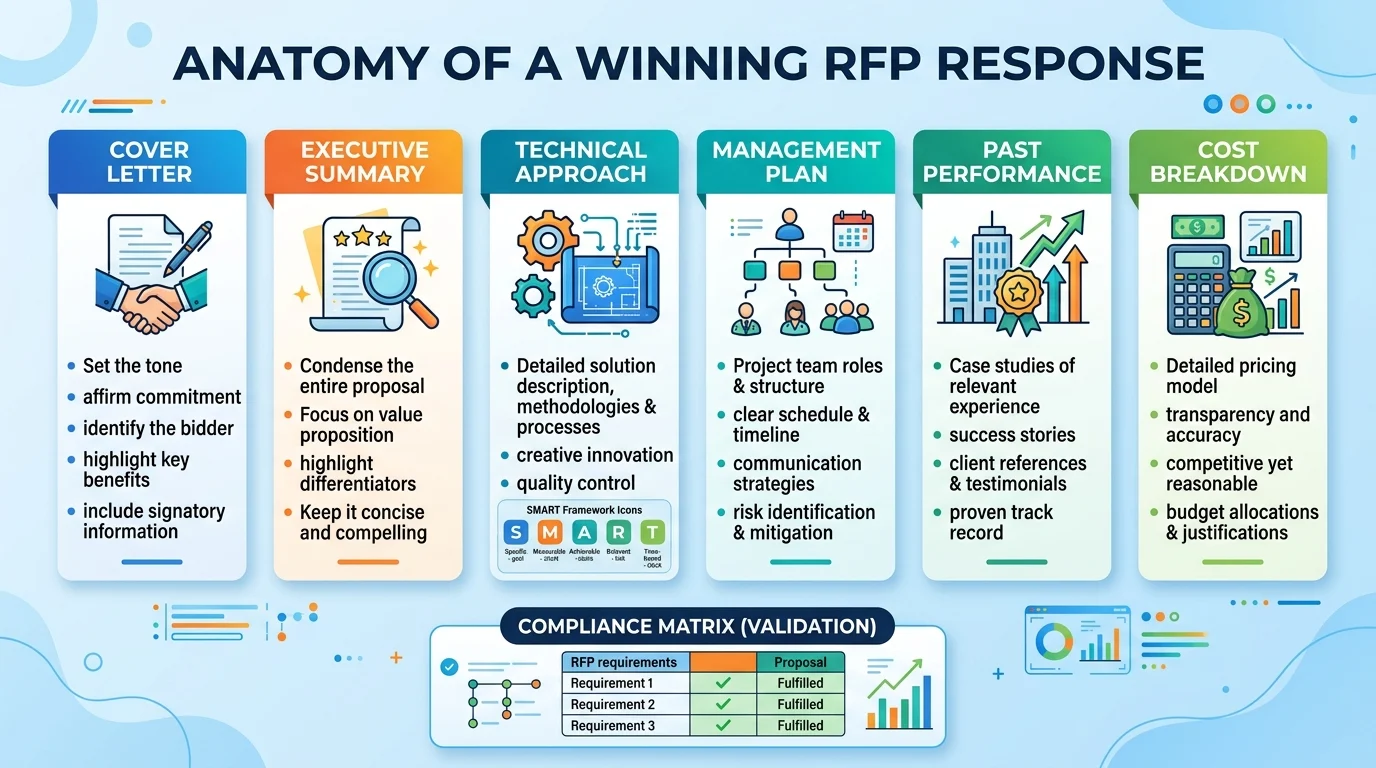
Quick Ans: An RFP response is your formal proposal to a client’s Request for Proposal. Winning responses follow a clear structure: cover letter, executive summary, technical approach, management plan, past performance, and cost breakdown. The best responses use SMART storytelling (Specific, Measurable, Achievable, Relevant, Time-bound) to prove capability rather than just claim it. Key success factors include mirroring the RFP’s structure, addressing every requirement directly, and quantifying results with real data.
You’ve found the perfect opportunity. The RFP landed in your inbox, and you know your company can deliver. But so can a dozen competitors. The difference between winning and losing often comes down to one thing: how well you tell your story.
An RFP response is your formal proposal to a client’s Request for Proposal. It’s not just a document. It’s your chance to prove you understand their problem, have solved it before, and can deliver measurable results. Most responses fail because they talk about capabilities in vague terms. The winners prove their claims with structured, quantified examples.
This guide breaks down real RFP response examples across every critical section. From executive summaries that grab attention to technical approaches that demonstrate expertise, you’ll see exactly what separates winning proposals from the pile of rejections. Whether you’re responding to your first RFP or your hundredth, these examples will sharpen your approach.
Cover Letter Examples
1. The Direct Opener
“We are pleased to submit our response to RFP No. [Number] for [Service]. Our team brings 15 years of experience delivering similar solutions to government agencies, including [Agency Name].”
2. The Mission Alignment Approach
“Your agency’s commitment to [specific mission] aligns perfectly with our expertise. At [Company], we understand the intricacies of [specific challenge] and are ready to deliver [outcome].”
3. The Certification Lead
“Our response outlines capabilities including ISO 9001:2015 certification, DCAA-approved accounting systems, and Top Secret facility clearance. We hold 55+ prime contracts with state and local government agencies.”
4. The Past Success Hook
“Having successfully supported [Agency] under prior contract #[Number], we are pleased to build upon that relationship. Our engineers average 20+ years of experience in [relevant field].”
5. The Compliance Affirmation
“With this submission, we accept all terms and conditions defined in the solicitation, acknowledge receipt of amendments and Q&As issued, and look forward to lending our expertise to [Department].”
6. The Value Promise
“This response outlines our capabilities and directly addresses the requirements outlined in the Request for Proposal. We promise to bring best value to [Department] and win trust by excelling.”
7. The Partnership Framing
“We are excited to help [Client] improve [specific outcome] by implementing [solution] tailored to [their environment]. This proposal outlines how our solution can help [Client] achieve [specific goal].”
8. The Differentiator Statement
“Unlike standard [competitor type] proposals, we provide 24/7 live support to resolve critical issues in real time. This commitment has resulted in 98% client retention across our portfolio.”
9. The Understanding Demonstration
“We have reviewed your RFP in detail and understand the critical need for [specific requirement]. Our response demonstrates exactly how we will meet and exceed your expectations.”
Executive Summary Examples
1. The Problem-First Opening
“[Client]’s challenge: Connecting disjointed customer data across 85 locations and your e-commerce platform while training over 300 associates on a new system without disrupting operations.”
2. The Solution Statement
“Our platform delivers: Seamless integration with your existing Oracle ERP system, requiring zero downtime. Unified customer profiles accessible across all channels within 45 days of implementation.”
3. The Quantified Benefit
“Our CRM platform’s personalized marketing automation features will increase loyalty program sign-ups by 20% within the first year. This directly supports your stated goal of increasing repeat purchases.”
4. The Differentiator Highlight
“Unlike competitors proposing six-month deployment timelines, our FastTrack methodology will have your core systems operational within 60 days, aligning perfectly with your holiday season preparation timeline.”
5. The Team Credibility
“Your project will be led by [Team Lead Name], supported by [Key Team Members]. Together, they bring [X years] of experience and a proven track record in [relevant field].”
6. The Value Proposition
“Our [specific solution] has consistently delivered [specific results]. For example, we helped [similar client] achieve [outcome], and we’re confident we can do the same for you.”
7. The Client-Centric Alignment
“Your commitment to [achieving X] aligns perfectly with our expertise. We understand the intricacies of [specific challenge] and are ready to deliver [outcome].”
8. The Past Performance Proof
“Retailer X wanted to reduce cart abandonment. We implemented automated follow-up emails that resulted in a 12% increase in completed purchases within three months.”
Technical Approach Examples
1. The Structured Response
“Mirror the SOW structure: one response per major task. Address methods, tools, technologies, and rationale for selection for each requirement.”
2. The Requirement Mapping
“Requirement 3.2: Multi-level approval workflow. Response: Supported via configurable workflow engine with unlimited approval stages.”
3. The Architecture Explanation
“The platform operates on a multi-tenant SaaS architecture hosted on AWS with REST API support and SAML-based SSO integration.”
4. The Integration Detail
“Seamless integration with your existing Oracle ERP system, requiring zero downtime. REST API support for external integrations.”
5. The Methodology Statement
“Our FastTrack methodology delivers core systems operational within 60 days, compared to competitors proposing six-month timelines.”
6. The Security Compliance
“SOC 2 Type II certified with AES-256 encryption at rest and TLS 1.2 in transit. Role-based authentication with activity logging.”
7. The Scalability Promise
“Support for traffic growth of up to 200% over five years. Multi-tenant SaaS architecture ensures consistent performance.”
8. The Standards Citation
“Applicable standards: WCAG 2.1 AA compliance, Section 508 requirements, and SOC 2 Type II certification.”
9. The QA/QC Protocol
“Quality assurance includes multi-stage approval: Sales Leadership review, Finance compliance check, and final CFO approval to ensure accuracy.”
10. The Risk Management
“Risk identification with specific mitigation plans. If data migration exceeds two weeks, additional resources allocated at no extra cost.”
Past Performance Examples
1. The SMART Story Structure
“Specific: Took over failing global FM contract when previous supplier dropped out last minute. Measurable: 8-week transition, 15% cost savings, 3-year contract extension.”
2. The Quantified Results
“Achievable: Mobilized teams, built transition plan in a week, secured local agreements in 12 countries. Relevant: Handled similar contracts before.”
3. The Reference Card Format
“Client: Cogentrix Energy. Customer since 2014 Q2. Services: PS Upgrades, Updates, Training, IT Managed Services. Contact: Dale Roddick, Director of IT Applications.”
4. The CPARS Rating Reference
“Past performance includes contracts with Satisfactory or above CPARS ratings. Three references available with verified contact information.”
5. The Challenge-Response Format
“Challenges: Previous supplier dropped out last minute. Corrective Actions: Mobilized teams, built transition plan in one week, secured local agreements in 12 countries.”
6. The Outcome Summary
“Results: 8-week transition completed, 15% cost savings achieved, 3-year contract extension granted. Client retained as ongoing partner.”
7. The Relevant Experience Statement
“6 years relevant experience in MOUD services. Beginning and within years of service added more services to the SOR project.”
8. The Project Scope Parallel
“Period and Scope: 2014-Present, PS Upgrades, Updates, Training, IT Managed Services. Elements paralleling current SOW requirements.”
9. The Contract Vehicle
“Contract Number: #13-2016 Information Technology Consulting and Technical Services. Vehicle: Statewide contract for Enterprise Solutions team.”
10. The Client Retention
“Every Inc. Customer since Q4 2011. Services: PS Upgrades, Updates, Training, IT Managed Services. Contact: Wendy Jamison, Supervisor Enterprise Business Solutions.”
11. The Quantified Achievement
“Over 50 companies’ applications upgraded, updated, hosted, and/or migrated into AWS public and government cloud environments since 2011.”
12. The Experience Depth
“Our engineers average 20+ years of on-premises infrastructure, software development, and application support experience.”
Management Plan Examples
1. The Org Structure Statement
“Management philosophy, org chart with key personnel (% time, reporting lines, sub interfaces). PM authority and span of control documented.”
2. The Key Personnel Summary
“Key personnel: [Name], [Title], [Clearance Level]. Resumes include education, certifications, government contract experience, measurable accomplishments.”
3. The Staffing Plan
“Recruitment plan, retention approach, succession plan, subcontractor oversight. Key personnel highlighted with organizational depth.”
4. The Communication Protocol
“Progress reporting cadence (CDRL-compliant), change control process, COR/COTR communication protocols, FAR clause procedural responses.”
5. The Schedule Management
“Milestones, deliverables, dependencies, critical path. Gantt or PERT format with historical duration estimates.”
6. The Invoicing Process
“Standard payment terms: net 30 for new business, net 60 for renewals. Invoices issued 60 days before subscription renewal date.”
7. The Payment Methods
“ACH, Credit Card, and Check accepted. P-cards accepted with no additional fee. No hidden fees; full pricing transparency.”
8. The Pricing Verification
“Multi-stage approval: Sales Leadership review, Finance team compliance check, final CFO approval. Cross-departmental training ensures accuracy.”
9. The Contract Compliance
“Customer shall pay all Subscription, Onboarding, and Professional Service fees within thirty days of invoice date. Fees invoiced annually in advance.”
10. The Team Composition
“Project team: [Team Lead], [Key Members]. [X years] combined experience. Proven track record in [relevant field]. Reporting structure documented.”
11. The Subcontractor Management
“Subcontractor oversight plan with clear role delineation. Interfaces between prime and sub documented with reporting lines.”
12. The Retention Strategy
“Recruitment plan, retention approach, succession plan. Key personnel identified with clear commitment levels.”
13. The Cost Structure
“Direct Labor: LCAT, hours by year/task, rate (loaded/unloaded). Fringe/Overhead/G&A: Rate %, allocation base, pool composition.”
14. The Deliverable Schedule
“Milestones and deliverables with dependencies and critical path. Gantt format with historical duration estimates.”
Cost and Pricing Examples
1. The Itemized Breakdown
“CRM software license: $50,000 per year. Data migration service: $10,000 one-time fee. Training for 50 users: $5,000.”
2. The Phased Timeline
“Weeks 1-2: Project kickoff and requirements workshop. Weeks 3-6: System configuration and integration testing.”
3. The Deployment Schedule
“Weeks 7-8: User training and pilot rollout. Week 9: Full deployment and go-live.”
4. The Budget Presentation
“Budget within allowable amount. Clear and concise, reviewed under budget. Justifications included for everything, neat and to the point.”
5. The Price Transparency
“No hidden fees. Full pricing transparency. Optional services selected based on specific needs. All licenses, setup, training included.”
6. The Payment Terms
“Net 30 for new business, net 60 for renewals. Invoices issued 60 days before renewal. Payment due on renewal date.”
7. The Cost Justification
“Low bid with employee stated and broken down. Justifications included for everything. Clear and concise.”
8. The Implementation Cost
“Annual SaaS license fee with fixed implementation services and defined renewal terms. Licensing, implementation, and support costs separated.”
9. The Training Cost
“Training for 50 users: $5,000. Phased approach allowing associates to maintain productivity. Administrator certification included.”
10. The Migration Cost
“Data migration service: $10,000 one-time fee. Zero downtime required. Integration with existing Oracle ERP system.”
11. The Total Cost of Ownership
“Annual license cost, implementation services breakdown, ongoing support and maintenance fees. Budget within allowable amount.”
12. The Cost Element Structure
“Direct Labor, Fringe/Overhead/G&A, Materials, Subcontracts. Each element detailed with rate, allocation base, and pool composition.”
13. The Materials Pricing
“Itemized with vendor quotes for major purchases. Subcontracts detailed with same structure as prime labor categories.”
14. The Rate Card
“Labor categories and rates with loaded/unloaded distinction. Indirect/fringe rates documented with allocation bases.”
Frequently Asked Questions
What is an RFP response?
It’s your formal proposal to a client’s Request for Proposal, structured to demonstrate your capability and approach.
What are the key sections of an RFP response?
Cover letter, executive summary, technical approach, management plan, past performance, and cost/price breakdown.
How long should an RFP response be?
Follow the RFP’s page limits. Typically cover letter is 2 pages, executive summary 3 pages, with technical sections varying by scope.
What makes an RFP response win?
SMART storytelling that proves capability with specific, measurable, achievable, relevant, and time-bound examples.
What is the SMART framework for past performance?
Specific, Measurable, Achievable, Relevant, Time-bound. It transforms vague claims into proven results.
Should I mirror the RFP structure?
Yes. Mirroring the RFP’s numbering and structure makes it easy for evaluators to score your response against requirements.
What is a compliance matrix?
A tool mapping every RFP requirement to a specific section of your response, ensuring nothing is missed.
How do I write an executive summary?
Focus on the client’s problem, your solution, quantified benefits, team credibility, and a clear call to action.
What is the difference between technical approach and management plan?
Technical approach covers methods and tools. Management plan covers organization, staffing, schedule, and administration.
How many past performance references should I include?
Three to five relevant contracts with verified contact information and CPARS ratings if available.
What if I lack prime contract experience?
Include key personnel track records and teaming partner experience with clear role delineation.
How do I address negative past performance?
Include a corrective action narrative showing what went wrong and how you fixed it.
What should be in the cost section?
Direct labor, fringe/overhead/G&A, materials, subcontracts, and any other applicable cost elements with rates and justification.
Conclusion
Winning RFP responses aren’t written. They’re built. Section by section, requirement by requirement, with proof at every step.
The examples in this guide show what works: cover letters that grab attention, executive summaries that align with client goals, technical approaches that demonstrate expertise, past performance that proves capability, and cost breakdowns that build trust. The common thread is specificity. Winners don’t claim they can deliver. They show they have delivered, with numbers, names, and verifiable results.
Your next RFP is an opportunity. Approach it strategically. Mirror the structure. Map every requirement. Tell SMART stories. Quantify everything. And remember what separates the best responses from the rest: the best ones prove it with real, structured examples.
Bookmark this guide for your next submission. Share it with your proposal team. And when you write your next RFP response, don’t just answer the question. Tell the story that makes your expertise undeniable.
Discover More:
- 150+ Baltimore Crisis Response Resources and Updates You Need to Know 2026
- Managed Detection and Response Solutions: Complete Guide for 2026

2 thoughts on “RFP Response Examples: Complete Guide for 2026”