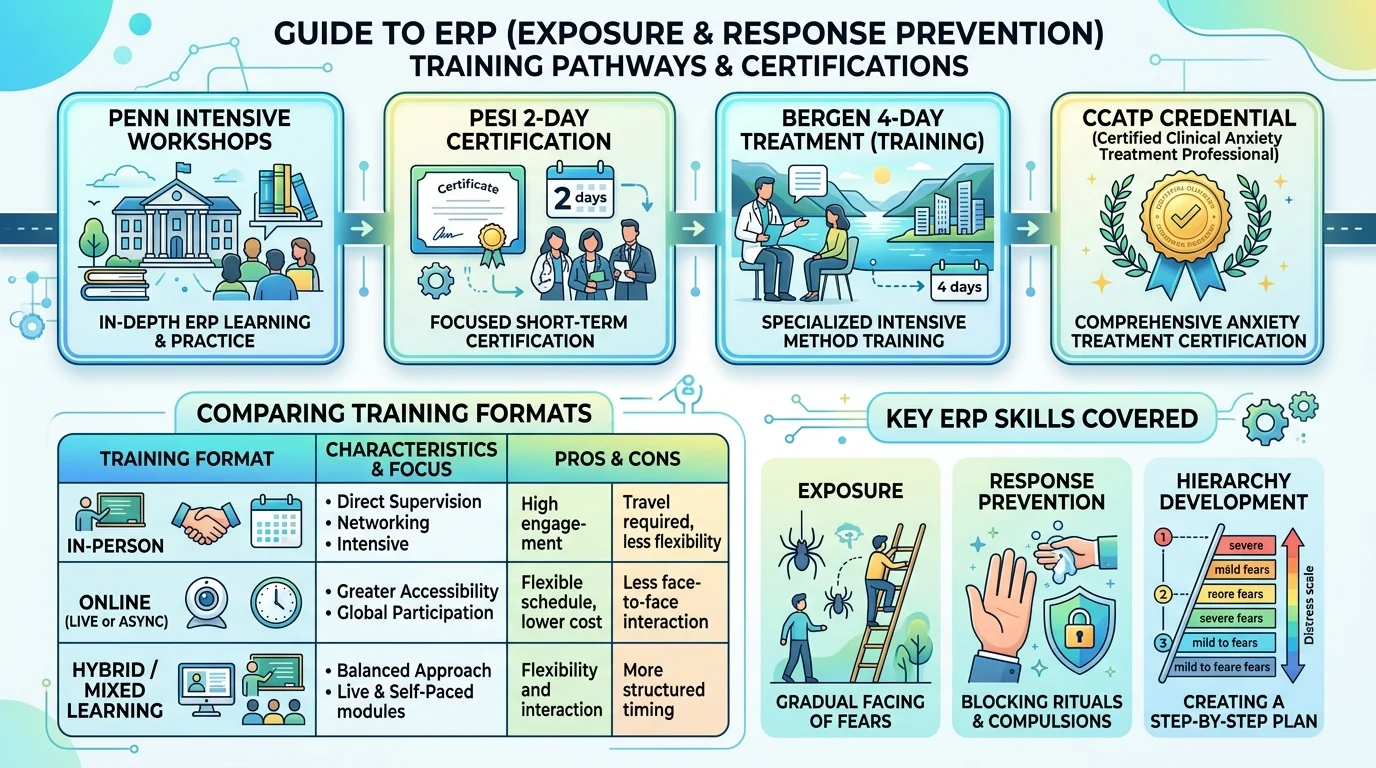
Quick Ans: Exposure and Response Prevention (ERP) training prepares mental health professionals to deliver the gold-standard treatment for obsessive-compulsive disorder (OCD). Key training options include the University of Pennsylvania’s intensive workshops (24 CE credits), PESI’s 2-day certification courses leading to CCATP credentials, and specialized programs like the Bergen 4-Day Treatment. ERP training covers exposure hierarchies, response prevention strategies, imaginal and in vivo techniques, and treatment planning. Research shows trained providers significantly improve OCD diagnosis and treatment outcomes.
Obsessive-compulsive disorder affects millions worldwide, yet many patients never receive the treatment with the strongest evidence base. That treatment is Exposure and Response Prevention, or ERP. The problem isn’t the therapy itself. The problem is that too few clinicians are trained to deliver it.
ERP training bridges that gap. It equips therapists with the skills to guide patients through facing their fears without performing rituals. The approach sounds simple, but effective delivery requires structured training, supervised practice, and ongoing consultation. Research shows that a single one-hour educational program can significantly improve providers’ knowledge, attitudes, and confidence in using ERP.
Whether you’re a psychologist, counselor, social worker, or student, understanding ERP training pathways opens doors to treating one of the most misunderstood conditions in mental health. This guide covers the major training programs, what they teach, and how to choose the right path for your career.
What Is ERP Training?
1. A Specialized Clinical Skill Set
ERP training teaches clinicians to deliver Exposure and Response Prevention, the first-line psychotherapy for OCD.
2. Rooted in Cognitive Behavioral Therapy
ERP is a form of CBT that uses structure and goal setting to guide treatment.
3. Focuses on Breaking the OCD Cycle
Training covers how to help patients face obsessions without engaging in compulsions.
4. Includes Assessment and Treatment Planning
Clinicians learn to assess OCD symptoms and build exposure hierarchies.
5. Teaches Exposure Techniques
Training covers both in vivo (real-life) and imaginal exposure methods.
6. Emphasizes Response Prevention
Clinicians learn to guide patients in resisting rituals and avoidance behaviors.
7. Requires Supervised Practice
Effective training includes consultation and supervision during initial cases.
8. Covers Treatment Planning
Training addresses how to develop fear hierarchies and pace exposures appropriately.
9. Addresses Cultural Considerations
Modern training includes diversity and cultural adaptation components.
10. Offers Continuing Education Credits
Most programs provide CE credits for licensed professionals.
11. Available in Multiple Formats
Training ranges from online courses to intensive in-person workshops.
12. Leads to Certification Options
Some programs offer certification like CCATP through Evergreen Certifications.
13. Builds Confidence in Treating Anxiety
Training helps clinicians manage their own anxiety about treating anxious clients.
14. Covers Co-Occurring Conditions
Training addresses OCD alongside depression, anxiety, and other disorders.
15. Prepares for Diverse Treatment Settings
Skills apply to outpatient, intensive outpatient, and inpatient settings.
Major ERP Training Programs
1. University of Pennsylvania Intensive Workshop
The Center for Treatment and Study of Anxiety offers a multi-day intensive workshop covering ERP for OCD.
2. 24 CE Credits Available
Participants receive 24 continuing education credits for professional counselors, marriage and family therapists, and clinical social workers.
3. Led by Expert Presenters
Workshops are taught by licensed clinical psychologists with specialization in OCD, PTSD, and anxiety disorders.
4. PESI 2-Day Anxiety Certification Course
PESI offers a 2-day certificate course integrating CBT and ERP for anxiety, OCD, and related conditions.
5. Leads to CCATP Certification
Upon completion, participants are eligible for Certified Clinical Anxiety Treatment Professional (CCATP) certification.
6. Covers Multiple Anxiety Disorders
Training addresses GAD, panic disorder, OCD, social anxiety, and phobias.
7. Includes Video and Case Examples
Participants learn through demonstration and practical application.
8. Bergen 4-Day Treatment Training
This concentrated Norwegian model delivers ERP over four consecutive days.
9. Proven Effective in Iceland
A study of 86 patients showed 94.9% response rate post-treatment and 68% remission.
10. IOCDF Training Programs
The International OCD Foundation supports training initiatives globally, including programs in Pakistan.
11. Online Group Consultation
Penn’s CTSA offers online group consultation for exposure therapy.
12. Pediatric OCD Training
Specialized workshops address ERP for children and adolescents.
13. Imaginal Exposure Mastery
Advanced workshops focus on writing effective imaginal exposure scripts.
14. Prolonged Exposure Consultant Training
Separate training prepares consultants in PE for PTSD, complementing ERP skills.
15. Global Training Initiatives
Programs have been delivered in Pakistan, Iceland, and other countries to expand access.
What ERP Training Covers
1. Understanding OCD Psychopathology
Training begins with the mechanisms that maintain obsessions and compulsions.
2. Assessment Tools
Clinicians learn to use instruments like the Yale-Brown Obsessive-Compulsive Scale (Y-BOCS).
3. Fear Hierarchy Development
Training covers how to build a list of feared situations from mild to severe.
4. In Vivo Exposure Techniques
Clinicians learn to guide real-life exposure to feared stimuli.
5. Imaginal Exposure Methods
Training covers guided visualization of feared scenarios.
6. Response Prevention Strategies
Techniques for helping patients resist compulsions.
7. Processing Exposure Experiences
How to debrief after exposures and reinforce learning.
8. Managing Anxiety During Sessions
Skills for helping patients tolerate distress without rituals.
9. Between-Session Homework
Training covers assigning and reviewing home practice.
10. Relapse Prevention
Strategies for maintaining gains and handling setbacks.
11. Covert Compulsion Identification
Training addresses mental rituals that aren’t observable.
12. Taboo Obsessional Content
Clinicians learn to identify and treat taboo obsessions.
13. Treatment Planning
How to structure a course of ERP from assessment to discharge.
14. Handling Treatment Resistance
Strategies for patients who struggle with exposures.
15. Cultural Adaptations
Training includes how to adapt ERP for diverse populations.
Certification and Credentials
1. CCATP Certification
The Certified Clinical Anxiety Treatment Professional credential is available through Evergreen Certifications.
2. No Hidden Fees
PESI covers the application fee for CCATP certification.
3. Professional Standards Apply
Certification requires meeting specific professional requirements.
4. Application Process
Complete the training and post-event evaluation to apply.
5. Certificate Timeline
Attendees receive CCATP documentation 4-6 weeks after completion.
6. SLPs Qualify for CAIP
Speech-language pathologists qualify for Certified Anxiety-Informed Professional certification instead.
7. IOCDF Certificate of Completion
Global training programs provide certificates upon successful completion.
8. CE Credits for Licensure
Many programs offer CE credits accepted for license renewal.
9. Continuing Education Requirements
Participants must attend all hours and complete evaluations.
10. No Late Arrivals Policy
CE credit requires full attendance with no early departures.
11. Certification Demonstrates Expertise
Credentials signal to employers and clients that you’ve invested in specialized training.
12. Professional Standards Verification
Evergreen Certifications verifies professional requirements before issuing credentials.
13. Multiple Certifying Bodies
Different organizations offer varying levels of certification and recognition.
14. Maintenance Requirements
Certifications may require ongoing education for renewal.
15. Career Advancement
Certification can expand referral networks and practice opportunities.
Training Formats and Delivery
1. In-Person Intensive Workshops
Multi-day workshops provide immersive training with live practice.
2. Online Self-Study Courses
Self-paced options allow flexible learning for busy professionals.
3. Live Webinar Training
Interactive online sessions combine instruction with real-time discussion.
4. Group Consultation
Ongoing group supervision supports skill development after initial training.
5. Individual Supervision
One-on-one consultation provides personalized feedback.
6. Hybrid Programs
Combined online didactic and in-person practice components.
7. Concentrated Formats
Bergen 4-Day Treatment trains providers in intensive delivery models.
8. Pediatric Specialization
Dedicated workshops address ERP for children and adolescents.
9. Advanced Mastery Courses
Follow-up training deepens skills in specific areas like imaginal exposure.
10. Global Online Training
Programs reach international participants via video conferencing.
11. Case-Based Learning
Training includes working through actual patient cases.
12. Demonstration Sessions
Live or recorded demonstrations show ERP techniques in action.
13. Practice Opportunities
Participants practice skills in supervised settings.
14. Resource Libraries
Training programs provide manuals, scripts, and treatment tools.
15. Ongoing Alumni Networks
Many programs maintain communities for continued learning.
Effectiveness of ERP Training
1. Single Session Improves Knowledge
A one-hour educational program significantly improved provider knowledge, attitudes, and confidence.
2. Better OCD Identification
Training helps clinicians recognize OCD, including taboo and covert presentations.
3. Increased ERP Utilization
Trained providers report using ERP more frequently and correctly.
4. Improved Patient Outcomes
Effective ERP training translates to better symptom reduction for patients.
5. Network Integration
Successful ERP changes OCD symptom networks toward more integrated patterns.
6. High Response Rates
Studies show over 6 in 10 patients experience fewer OCD symptoms after ERP.
7. Remission Achievable
More than 3 in 10 patients become fully symptom-free after completing ERP.
8. Bergen 4-Day Results
94.9% response rate and 68% remission in Icelandic implementation.
9. Long-Term Maintenance
Majority show improvement maintained 2-3 years post-treatment.
10. Cost-Effective Intervention
Brief educational programs show promise as simple, cost-effective solutions.
11. Addresses Treatment Gap
Training expands the pool of providers able to deliver evidence-based OCD care.
12. Cultural Adaptation Success
Training programs in Pakistan demonstrated positive results in diverse settings.
13. Provider Confidence Growth
Clinicians report increased comfort diagnosing OCD and using ERP.
14. Behavior Change
Most participants indicate they will change how they assess and treat OCD.
15. Global Dissemination
Training initiatives continue expanding access worldwide.
Who Should Pursue ERP Training?
1. Licensed Psychologists
Clinical and counseling psychologists benefit from specialized OCD training.
2. Clinical Social Workers
LCSWs and LICSWs can integrate ERP into their practice.
3. Licensed Professional Counselors
LPCs can enhance their anxiety treatment skills.
4. Marriage and Family Therapists
LMFTs can use ERP with individual clients presenting OCD.
5. Psychiatric Nurse Practitioners
PMHNPs can incorporate ERP into medication management practices.
6. Psychiatry Residents
Medical training programs increasingly include ERP exposure.
7. Graduate Students
Doctoral and master’s students in clinical psychology, counseling, and social work.
8. Interns and Postdocs
Pre-licensure trainees building specialized skills.
9. School Psychologists
Professionals supporting students with OCD in educational settings.
10. Behavioral Health Agencies
Organizations seeking to build internal ERP capacity.
11. Community Mental Health Providers
Clinicians serving underserved populations with limited OCD access.
12. Private Practice Clinicians
Therapists wanting to expand their referral base.
13. Anxiety Specialists
Providers focusing exclusively on anxiety and related disorders.
14. OCD Treatment Centers
Staff at specialized clinics requiring advanced training.
15. International Clinicians
Global providers seeking evidence-based training, as demonstrated in Pakistan.
Frequently Asked Questions
What is Exposure and Response Prevention (ERP)?
ERP is a form of cognitive behavioral therapy where patients face fear triggers without performing rituals. It’s the gold-standard treatment for OCD.
What does ERP training involve?
Training covers OCD assessment, exposure techniques, response prevention strategies, treatment planning, and supervised practice.
How long does ERP training take?
Programs range from 2-day intensives to multi-week workshops. Penn’s intensive is 4 days; PESI offers 2-day certification courses.
What credentials can I earn?
The main credential is CCATP (Certified Clinical Anxiety Treatment Professional) through Evergreen Certifications.
Is ERP training available online?
Yes. Penn offers online group consultation, and PESI provides self-study options. Global training programs have been delivered via video conferencing.
How much does ERP training cost?
Costs vary by program. PESI covers the CCATP application fee (a $99.99 value). Contact specific programs for current pricing.
Do I need a license to take ERP training?
Most programs are designed for licensed or license-eligible mental health professionals. Some accept graduate students.
Can ERP be used for other conditions?
While primarily for OCD, ERP principles apply to anxiety disorders, phobias, and related conditions.
How effective is ERP?
Studies show over 60% of patients experience fewer symptoms, and over 30% become symptom-free. Bergen 4-Day showed 94.9% response rate.
What is the Bergen 4-Day Treatment?
A concentrated ERP format delivered over four consecutive days, with strong evidence from Norway and Iceland.
Do I need supervision after training?
Yes. Effective ERP delivery typically requires consultation or supervision during initial cases.
Is ERP training available in Pakistan?
Yes. Training programs have been delivered in Karachi, and local clinics like The Meeting Matters offer ERP.
What is the difference between ERP and PE?
ERP treats OCD. Prolonged Exposure (PE) treats PTSD. Both are exposure-based therapies with separate training pathways.
Conclusion
ERP training is more than professional development. It’s a pathway to delivering one of the most effective treatments in mental health. For the millions living with OCD, trained clinicians represent the difference between years of struggle and a life reclaimed from fear.
The training landscape offers options for every career stage and learning preference. Penn’s intensive workshops provide deep, structured immersion. PESI’s certification courses deliver practical skills with a clear credential. The Bergen 4-Day model offers a concentrated format with remarkable outcomes. And global initiatives continue expanding access to places where OCD treatment was once unavailable.
The research is clear: training works. A single educational session improves provider knowledge and confidence. Structured programs produce clinicians who correctly diagnose OCD, use ERP effectively, and change lives. If you’re a mental health professional considering specialization, ERP training deserves your attention. The demand is high, the evidence is strong, and the impact is lasting. Share this guide with a colleague who might benefit, and take the first step toward becoming part of the solution.
Discover More:
- Response Prompts ABA: Complete Guide for 2026
- Hypersexuality Trauma Response: Complete Guide for 2026

1 thought on “Exposure and Response Prevention Training: Complete Guide for 2026”