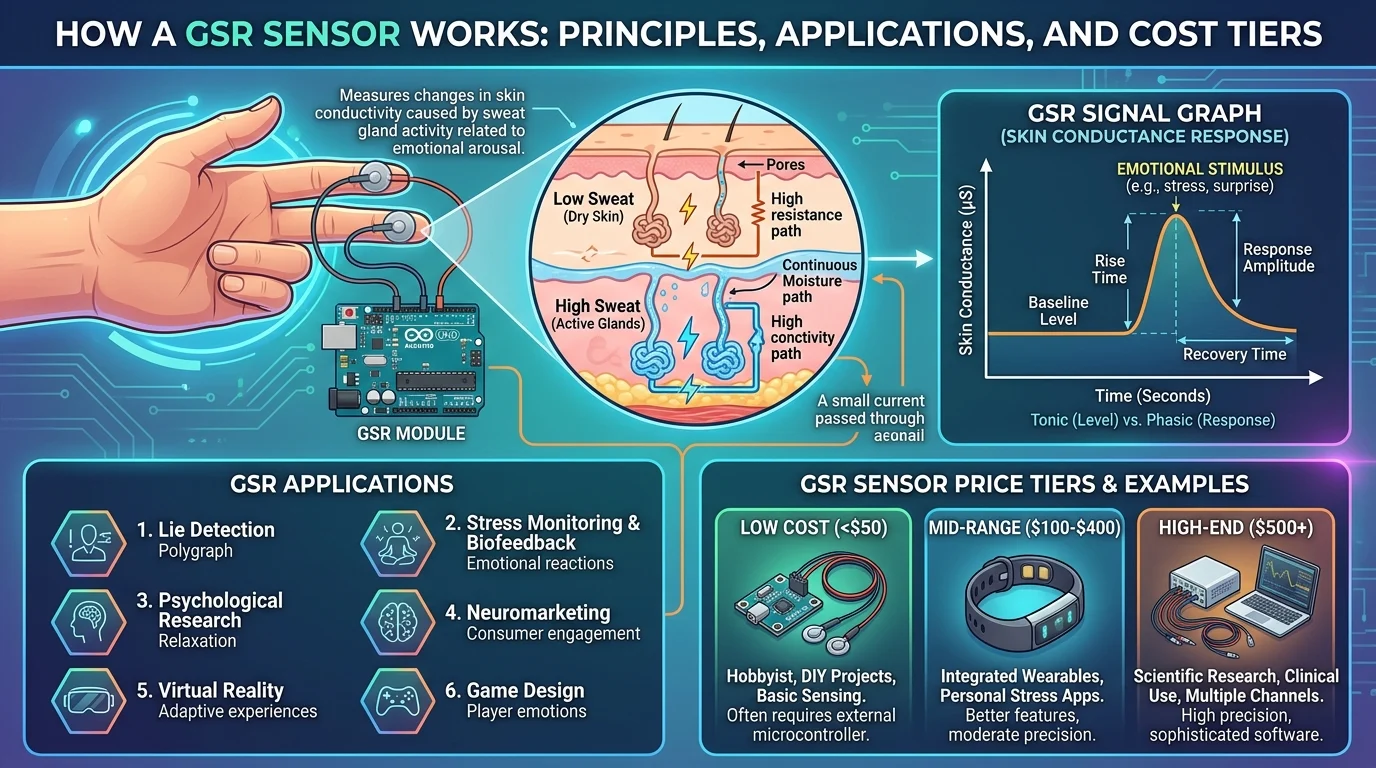
Quick Ans: A galvanic skin response (GSR) sensor measures changes in skin conductance caused by sweat gland activity, reflecting emotional arousal and sympathetic nervous system activation. Key facts: GSR sensors use two electrodes placed on fingers or palms, detect responses 0.8 to 4 seconds after stimulation, and cost between €150 for entry-level models to over €10,000 for clinical systems. Common applications include stress detection, lie detection, human-computer interaction, and biofeedback therapy.
Your skin is talking. Every time you feel nervous, excited, or scared, your sweat glands respond. A galvanic skin response sensor picks up those tiny changes and turns them into data you can see, measure, and analyze.
A GSR sensor measures the electrical conductance of your skin, which changes when sweat glands activate in response to emotional or physiological arousal . This isn’t about lying or telling the truth. It’s about measuring the intensity of your body’s response to stimulation, whether that’s a sudden noise, a stressful question, or an exciting video game moment.
The technology has been around for decades, but recent advances have made GSR sensors smaller, cheaper, and more accessible than ever. You can now build a basic GSR sensor for under $10 using an Arduino board and a few components . Or you can invest in research-grade equipment that costs thousands. Understanding how these sensors work helps you choose the right tool for your needs, whether you’re a researcher, developer, therapist, or curious tinkerer.
What Is a Galvanic Skin Response Sensor?
1. A Measure of Skin Conductance
A GSR sensor measures the electrical conductance of the skin, which changes based on sweat gland activity .
2. Also Called Electrodermal Activity (EDA)
GSR is part of a broader category called electrodermal activity, which includes skin conductance response (SCR) and skin resistance response (SRR) .
3. A Window Into the Sympathetic Nervous System
GSR reflects sympathetic nervous system activation, the branch responsible for your fight-or-flight response .
4. Not a Lie Detector
GSR measures arousal, not deception. It shows intensity but not valence, meaning it can’t tell if you’re excited or scared .
5. A Physiological Signal, Not a Psychological One
The sensor measures physical sweat response. Interpreting what that response means requires context and often other measures .
6. Two Electrodes, One Circuit
A basic GSR sensor uses two electrodes placed on the skin to create a circuit. A tiny current passes between them, and the sensor measures how easily it flows .
7. Placement Matters
Electrodes are typically placed on the fingers or palms because those areas have the highest concentration of sweat glands .
8. Response Time Is Fast
Skin conductance changes occur 0.8 to 4 seconds after a stimulus, making GSR useful for real-time applications .
9. Both Tonic and Phasic Components
GSR has a slowly changing baseline level (tonic) and rapid responses to stimuli (phasic) .
10. Used Across Many Fields
Applications include psychology research, human-computer interaction, game design, stress monitoring, and biofeedback therapy .
11. Available at Every Price Point
Entry-level sensors start around €150, research-grade devices cost €500 to €2,000, and clinical systems exceed €2,000 .
12. Wearable and Mobile Options Exist
Modern GSR sensors can be integrated into wearables, smart garments, and even mobile phones .
How GSR Sensors Work
1. The Basic Principle
GSR sensors apply a small electrical potential between two electrodes and measure how much current flows through the skin .
2. Sweat Glands Are the Key
Eccrine sweat glands, concentrated on palms and fingers, respond to emotional stimuli by secreting sweat .
3. More Sweat Means More Conductance
When sweat glands activate, skin conductance increases because sweat contains electrolytes that conduct electricity .
4. The Sympathetic Connection
These sweat glands are controlled by the sympathetic nervous system, which activates during emotional arousal .
5. Exosomatic vs. Endosomatic
Exosomatic GSR applies an external current and measures conductance. Endosomatic GSR measures the skin’s natural electrical potential without external current .
6. Signal Components
The GSR signal has a tonic level (skin conductance level, SCL) and phasic responses (skin conductance responses, SCRs) .
7. The SCR Waveform
A skin conductance response rises quickly, peaks, and then recovers more slowly. The rise time is shorter than the recovery time .
8. Amplitude and Duration Matter
Proper analysis of SCR data should incorporate both the amplitude and duration of the response, not just the peak .
9. Integrated SCR (ISCR)
A more accurate method called integrated SCR calculates the area under the curve, capturing both amplitude and duration .
10. Common Analysis Mistakes
Many researchers use simple mean change scores or sum of amplitudes, which are considered arbitrary and inaccurate .
11. Signal Filtering Is Essential
Environmental noise and material characteristics can create variations. Preprocessing rules like the sigma rule help identify meaningful peaks .
12. The Sigma Rule for Peak Detection
A common method defines outliers as measurements exceeding the mean plus 3 standard deviations within a sliding window .
Types of GSR Sensors
1. Finger Electrode Sensors
The most common type, using two finger bands with conductive electrodes placed against the skin .
2. Dry Electrode Sensors
Textile-based dry electrodes are increasingly used in wearable applications, offering comfort and long-term monitoring .
3. Wireless Sensors
Bluetooth-enabled sensors like the Shimmer3 GSR+ allow untethered data collection .
4. Mobile Phone-Based Sensors
Low-cost prototypes use a phone’s audio jack to send signals and measure conductance changes .
5. Integrated Wearable Devices
GSR sensors are integrated into smartwatches, fitness trackers, and IoT-based health monitoring devices .
6. Textile Electrodes for Smart Garments
Conductive yarns stitched, knitted, or embroidered into fabric create electrodes for continuous monitoring during sports and daily activities .
7. Clinical-Grade Devices
Systems like the BIOPAC EDA/GSR module offer high-precision measurements for research and clinical use .
8. Educational Kits
NeuLog and similar brands provide GSR sensors designed for classroom experiments and teaching .
9. DIY Arduino Sensors
Simple prototypes using Arduino, a resistor, and metal conductors cost under $10 and work for basic experiments .
10. Human Interface Devices
GSR sensors are being integrated into computer mice and trackpads for stress detection during work .
Key Applications
1. Stress Detection and Monitoring
GSR is widely used to detect psychological stress in real-time, with systems designed for personal early detection .
2. Human-Computer Interaction
Researchers use GSR to time interruptions during periods of increasing arousal and to assess user experience .
3. Game Design and Player Experience
GSR signals correlate with self-reported arousal in games, helping designers understand player engagement .
4. Lie Detection and Polygraphs
GSR is a key component of polygraph tests, though it measures arousal rather than deception .
5. Biofeedback Therapy
GSR biofeedback helps individuals learn to recognize and control their physiological stress responses .
6. Virtual Reality Exposure Therapy
VRET uses GSR to monitor patient responses during controlled exposure to feared stimuli .
7. Mental Health Research
GSR is used to study emotional responses, anxiety, and stress-related conditions .
8. Sports and Performance
Intelligent garments with GSR sensors monitor athletes during intensive training .
9. Collaborative Settings
GSR can support sensing human emotions during collaboration, with video chat participants seeing each other’s emotional status .
10. Mobile Health Applications
Mobile GSR sensors are used for inferring human emotions in mental health contexts .
How to Choose a GSR Sensor
1. Define Your Budget First
Entry-level: €150–€499. Research-ready: €500–€2,000. Clinical-grade: €2,000+ .
2. Consider Your Application
Teaching and simple studies need less precision than clinical research .
3. Check Connectivity Options
Wireless and Bluetooth sensors cost more but offer freedom of movement .
4. Evaluate Software Compatibility
Some sensors integrate with platforms like iMotions for comprehensive analysis .
5. Factor in Accessories
Electrodes, straps, and extended warranties add to the total cost .
6. Look at Sample Rate
Higher sample rates capture faster responses. The NeuLog sensor offers up to 100 S/sec .
7. Check Measurement Modes
Some sensors offer both absolute conductivity (µS) and arbitrary units for relative changes .
8. Consider Wearability
For long-term monitoring, textile dry electrodes and wearable designs are more comfortable .
9. Assess Signal Quality
Research-grade devices provide more stable signals with better signal-to-noise ratios .
10. Read the Reviews
User experiences reveal real-world performance and reliability .
Frequently Asked Questions
What is a galvanic skin response sensor?
A GSR sensor measures skin conductance, which changes when sweat glands activate in response to emotional or physiological arousal .
How does a GSR sensor work?
It applies a small current between two electrodes on the skin and measures how easily electricity flows. More sweat means more conductance .
Where do you place GSR electrodes?
On the fingers or palms, because those areas have the highest concentration of sweat glands .
How fast does GSR respond?
Skin conductance changes occur 0.8 to 4 seconds after a stimulus .
Is GSR the same as a lie detector?
No. GSR measures arousal, not deception. It’s one component of polygraph tests but cannot detect lies on its own .
How much does a GSR sensor cost?
Entry-level sensors start around €150. Research-grade devices cost €500 to €2,000. Clinical systems exceed €2,000 .
Can I build a GSR sensor myself?
Yes. A basic Arduino-based GSR sensor can be built for under $10 using a resistor, metal conductors, and an Arduino board .
What is the difference between tonic and phasic GSR?
Tonic is the slowly changing baseline level. Phasic is the rapid response to a specific stimulus .
Can GSR tell if I’m happy or sad?
No. GSR shows arousal intensity but not valence, meaning it can’t distinguish positive from negative emotions .
What is the sigma rule in GSR analysis?
A method for identifying meaningful peaks by flagging measurements that exceed the mean plus 3 standard deviations .
Can GSR sensors be worn during sports?
Yes. Textile dry electrodes and smart garments enable GSR monitoring during physical activity .
What is electrodermal activity (EDA)?
EDA is the broader term for changes in skin electrical properties. GSR is a type of EDA measurement .
Conclusion
Galvanic skin response sensors open a window into the body’s emotional responses. By measuring skin conductance, they reveal the intensity of sympathetic nervous system activation, giving researchers, developers, and therapists a real-time signal of arousal and stress. The technology has become remarkably accessible, from DIY Arduino prototypes costing under $10 to research-grade wireless systems.
Understanding what GSR can and cannot tell you is essential. It measures intensity, not valence. It shows arousal, not emotion. Proper analysis requires attention to both amplitude and duration, and pairing GSR with other measures provides a fuller picture. Whether you’re building a stress-detection system, studying user experience, or exploring biofeedback, GSR sensors offer a practical, non-invasive way to measure the body’s response to the world.
Discover More:
- Sabrina Carpenter White House Response: The Full Story Behind the Controversy 2026
- Exposure and Response Prevention Training: Complete Guide for 2026

1 thought on “Galvanic Skin Response Sensor: Complete Guide for 2026”