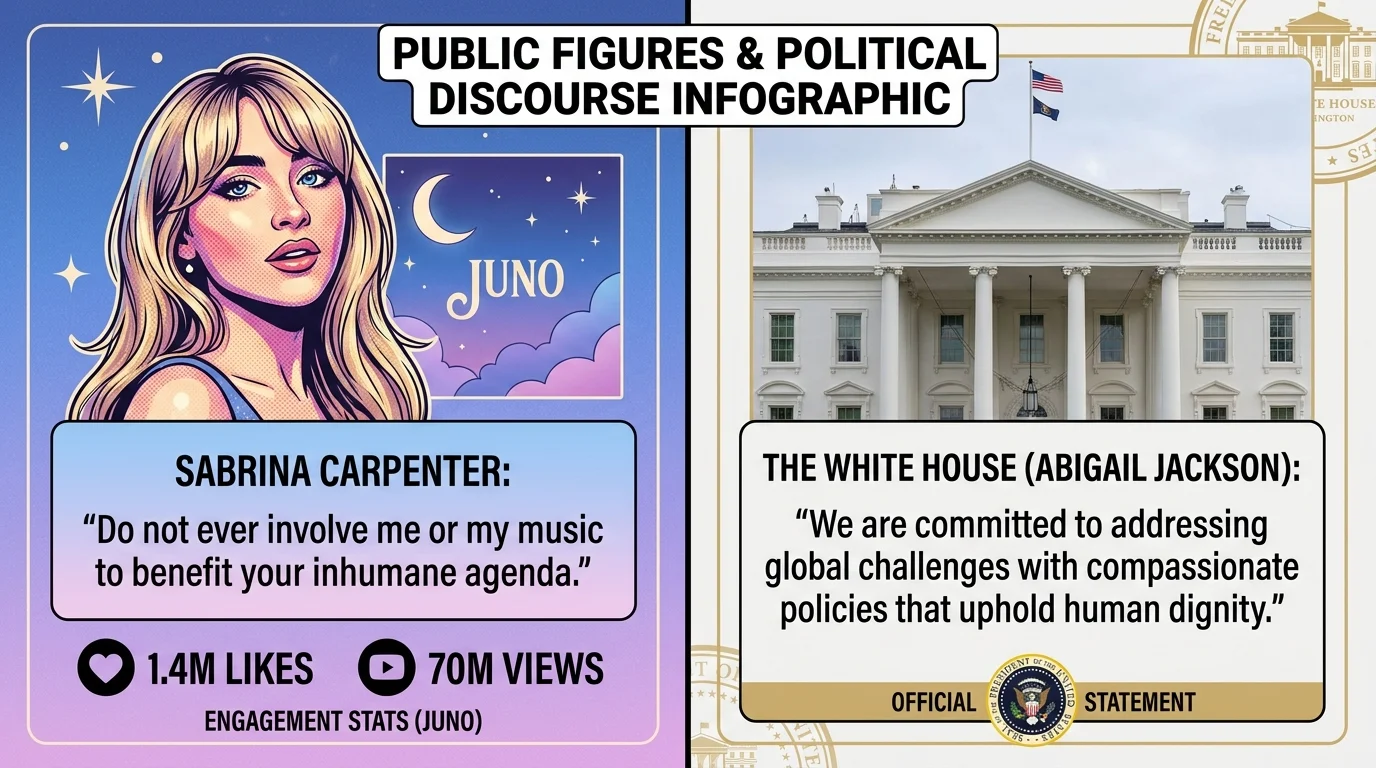
Quick Ans: Sabrina Carpenter condemned the White House for using her song “Juno” in an ICE deportation video, calling it “evil and disgusting” . The White House responded with a statement defending the deportations and insulting anyone who would oppose them . This sparked a larger debate about artists’ rights and government use of copyrighted music without permission .
Imagine scrolling through social media and suddenly seeing your own song being used to promote a political agenda you completely disagree with. That’s exactly what happened to pop star Sabrina Carpenter in December 2025 when the White House used her hit track “Juno” in a video promoting ICE deportations .
Carpenter wasn’t just upset about her music being used without permission. She was horrified by the content of the video itself, which showed agents detaining and arresting immigrants . Her reaction was swift and direct – she took to social media to make her feelings crystal clear. But what happened next caught everyone’s attention.
This wasn’t just another celebrity complaining about unauthorized music use. The White House didn’t apologize or back down. Instead, they fired back with a response that was just as pointed as Carpenter’s original statement . Let’s break down everything that happened, including all the key responses and what they mean for artists and the government.
What Actually Happened
1. The White House Video Appeared on Social Media
On December 1, 2025, the White House posted a video on X (formerly Twitter) and TikTok showing ICE agents detaining immigrants .
2. Sabrina Carpenter’s Song “Juno” Was Used as Soundtrack
The video featured Carpenter’s hit song without her permission or knowledge .
3. The Caption Referenced Her Lyrics
The White House wrote “Have you ever tried this one? Bye-bye” – a direct reference to “Juno” lyrics .
4. The Video Showed Enforcement Actions
The footage included agents chasing individuals, carrying out handcuffing operations, and detaining people .
5. Carpenter Responded Immediately
She posted on X: “This video is evil and disgusting. Do not ever involve me or my music to benefit your inhumane agenda” .
6. The White House Fired Back
Spokeswoman Abigail Jackson responded: “Here’s a Short n’ Sweet message for Sabrina Carpenter: we won’t apologize for deporting dangerous criminal illegal murderers, rapists, and pedophiles from our country” .
7. Jackson’s Response Got Personal
She added: “Anyone who would defend these sick monsters must be foolish, or is it slow?” .
8. Carpenter Became Part of a Larger Pattern
She joined other artists like Jess Glynne who had their music used in similar deportation videos .
9. Legal Experts Weighed In
Legal experts noted that artists have a legal basis to oppose unauthorized political use of their music, but the government enjoys sovereign immunity protection .
10. The Video Was Eventually Removed
The video was taken down, but Carpenter’s legal options remain limited due to government protections .
Sabrina Carpenter’s Response
1. “This video is evil and disgusting”
Carpenter’s initial response was brief but powerful, calling out the content and the message behind it .
2. “Do not ever involve me or my music to benefit your inhumane agenda”
She drew a clear line, stating she wanted no association with the White House’s immigration policies .
3. No Wording About Permission or Copyright
Her focus was on the moral dimension, not the legal side of music usage .
4. Her Fans Amplified the Message
Carpenter’s fanbase shared her response widely, creating additional pressure on the White House .
5. She Linked the Video to Her Values
By calling the agenda “inhumane,” she connected her music to her personal beliefs and public image .
6. She Didn’t Address the White House’s Response
After the initial exchange, Carpenter didn’t engage further with the White House’s counter-statement .
7. The Response Positioned Her Alongside Other Artists
Her reaction mirrored those of other musicians who have protested similar usage in deportation videos .
8. She Used Social Media as Her Platform
Carpenter chose X to deliver her response, reaching millions of followers directly .
9. The Response Protected Her Brand
By distancing herself from the video, she preserved her reputation with fans who oppose the administration’s policies .
10. She Maintained Her Artistic Integrity
Her response showed she wouldn’t let her work be co-opted for causes she doesn’t support .
The White House Response
1. “Here’s a Short n’ Sweet message for Sabrina Carpenter”
The White House cleverly referenced her album title in their response, turning her own branding against her .
2. “We won’t apologize for deporting dangerous criminal illegal murderers, rapists, and pedophiles from our country”
This became the core of their defensive position, framing the deportations as necessary safety measures .
3. “Anyone who would defend these sick monsters must be foolish, or is it slow?”
This personal attack on Carpenter and anyone agreeing with her was particularly pointed and aggressive .
4. Spokeswoman Abigail Jackson Delivered the Message
The White House used an official spokesperson for this response, adding weight to their position .
5. The Response Emphasized Criminal Allegations
The statement repeatedly used strong language about criminals, murderers, rapists, and pedophiles to justify their actions .
6. No Acknowledgment of Copyright Concerns
The White House response completely ignored the unauthorized use of Carpenter’s music .
7. It Doubled Down Instead of Backing Down
Rather than apologize or remove the video, the administration escalated the conflict .
8. The Response Framed Carpenter as Protecting Criminals
The statement painted Carpenter as someone defending “sick monsters,” turning the debate into a moral showdown .
9. Internal Sources Claimed Intentional Provocation
Reports later emerged that White House officials intentionally used songs from anti-Trump artists to provoke backlash and amplify culture-war messaging .
10. The Video Was Still Removed Despite the Tough Talk
Despite the aggressive response, the video eventually disappeared from official channels .
Why This Matters for Artists
1. Government Sovereign Immunity Limits Legal Options
Artists cannot sue the government for injunctions to remove unauthorized content due to sovereign immunity protections .
2. Only Monetary Damages Are Possible
The only legal “remedy” for artists is filing a costly claim for monetary compensation, not removal of content .
3. Right of Publicity Claims Are Also Blocked
Artists can’t sue for unauthorized use of their likeness or image under the Federal Tort Claims Act because right of publicity claims are excluded .
4. Artists Often Rely on Public Pressure Instead
With legal options limited, artists use social media to generate public outcry and pressure platforms into removal .
5. Platforms May Remove Content Proactively
While the government can’t be forced to remove content, platforms like X and TikTok may take videos down to avoid risk .
6. A Pattern of Unauthorized Use Exists
Carpenter’s case follows similar incidents with other artists. Jess Glynne had her music used in a July 2025 deportation video . Celine Dion, Guns N’ Roses, and the Rolling Stones have also objected to political use of their music .
7. The Culture-War Strategy
Insiders suggested officials deliberately used songs from outspoken anti-Trump artists to provoke backlash and amplify their message .
8. Congressional Authorization Would Be Needed to Change This
Artists can only sue the U.S. government for monetary compensation under current law; injunctive relief is unavailable without a change to sovereign immunity rules .
9. Some Legal Paths Might Exist
The Lanham Act, the Administrative Procedure Act, or First Amendment compelled speech claims might offer alternative legal strategies, but these are not slam-dunk cases .
10. The “Bad Faith” Gap
Society and the legal system are not sufficiently prepared to deal with bad-faith actors, especially when the government acts in bad faith .
Frequently Asked Questions
Why did Sabrina Carpenter condemn the White House video?
She called the video “evil and disgusting” and said she didn’t want her music used to support what she called an “inhumane agenda” .
What was the White House response to Sabrina Carpenter?
White House spokeswoman Abigail Jackson said they won’t apologize for deporting “dangerous criminal illegal murderers, rapists, and pedophiles” and insulted anyone who would defend them .
What song did the White House use in the video?
The White House used Carpenter’s hit song “Juno” without permission as the soundtrack for an ICE deportation video .
Did the White House get permission to use the song?
No. Carpenter stated she didn’t authorize the use of her music, and there’s no indication the White House obtained permission .
Can artists stop the government from using their music?
Very difficult. The federal government is protected by sovereign immunity, so artists can’t get an injunction to force removal. They can only claim monetary damages .
Is Sabrina Carpenter the only artist this has happened to?
No. Other artists like Jess Glynne had their music used in similar deportation videos, and artists like Celine Dion and the Rolling Stones have objected to political use of their music .
What was the White House’s caption for the video?
The caption read “Have you ever tried this one? Bye-bye” – a reference to Carpenter’s “Juno” lyrics .
Was the video removed?
The video appears to have been taken down, although the White House’s aggressive response initially suggested they would stand by it .
Conclusion
The Sabrina Carpenter White House response situation highlights a growing tension between artists and the government over unauthorized music use. Carpenter took a bold stand against seeing her creative work attached to immigration enforcement policies she opposes. Her response was clear, direct, and unwilling to compromise.
The White House’s response was equally firm, doubling down on their position while completely ignoring the copyright concerns. What made this exchange particularly notable was how both sides refused to back down, turning a music usage dispute into a wider political and cultural debate.
Whether you support Carpenter’s position or the administration’s message, this incident shows how music can become a powerful weapon in political battles. Artists deserve to have their work respected, and the government should think twice before using creative works in ways their creators find objectionable. Carpenter’s willingness to speak out sends a message that even the highest office in the land must respect artistic integrity.
Discover More:
- 200+ IVR Interactive Voice Response Scripts for Every Business Scenario in 2026
- 200+ Best Habari Gani Responses for Every Situation in 2026

2 thoughts on “Sabrina Carpenter White House Response: The Full Story Behind the Controversy 2026”