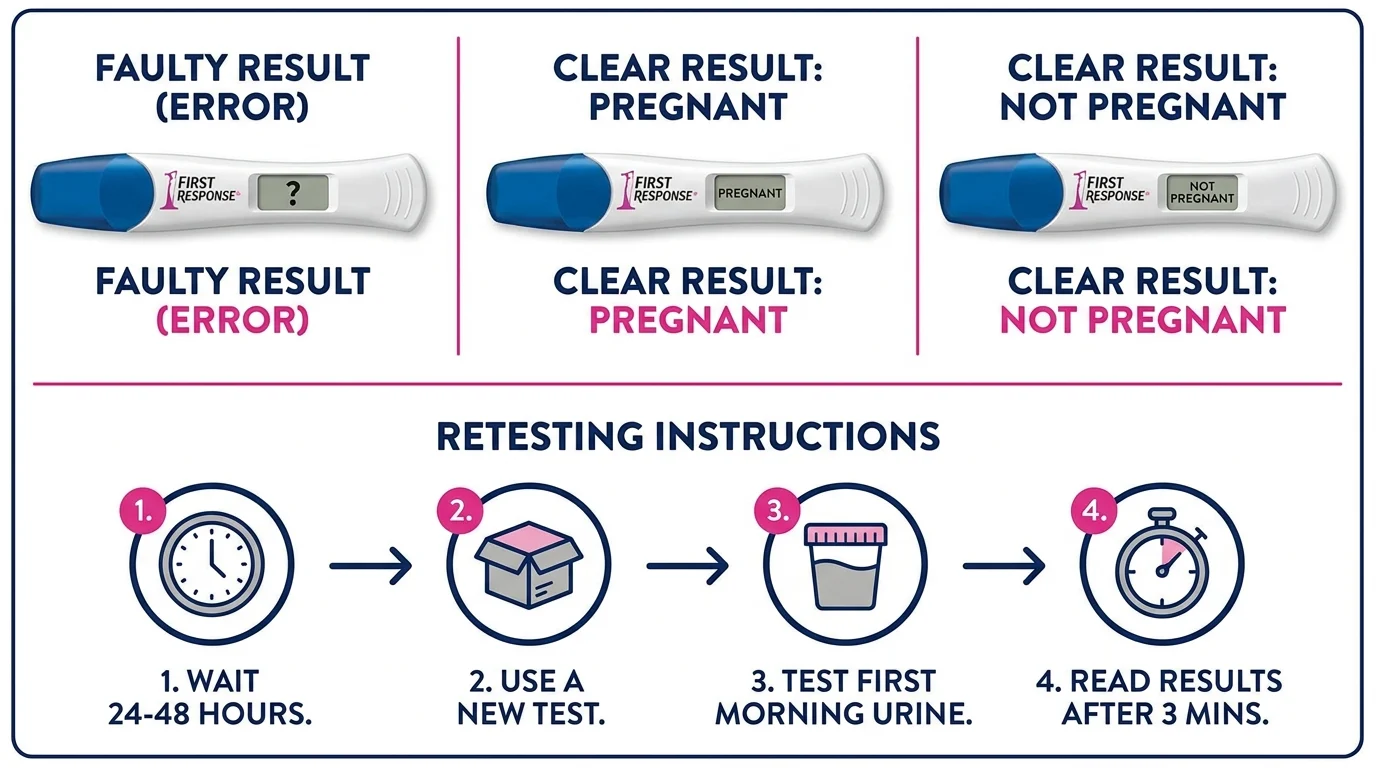
Quick Ans: Seeing a question mark on your First Response pregnancy test usually means an error occurred, not an uncertain result . Here are 5 immediate actions to take: Wait 3-5 minutes and check again, test again with first morning urine, verify the test isn’t expired, contact the First Response helpline at 1-800-367-6022, or consult your healthcare provider for a blood test.
Picture this: You’re staring at a pregnancy test, heart racing, waiting for that life-changing answer. Then instead of “Pregnant” or “Not Pregnant,” you see a question mark staring back at you. Cue the panic, confusion, and maybe a few tears. Your first response question mark moment can feel like an emotional rollercoaster you never signed up for.
Here’s the truth: that question mark isn’t your body giving mixed signals. It’s actually an error message from the test itself . Think of it like your computer’s blue screen of death – something went wrong during the testing process, and the digital display can’t give you a valid result.
Whether you’re hoping for a positive, praying for a negative, or just wanting clarity, that little symbol can trigger some big feelings. Understanding what it means and what to do next can save you from unnecessary stress. Let’s break down exactly what’s happening and how to handle it.
What That Question Mark Actually Means
1. It’s an Internal Error Message
The question mark appears when the test’s electronics detect a problem that prevents a valid result .
2. It Does NOT Mean “Maybe Pregnant”
That symbol is not interpreting your hormone levels as borderline .
3. The Chemical Test May Have Worked
The error often occurs in the digital translation step, not the hCG detection itself .
4. The Test Is Invalid
You cannot interpret a question mark as any type of pregnancy result .
5. Similar to a Computer Error Code
The test is literally telling you something malfunctioned .
6. Manufacturing Defects Can Cause It
Though rare, faulty electronics or low batteries in digital tests can trigger errors .
7. Expired Tests Are a Common Culprit
The chemical reagents degrade over time, leading to invalid readings .
8. Environmental Factors Matter
Heat, cold, or moisture exposure can damage the test components .
9. Digital vs. Non-Digital Are Different
Non-digital First Response tests show lines, not question marks .
10. The Test Can’t Self-Diagnose Issues
It simply signals “something went wrong” without explaining what .
Common Causes of the Question Mark Error
1. Insufficient Urine Sample
The absorbent tip must be fully saturated for the designated time (usually 5-10 seconds) .
2. Over-Saturation of the Tip
Holding the tip in urine too long can flood the internal strip and damage electronics .
3. Reading Too Early
Digital tests need the full processing time before displaying results .
4. Reading Too Late
Checking results after the time window can cause display resets or errors .
5. Using Diluted Urine
Testing later in the day after drinking fluids can interfere with proper function .
6. Expired Test Products
Always check the expiration date on the box before testing .
7. Improper Storage Conditions
Keep tests in cool, dry places away from bathroom moisture .
8. Malfunctioning Internal Circuitry
Though rare, manufacturing defects can affect digital components .
9. Low Battery in Digital Tests
Digital displays require adequate power to function correctly .
10. Damaged Absorbent Tip
Physical damage to the tip prevents proper urine absorption .
Immediate Steps After Seeing a Question Mark
1. Stay Calm and Don’t Panic
Remember this is a test error, not a medical result .
2. Check the Expiration Date
Verify your test hasn’t expired before retesting .
3. Read Instructions Carefully
Review the specific timing and usage directions for your test .
4. Test Again with First Morning Urine
Morning urine contains the highest hCG concentration for accurate results .
5. Ensure Proper Technique
Hold the absorbent tip downward while replacing the overcap .
6. Wait the Full Processing Time
Allow 3-5 minutes before reading the result window .
7. Don’t Add or Remove Urine During Testing
This can flood or under-saturate the test strip .
8. Use a Fresh Test from a New Box
If one test shows an error, try another from a different package .
9. Check the Result Window for Lines
Non-digital tests show pink lines – look for two lines or one line .
10. Contact First Response Support
Call 1-800-367-6022 for troubleshooting assistance .
Understanding First Response Test Results (Non-Digital)
1. Two Pink Lines = Pregnant
One line may be lighter than the other – any two visible lines indicate pregnancy .
2. One Pink Line = Not Pregnant
Only one line appears in the result window for a negative result .
3. Invalid Test = No Lines
If no lines appear after the designated time, the test is invalid .
4. Lines Should Appear Within 3 Minutes
Non-digital tests show results within the 3-minute window .
5. Don’t Read After 10 Minutes
Negative results should not be read after this timeframe .
6. Faint Lines Still Count
A faint second line is still a positive result .
7. Evaporation Lines Are Different
These appear after the time window and don’t indicate pregnancy .
8. First Morning Urine Is Best
This provides the highest concentration of hCG for early detection .
9. Test Can Detect 6 Days Before Missed Period
First Response claims early detection before your expected period .
10. Consult Doctor for Confirmation
All results should be confirmed by a healthcare provider .
Accuracy and Limitations of First Response Tests
1. 99% Accuracy From Expected Period Day
Laboratory studies show high accuracy rates .
2. 76% Accuracy 5 Days Before Period
Early testing has lower detection rates .
3. Some Pregnant people May Test Negative Early
hCG levels vary and may be too low for detection .
4. Miscalculated Period Dates Can Affect Results
Inaccurate timing leads to premature testing .
5. Certain Medications Can Interfere
Only medications containing hCG affect results – others like Clomid or painkillers don’t .
6. Ectopic Pregnancies May Show Positive
Test detects hCG regardless of pregnancy location .
7. Chemical Pregnancies Can Cause Positives
Early miscarriages sometimes show positive results .
8. False Positives Are Rare But Possible
Always confirm positive results with your doctor .
9. False Negatives Occur With Early Testing
Retest after missed period for more reliable results .
10. Healthcare Professional Confirmation Is Essential
Test results should never replace medical diagnosis .
Emotional Impact and Coping Strategies
1. Normalize Your Anxiety
Feeling stressed about an ambiguous result is completely valid .
2. Take Deep Breaths Before Retesting
Calm nerves help ensure proper testing technique .
3. Talk to Someone You Trust
Sharing the experience can reduce emotional burden .
4. Remember It’s an Error, Not a Diagnosis
The question mark says nothing about your pregnancy status .
5. Avoid Googling Symptoms During Uncertainty
The internet can amplify anxiety unnecessarily .
6. Give Yourself Permission to Feel All Emotions
Hope, fear, excitement, and dread can coexist .
7. Consider a Blood Test for Certainty
Doctor’s office blood tests are more definitive .
8. Wait for Clear Results Before Planning
Avoid making decisions based on ambiguous tests .
9. Understand Your Feelings Are Normal
Emotional whiplash is common during this experience .
10. Seek Support From Partner or Friend
You don’t have to navigate this alone .
Frequently Asked Questions
What does a question mark mean on a First Response test?
It’s an internal error message, not an uncertain pregnancy result .
Is a question mark the same as “maybe pregnant”?
No, the test is telling you it malfunctioned, not that it’s uncertain .
Can I interpret a question mark as a positive?
Never treat a question mark as any type of pregnancy result .
What should I do if I see a question mark?
Retest with first morning urine following instructions exactly .
Why did my First Response test show a question mark?
Common causes include insufficient urine, over-saturation, expired tests, or malfunctioning electronics .
Does the question mark mean I’m pregnant?
The question mark provides no information about pregnancy status .
Can a question mark appear from testing too early?
Testing too early can cause invalid results, but it shows as an error, not a definite answer .
Should I call my doctor about a question mark?
Contact your healthcare provider if you’re concerned or if you need a blood test for clarity .
Are digital tests more likely to show errors?
Digital tests have more components that can malfunction, including electronics and batteries .
How accurate is First Response overall?
First Response is 99% accurate from the day of your expected period .
Conclusion
Seeing a question mark on your First Response pregnancy test is undoubtedly stressful, but knowing the facts can reduce anxiety. That symbol simply means your test encountered an error – it tells you nothing about your pregnancy status .
The best approach is to stay calm, check your test’s expiration date, and retest with first morning urine following instructions carefully . If you’re still uncertain after retesting, a doctor’s visit for a blood test provides definitive answers .
Your feelings during this experience are completely valid . Whether you’re anxious, excited, or confused, give yourself space to process. When in doubt, consult your healthcare provider – they’re there to help you navigate these moments with clarity and compassion.
Discover More:
- 200+ Best Habari Gani Responses for Every Situation in 2026
- 150+ Baltimore Crisis Response Resources and Updates You Need to Know 2026

3 thoughts on “150+ Best First Response Question Mark Replies for Every Situation 2026”