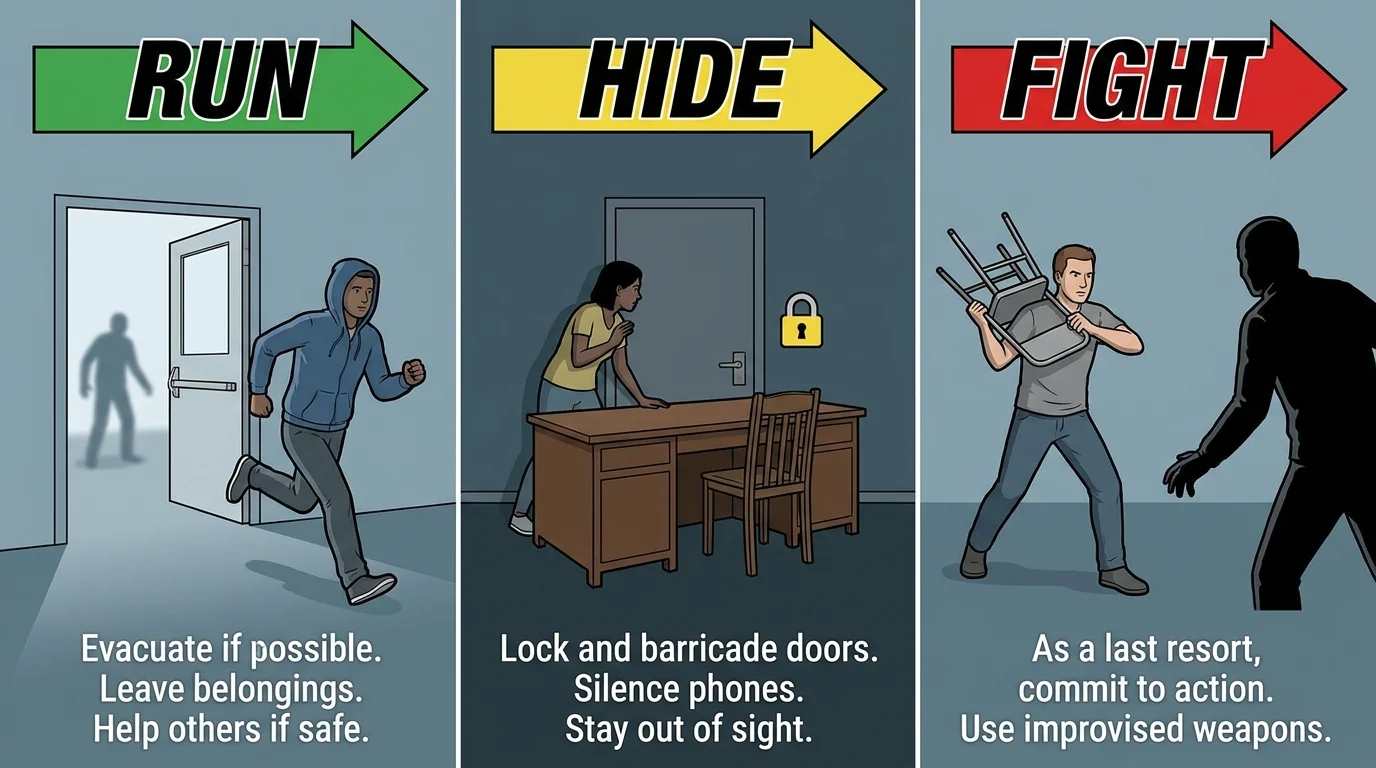
Quick Ans: A tactical response to an active shooter follows the “Run, Hide, Fight” framework developed by the Department of Homeland Security and FBI . First, RUN if a safe escape route exists, leaving belongings behind and helping others evacuate . Second, HIDE if escape isn’t possible by locking doors, barricading entry points, silencing phones, and staying out of sight . Third, FIGHT as an absolute last resort by using improvised weapons and committing to aggressive action . Call 911 only when safely away from danger and provide the shooter’s location and description .
The unthinkable happens. You hear gunshots. Your heart pounds. Your mind races. In that moment, knowing how to respond can mean the difference between life and death. According to the FBI, there were 223 active shooter incidents in the U.S. from 2020 to 2024 — that is 70% more than the previous five-year period . Active shooter situations are unpredictable and evolve rapidly, which makes having a clear, practiced response plan absolutely essential .
Whether you are in an office, school, hospital, or public space, the principles of tactical response remain consistent. The “Run, Hide, Fight” framework, endorsed by the FBI and Department of Homeland Security, provides a simple, memorable guide to survival . This isn’t about being a hero; it is about equipping yourself with the knowledge to make life-saving decisions under extreme stress. Preparation saves lives. Let’s break down exactly what to do.
Understanding the “Run, Hide, Fight” Framework
1. Developed by the FBI and DHS
The “Run, Hide, Fight” program includes videos and guidance that can initiate planning and training exercises .
2. The Standard National Model
This framework is widely adopted across the U.S. as the standard for civilian active shooter response .
3. Simple and Memorable
It is designed to be recalled even in high-adrenaline moments when panic can impair clear thinking .
4. A Prioritized Action Plan
The steps are meant to be followed in order, but they may not always occur in the same sequence .
5. Intended for Civilians
The framework is designed for individuals without tactical training .
6. Focuses on Survival
Every action is geared towards maximizing the chance of survival .
7. Recognizes Rapid Evolution
Active shooter situations change quickly, requiring constant reassessment .
8. Empowers Individuals
It provides a clear sense of agency in a chaotic situation .
9. Complements Law Enforcement Response
The framework guides civilians until police arrive .
10. Taught in Training Programs
Programs like ALICE (Alert, Lockdown, Inform, Counter, Evacuate) incorporate these principles .
11. Used by Major Universities
Institutions like NYU base their active threat preparedness on this model .
12. Not a One-Size-Fits-All Solution
The approach must be adapted to the specific environment .
13. A Lasting Legacy of Past Tragedies
The framework was refined in response to events like Columbine and Sandy Hook .
14. Subject to Ongoing Debate
Some experts question the “Fight” component, especially in school settings .
15. A Subject of Continuous Training
Regular drills help internalize the steps for quick recall .
RUN: Evacuate If Safe to Do So
1. The First and Most Critical Action
Running is the top priority if a safe escape route exists .
2. Identify Exits Immediately
Know the nearest exit routes in any building you enter .
3. Leave Belongings Behind
Do not delay to grab personal items .
4. Encourage Others to Follow
Help others evacuate if possible, but do not wait for those who refuse .
5. Create Distance, Not Just a Building
Evacuating doesn’t have to mean leaving the building. Get away to a different floor or room to create distance .
6. Go Upstairs If Needed
If going down isn’t possible, going upstairs can also be a safe option .
7. Do Not Attempt to Move the Wounded
Moving a severely injured person can worsen their condition; wait for medical professionals.
8. Keep Hands Visible
When encountering police, keep your hands visible to show you are not the threat .
9. Call 911 Only When Safe
Contact emergency services when you have reached a secure location .
10. Provide Critical Information
Tell dispatchers the shooter’s location, appearance, and the type of weapons used .
11. Run in a Zigzag Pattern (If Under Fire)
This can make you a harder target, but only if you are already being shot at .
12. Prioritize Escape Above All Else
Escaping is always the best outcome, even if it means leaving others behind .
13. Use the Buddy System Where Possible
Helping each other can improve chances of successful evacuation.
14. Know Your Surroundings
Regularly review escape routes in your workplace or school .
15. Don’t Hesitate
Preparation reduces the risk of freezing; hesitation can be deadly .
HIDE: Shelter in Place If Escape Is Impossible
1. If You Cannot Run, Hide
If escape isn’t an option, secure a hiding place .
2. Lock and Barricade Doors
Use furniture or heavy objects to block the entrance .
3. Turn Off All Lights
Darkness makes it harder for the shooter to locate you .
4. Silence Your Phone
Turn off vibrations and put your phone on silent .
5. Remain Quiet
Do not speak, cough, or make any noise that could give away your position .
6. Stay Out of the Shooter’s View
Get behind large objects like desks or filing cabinets .
7. Choose a Room with an Exit
If possible, select a room that offers an alternative escape route.
8. Lock Windows as Well
Secure all entry points, not just the doors.
9. Create a “Safe Room”
If in a workplace or school, pre-identified safe rooms can be lifesaving.
10. The Goal is to Be a “Hard Target”
Make it difficult and time-consuming for the shooter to access your location.
11. Consider the “Lockdown” Phase
This is a core part of programs like ALICE .
12. Wait for Law Enforcement to Give the All-Clear
Do not come out until police confirm it is safe .
13. Debate Over Effectiveness
Some experts argue hiding without a plan to fight can make you a “sitting duck” .
14. Use What’s Available
Barricade doors with anything heavy, like desks, chairs, or cabinets.
15. Practice Situational Awareness
The best hiding spots are usually known before a crisis begins.
FIGHT: Act as a Last Resort
1. An Absolute Last Option
Fighting is only considered when your life is in imminent danger .
2. Act Aggressively
Use full force to incapacitate the attacker .
3. Improvise Weapons
Use any available object — scissors, chairs, fire extinguishers, pens, or books — as a weapon .
4. Commit Fully
Half-hearted action is unlikely to succeed. Commit to stopping the threat .
5. Work as a Team
If possible, coordinate with others to overwhelm the shooter .
6. Aim for the Head or Eyes
If you must fight, aim for these vulnerable areas.
7. Use Distraction
Throwing objects can distract the shooter and buy time.
8. This Is Not About Being a Hero
It is about survival when all other options have failed .
9. Training Matters
Even basic self-defense training can improve your chance of success.
10. Part of the ALICE Model
“Counter” or “Fight” is a recognized component of active shooter training .
11. Overcome the Freeze Response
Training helps overcome the natural panic response .
12. Surprise is Your Ally
An unexpected, aggressive response can disorient the attacker.
13. Do Not Negotiate
The goal is to stop the attacker through force, not conversation.
14. Use Environmental Objects
Anything from a hot coffee cup to a heavy stapler can be used.
15. Last Resort Only
Always try to run or hide before considering this option .
Advanced Tactical Considerations
1. Situational Awareness
Maintaining awareness of your surroundings is the first line of defense .
2. Alert Systems and Technology
Multi-modal emergency alerts can notify occupants instantly, enabling faster response .
3. Panic Button Integration
Systems like Rave Alert allow users to report an incident immediately without searching for a phone number .
4. Collaboration with Law Enforcement
Sharing floor plans and live video with 9-1-1 helps first responders locate the threat quickly .
5. The “Enter, Evaluate, Evacuate” Model
This 3-phase approach (3 Echo) guides the initial response for first responders and victims .
6. ALERRT Training for First Responders
The ALERRT Level 1 course prepares law enforcement to isolate, distract, and neutralize the shooter .
7. Incident Command Structure
Effective response requires coordination between police, fire, and EMS .
8. Rescue Task Forces
Integrated teams of law enforcement and EMS enter the warm zone to extract the wounded .
9. Addressing the “Clock”
Survival depends on rapid treatment; “stage down the street” is no longer acceptable .
10. Post-Engagement Priorities
After the shooter is neutralized, focus shifts to triage and evacuation .
11. Improvised Explosive Devices (IEDs)
Training often includes awareness of secondary devices .
12. Overcoming Hesitation
Preparation and drills are crucial to reducing hesitation during an event .
13. Multi-Disciplinary Training
Collaboration between EMS, fire, and law enforcement optimizes performance .
14. Environmental Design
Access control and video security are critical preventive measures .
15. The Role of Employers
Employers play a vital role by offering training, conducting drills, and fostering vigilance .
Preparing for an Incident
1. Participate in Active Shooter Drills
Regular practice helps internalize survival responses .
2. Know Your Environment
Identify all exits, lockable rooms, and potential hiding spots in your workplace, school, or home .
3. Report Concerning Behavior
Prevention starts with recognizing warning signs and encouraging staff to report concerning behavior .
4. Understand Your Organization’s Plan
Familiarize yourself with the emergency action plan, including alarms, protocols, and assembly points .
5. Personal Empowerment
Understand that you are responsible for your own survival, and your actions matter.
6. Mental Rehearsal
Imagine yourself responding effectively; this can improve real-world performance.
7. Maintain an “If-Then” Mindset
“IF this happens, THEN I will…” This reduces panic and improves decision-making .
8. Get Certified
Programs like ALICE Training offer certification for individuals and organizations .
9. Avoid Hesitation
In a crisis, doing something is often better than doing nothing .
10. Have a Communication Plan
Know how you will receive alerts and how to communicate with family or colleagues .
11. Secure Your Space
Ensure your workplace has access control and physical security measures .
12. Review Regularly
Threats evolve; review plans at least annually.
13. Watch for Early Indicators
Active shooters often display observable warning signs before an event.
14. Take It Seriously
Active shooter incidents are rare but severe. Preparation is not paranoia.
15. Lead by Example
If you are a manager, demonstrate a commitment to safety to build a culture of vigilance.
Frequently Asked Questions
What is the “Run, Hide, Fight” framework?
It is a survival strategy developed by the FBI and Department of Homeland Security that prioritizes running to escape, hiding if escape isn’t possible, and fighting only as a last resort .
What should I do if I hear gunshots?
Immediately assess your location. If you can safely escape, run and leave everything behind. And if you cannot, find a secure place to hide and barricade the door . If you are in imminent danger and have no other choice, fight with any improvised weapon you can find .
Should I try to call 911 during the attack?
Only call 911 if you are safe and can do so without revealing your position . Provide the dispatcher with the shooter’s location, physical description, and type of weapon used .
What if the police tell me to evacuate one way and I see the shooter that way?
Do not follow the police direction if it leads you directly into danger. Use your own judgment based on what you see.
Is fighting encouraged in active shooter situations?
Fighting is an absolute last resort. It is only recommended when your life is in immediate danger and you have no other options . It is not about being a hero; it’s about survival.
How can I prepare for an active shooter event?
Participate in drills, know your building’s exits, identify safe rooms, and understand the “Run, Hide, Fight” protocol . Awareness and mental rehearsal are key to overcoming hesitation .
What is the difference between “Hide” and “Fight”?
“Hiding” means sheltering in place and staying out of sight . “Fighting” means taking aggressive action against the shooter to stop them, and it should only be considered if the shooter enters your hiding place .
Conclusion
The tactical response to an active shooter is about survival. The “Run, Hide, Fight” framework empowers you to make life-saving decisions in a chaotic and terrifying situation. Preparation and knowledge are your most powerful tools. By understanding these principles and regularly practicing drills, you can overcome the natural freeze response and take action that could save your life and the lives of others.
Remember, these situations are unpredictable and evolve rapidly . Stay aware of your surroundings, know your exits, and never hesitate to act. Share this information with your family, colleagues, and friends. The more people who know this simple framework, the better prepared we can all be. Your safety is your responsibility — take it seriously.
Discover More:
- 150+ Best First Response Question Mark Replies for Every Situation 2026
- Understanding Trauma Responses: Fight, Flight, Freeze, and Fawn 2026
