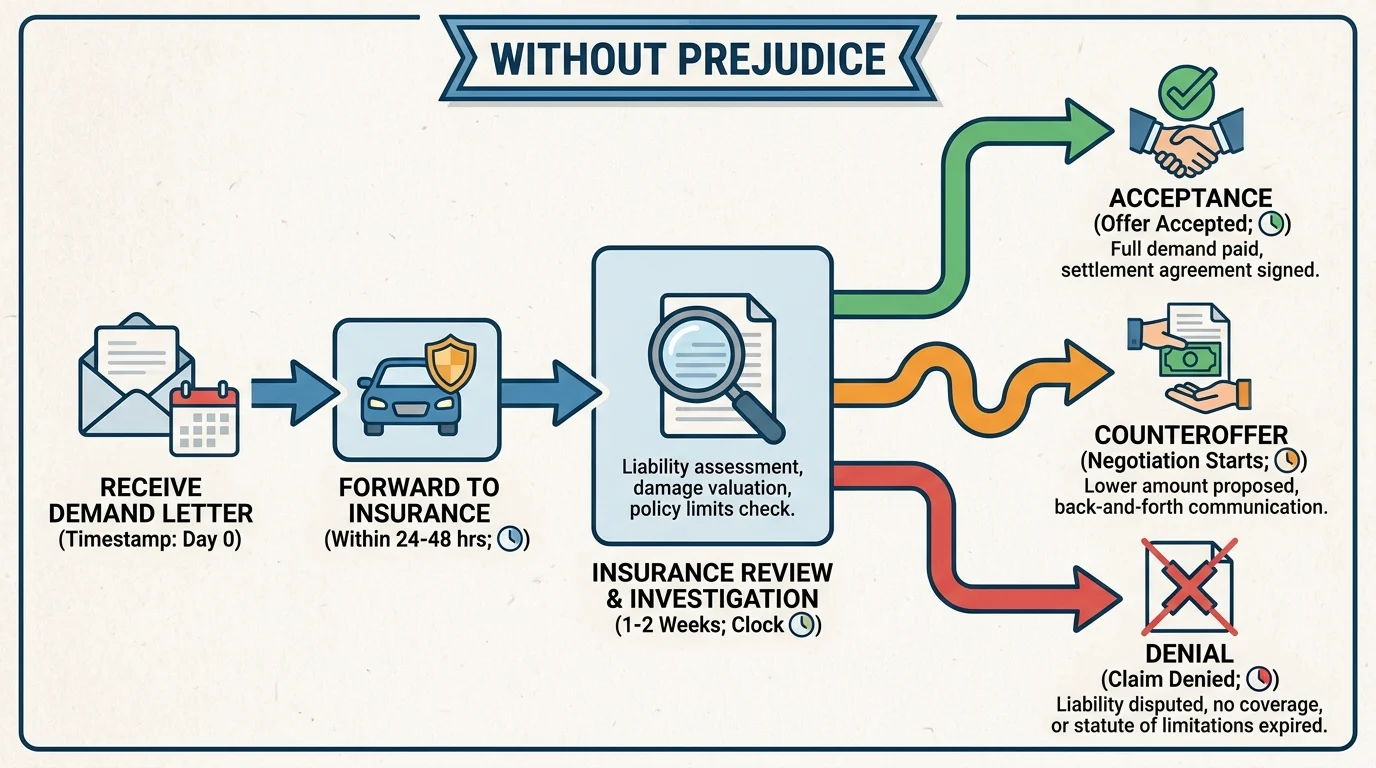
Quick Ans: A car accident demand letter response is a formal reply to a settlement request from an injured party or their attorney. Key steps: forward the letter to your insurance company immediately, never admit fault, respond within the stated deadline (usually 30 days), and consult an attorney if the demand exceeds your policy limits. Possible responses include full acceptance, a counteroffer, a request for more information, or a denial of the claim. Most insurers respond within 30-60 days, but there is no strict legal deadline.
You open your mail and find a thick envelope. Inside is a formal letter demanding thousands of dollars for a car accident you were involved in months ago. Your heart sinks. What do you do next? This is a car accident demand letter, and how you respond can make or break your case.
A demand letter is a formal written notice from an injured party or their attorney to the at-fault driver’s insurance company, stating the facts of the accident, the injuries sustained, and the amount of compensation demanded . It serves as the opening document in settlement negotiations and signals that the claimant is prepared to pursue legal action if a fair settlement isn’t reached.
Receiving one can feel intimidating, but it’s actually a normal part of the claims process. The key is responding strategically rather than emotionally. Don’t ignore it. Don’t admit fault. And whatever you do, don’t try to handle it alone without proper guidance. Your response sets the tone for everything that follows.
Understanding the Demand Letter
1. A Formal Settlement Request
It’s a written notice from an injured party or their attorney to the at-fault driver’s insurance company, requesting compensation for damages .
2. Contains Accident Details
The letter includes the date, time, location, and a clear account of how the accident occurred and why the other driver is at fault .
3. Lists All Injuries and Treatment
A detailed account of all injuries sustained, including diagnosis, treatment received, and any ongoing medical needs .
4. Includes Itemized Expenses
Medical bills, lost wages, property damage costs, and future treatment estimates are all documented .
5. Covers Pain and Suffering
Compensation for physical pain and emotional impact of the injuries is included in the demand .
6. States a Specific Amount
The letter demands a specific dollar amount and gives a deadline for the insurer’s response .
7. Opens Settlement Negotiations
It serves as the starting point for negotiations between the injured party and the insurance company .
8. Signals Litigation Readiness
A well-documented demand letter shows the attorney is prepared to proceed to litigation if a fair settlement is not reached .
9. Not a Lawsuit
A demand letter does not start a lawsuit; it is a pre-litigation step meant to resolve the claim without court involvement .
10. Usually Sent to Insurance
The letter is typically sent to the at-fault driver’s insurance company rather than to the driver personally .
11. Includes Policy Information
The letter references the insurance policy number and claim number for identification .
12. May Include Expert Reports
Medical expert opinions or accident reconstruction reports are sometimes attached .
Immediate Steps After Receiving the Letter
1. Don’t Ignore It
Ignoring the letter is not recommended, as it can strengthen the claimant’s case by implying you refused to negotiate in good faith .
2. Forward to Your Insurance Company Immediately
Notify your auto insurer the same day you receive it. They handle the response on your behalf under your liability coverage .
3. Review the Deadline Carefully
Demand letters typically give 30 days to respond. Missing the deadline can be used against you in subsequent litigation .
4. Never Admit Fault
Do not admit fault verbally or in writing. Any response should be through your insurer or attorney .
5. Write “Without Prejudice” on Your Response
This means the response can’t be used by the other party as evidence in court, allowing you to speak openly without risk .
6. Gather Your Evidence
Collect police reports, photos, witness statements, and any documentation that disputes the claimed facts or damages .
7. Consult an Attorney
If the demand exceeds your policy limits or disputes your liability, a personal injury attorney can help evaluate your exposure and negotiate .
8. Respond in Writing
Always respond in writing, not over the phone. This creates a paper trail and protects your legal position .
How to Respond to the Demand Letter
1. Acknowledge Receipt Promptly
Send a brief acknowledgment to confirm you received the letter and are reviewing it .
2. Request More Time If Needed
If you need more time to gather evidence or consult an attorney, formally request an extension .
3. Provide Documentation to Your Insurer
Send all relevant documents to your insurance company, including the demand letter itself .
4. Let Your Insurer Handle the Response
Your liability coverage typically requires the insurer to investigate and respond on your behalf .
5. Don’t Admit Liability
Avoid any language that could be interpreted as accepting fault for the accident .
6. Don’t Discuss Policy Limits
Never disclose your policy limits to the claimant or their attorney .
7. Be Honest But Cautious
Provide truthful information to your insurer, but avoid speculation or assumptions .
8. Use “Without Prejudice” on All Correspondence
This legal phrase protects your communications from being used in court .
9. Document Everything
Record all communication attempts, including dates, times, and names of adjusters .
10. Don’t Settle Without Insurer Approval
Your insurance policy typically requires the insurer’s consent before you can settle a claim .
11. Consider a Counteroffer Strategy
Work with your insurer to develop a counteroffer based on evidence if the demand is inflated .
12. Request Itemized Breakdown
If the demand lacks detail, request a full itemization of damages claimed .
13. Verify Medical Documentation
Confirm that all claimed medical treatment relates to the accident .
14. Assess Comparative Fault
If the other driver shares blame, gather evidence to support this position .
15. Maintain Professional Communication
Keep all written communications professional, factual, and unemotional .
Possible Responses From the Insurance Company
1. Full Acceptance
The insurer agrees to pay the amount demanded. In exchange, you sign a release and the claim ends .
2. Counteroffer
This is the most common outcome. The insurer responds with a lower number to start negotiations .
3. Request for More Information
The insurer requests additional documentation to evaluate the settlement demand .
4. Claim Denial
The insurer denies liability for your claim and refuses to pay your demand .
5. Deliberate Silence
Sometimes insurers go silent as a negotiation tactic, hoping to pressure you into accepting a lower settlement .
6. Rejection With Explanation
The company may reject the demand because the liable party argues that the injury victim shares the blame for their damages .
7. Acceptance With Conditions
The insurer may accept but with specific conditions attached, such as medical record releases.
8. Partial Acceptance
The insurer agrees to cover certain damages but disputes others.
9. Request for Extension
The insurer asks for more time to review the claim due to complexity or high claim value.
10. Litigation Threat
If negotiations fail, the insurer may indicate they are prepared to defend against a lawsuit.
11. Offer of Structured Settlement
The insurer may propose payments over time rather than a lump sum .
12. Request for Independent Medical Exam
The insurer may request a medical evaluation by their own doctor .
13. Dispute of Causation
The insurer may argue that the injuries were not caused by the accident .
14. Request for Release of Records
The insurer may ask you to sign medical record releases .
15. Proposal for Mediation
The insurer may suggest alternative dispute resolution to avoid court .
Response Timeframes and Expectations
1. No Legal Deadline Exists
Insurance companies are not legally required to respond to a demand letter by a fixed deadline in most states .
2. Typical Response Window: 30-60 Days
Most insurers respond within 30-60 days, but complex cases can take longer .
3. Straightforward Cases: 30-45 Days
Simple injury claims with clear liability often receive responses within 30-45 days .
4. Complex Cases: 45-90 Days
Cases involving severe injuries, multiple vehicles, or disputed liability take longer .
5. Serious Injuries Take Longer
Claims involving surgery, permanent injury, or future care require more thorough evaluation .
6. Higher Demands Require Approval
Large settlements often require supervisor or committee approval, slowing the process .
7. Disputed Liability Delays Response
If fault is unclear, insurers delay while investigating or building defenses .
8. Insurer Practices Vary
Some carriers are simply slower and more bureaucratic than others .
9. Silence Is Often a Negotiation Tactic
Delays often reflect strategy rather than confusion, not a rejection .
10. State Farm Average: 67 Days
One insurer, State Farm, takes an average of 67 days to respond to demand letters .
11. Allstate Average: 53 Days
Allstate typically responds within about 53 days on average .
12. GEICO Average: 48 Days
GEICO is among the faster responders at around 48 days .
13. Progressive Average: 55 Days
Progressive falls in the middle range at approximately 55 days .
14. USAA Average: 42 Days
USAA tends to respond more quickly at about 42 days .
15. Follow Up After 30 Days
If you haven’t heard back after 30 days, a polite follow-up is appropriate .
Factors That Affect Response Time
1. Severity of Injuries
Claims involving catastrophic injuries take longer to evaluate .
2. Amount Demanded
Higher demands require more approval steps .
3. Policy Limits
If damages exceed the at-fault driver’s policy limits, high-level approval is needed .
4. Disputed Liability
Unclear fault requires additional investigation .
5. Quality of Documentation
Incomplete demand letters require additional information, causing delays .
6. Preexisting Conditions
If the claimant had preexisting injuries, a more extensive investigation is needed .
7. Insurance Company Resources
High caseloads can slow response times .
8. Complexity of the Case
Multiple parties or complicated issues take longer .
9. Prior Communication
If there has been previous communication about the claim, the insurer is more likely to respond quickly .
10. Company Size
Smaller companies typically have longer response times than larger ones .
11. Available Medical Records
Delays in obtaining medical records slow the response .
12. Witness Availability
Unavailable witnesses can delay investigation completion .
13. Time of Year
Holiday periods often see slower response times .
14. Attorney Involvement
Claims with attorneys typically proceed more efficiently .
15. State Regulations
Some states have specific deadlines that insurers must follow .
What to Do if the Insurance Company Ignores Your Letter
1. Follow Up Regularly
Continue to reach out to the insurance company at least once every week .
2. Contact a Supervisor
Ask to speak to the claims manager or adjuster’s supervisor .
3. Send a Follow-Up Demand
Send another letter with a firm litigation deadline .
4. Mention Bad Faith Concerns
Inform the adjuster that you have concerns they are handling your claim in bad faith .
5. Escalate the Claim
Ask for the claim to be escalated to a higher authority .
6. File a Lawsuit
If silence continues, filing a lawsuit can force engagement .
7. File a Complaint with Regulators
Insurance regulators oversee insurer behavior. You may file a complaint with your state’s insurance department .
8. Consult an Attorney
A lawyer can apply pressure and protect critical deadlines .
9. Avoid Repeated Calls Without Leverage
Persistent pressure without leverage can weaken your position and signal urgency .
10. Document Everything
Keep records of all communication attempts, including dates, times, and names of adjusters .
11. Send a Certified Letter
Send follow-up correspondence via certified mail with return receipt requested .
12. Request a Written Explanation
Formally request a written explanation for the delay in responding .
13. Consider Alternative Dispute Resolution
Propose mediation or arbitration as an alternative to continued silence .
14. Review Your Policy for Deadlines
Check if your insurance policy specifies any timeframes for claim handling .
15. Prepare for Litigation
If silence continues, prepare your case for court filing .
Frequently Asked Questions
What is a car accident demand letter?
It’s a formal written notice from an injured party or their attorney to the at-fault driver’s insurance company, stating the facts of the accident, the injuries sustained, and the amount of compensation demanded .
How long do I have to respond to a demand letter?
Demand letters typically give 30 days to respond. The specific deadline should be stated in the letter itself .
What happens if I ignore a demand letter?
Ignoring it is not recommended, as it can strengthen the claimant’s case by implying you refused to negotiate in good faith .
Do insurance companies have to respond to demand letters?
No, insurance companies are not legally required to respond to demand letters by a fixed deadline in most states .
How long does an insurance company typically take to respond?
Most insurers respond within 30-60 days. However, State Farm takes an average of 67 days .
What should I do if I receive a demand letter?
Forward it to your insurance company immediately, never admit fault, respond in writing, and consult an attorney if the demand exceeds your policy limits .
What responses can I expect from the insurance company?
Possible responses include acceptance, counteroffer, request for more information, denial, or silence .
Can I respond to a demand letter myself?
You can, but it’s strongly recommended to let your insurance company handle the response. If you respond personally, never admit fault and write “without prejudice” on your response .
Does a demand letter mean I’m being sued?
No. A demand letter is a pre-litigation step meant to resolve the claim without court involvement .
What does “without prejudice” mean on a response?
It means the response can’t be used by the other party as evidence in court, allowing you to speak openly without risk .
Conclusion
Receiving a car accident demand letter can be stressful, but it’s a normal part of the claims process. The key is responding strategically rather than emotionally. Always forward the letter to your insurance company immediately, never admit fault, and respond within the stated deadline. If the demand exceeds your policy limits or disputes your liability, consulting an attorney is essential.
Understanding that insurance companies have no legal deadline to respond helps manage expectations . Most responses take 30-60 days, but delays are often negotiation tactics rather than rejections. Patience and persistence, coupled with proper legal guidance, will serve you best. Your response sets the tone for everything that follows. Handle it carefully, and you’ll protect your legal position while working toward a fair resolution.
Discover More:
- 200+ Best Habari Gani Responses for Every Situation in 2026
- Crisis Response Plan: Your Comprehensive Guide to Building Resilience 2026

2 thoughts on “Car Accident Demand Letter Response: Complete Guide for 2026”