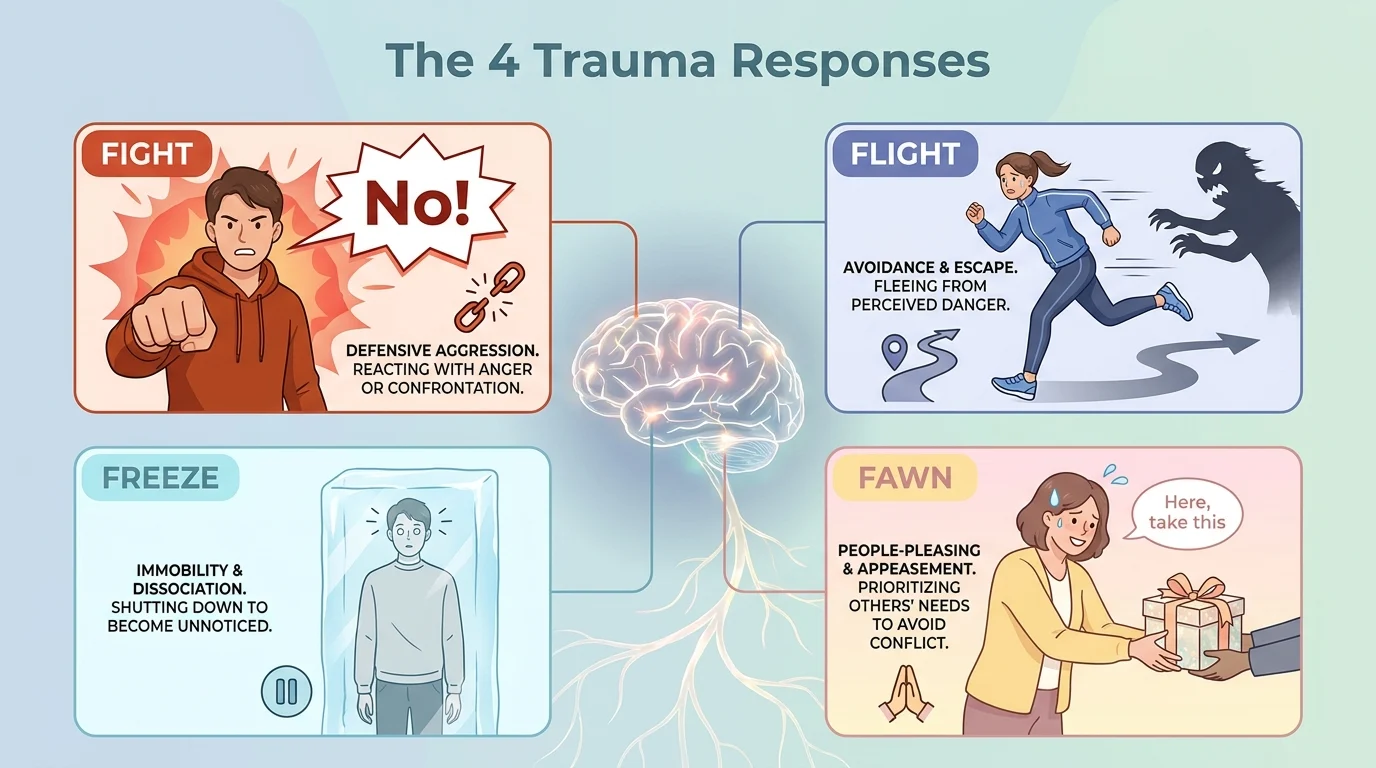
Quick Ans: Trauma responses are automatic, unconscious survival reactions your body uses when facing a perceived or real threat . The four most commonly recognized responses are Fight (confronting the threat with aggression or control), Flight (escaping or avoiding the danger), Freeze (shutting down or becoming unable to act), and Fawn (appeasing the threat through people-pleasing or compliance) . Sometimes, a fifth response called Flop is mentioned, where the body goes limp or faints . These responses are designed for survival, but after trauma, they can become stuck and activate in non-threatening situations .
Have you ever reacted to a situation in a way that surprised you? Maybe you yelled at a friend for a minor comment, felt an overwhelming urge to flee a crowded room, or completely shut down during an argument. These reactions might not be personality flaws—they could be your nervous system’s way of protecting you based on past experiences.
Trauma responses are your brain’s built-in survival toolkit. They are reflexive, unconscious actions that prepare your body to face danger . This system is the result of millions of years of evolution, designed to keep you alive in life-threatening situations. However, when you’ve experienced overwhelming or prolonged stress, this “alarm system” can become dysregulated. It may start going off in situations that aren’t truly dangerous, leading to reactions that feel confusing or out of your control .
Understanding these automatic responses is a powerful first step. It helps you recognize that these reactions aren’t personal failings but are normal, adaptive strategies developed for survival . This knowledge can build self-compassion and guide you toward healthier ways of managing stress and healing from trauma.
The Physiology Behind the Response
Why Your Body Reacts Automatically
When your brain perceives a threat, a small region called the amygdala—the brain’s “fire alarm”—sounds the alert . This instant signal bypasses your “thinking brain” (the prefrontal cortex) and activates your sympathetic nervous system . A cascade of stress hormones, including adrenaline and cortisol, floods your body, preparing it for intense action .
This leads to physical changes like a racing heart, rapid breathing, dilated pupils, and blood being redirected to your major muscle groups . Your body is getting ready to fight or flee. This response usually calms down 20 to 30 minutes after the threat passes . But with trauma, your brain can become stuck in “hyperdrive,” activating this system even when you’re safe .
The Window of Tolerance
This concept describes your optimal zone of emotional and physiological arousal . Within this window, you can handle stress effectively. Trauma responses push you outside this window into hyperarousal (fight or flight) or hypoarousal (freeze or fawn) . When you’re outside your window, you’re more likely to react based on survival instincts rather than rational thought.
The Four Core Trauma Responses
1. Fight Response
The fight response is an active, self-preservation strategy where you confront the threat, often with anger or aggression . This response is rooted in the belief that maintaining power and control over a situation will lead to safety .
- When it’s healthy: This response can be healthy when used for assertion and setting clear boundaries. For example, standing up to someone who is treating you unfairly .
- When it’s unhealthy: As a trauma response, it manifests as becoming overly controlling, argumentative, or physically or verbally aggressive in situations that don’t warrant it . Examples include yelling at a friend for a minor mistake or bullying a colleague .
- Body cues: Clenched jaw, racing heart, feeling of a knot in your stomach, or balling your hands into fists .
2. Flight Response
The flight response is the instinct to escape or avoid a perceived threat . It’s characterized by avoidant behavior and the belief that fleeing conflict is the path to safety .
- When it’s healthy: This response can be beneficial when you’re in a genuinely dangerous situation and need to get away. It’s also healthy to withdraw from an unhealthy relationship .
- When it’s unhealthy: As a chronic response, it can lead to isolating yourself, avoiding difficult conversations, overworking to distract yourself, or ending relationships prematurely to avoid potential pain . This might look like “ghosting” someone or throwing yourself into perfectionism to escape criticism .
- Body cues: Feeling restless, fidgety, experiencing panic or anxiety, or feeling an overwhelming urge to run away .
3. Freeze Response
The freeze response is a stalling tactic. Your brain hits the “pause” button, but remains hypervigilant, waiting to determine the best course of action . This response is often triggered when fighting or fleeing seems impossible .
- When it’s healthy: Freezing can be useful when you need to be fully present, exercise awareness, or take a mindful approach to a situation .
- When it’s unhealthy: As a trauma response, it manifests as feeling “stuck,” unable to move or speak, or dissociating (feeling disconnected from your thoughts, feelings, or body) . You might feel numb, have difficulty making decisions, or constantly “zone out” .
- Body cues: Numbness, feeling of paralysis, fixed or “glazed” eyes, and a sense of being disconnected from the present moment .
4. Fawn Response
The fawn response is a relatively newer addition to the model. It involves appeasing or pleasing the person who poses the threat to avoid conflict or harm . It’s often called the “please and appease” response .
- When it’s healthy: When used healthily, it can reflect deep compassion, active listening, and a willingness to compromise .
- When it’s unhealthy: As a trauma response, it becomes chronic people-pleasing at the expense of your own needs, rights, and boundaries . This might look like having a constant and overwhelming need to please others, difficulty saying “no,” or suppressing your own desires to gain approval . It can lead to codependent relationships and a lack of sense of self .
- Underlying belief: Many who use the fawn response unconsciously believe that the only way to be safe in a relationship is to forfeit all their needs .
Flop Response: A Note on an Additional “F”
Some mental health experts and sources include a fifth response known as the Flop response. This is a more extreme form of freeze where the body goes limp or the person may even faint . The nervous system essentially “shuts down” in the face of an overwhelming threat . It’s a common, though lesser-known, response in traumatic events .
When Trauma Responses Become a Problem
Trauma responses are adaptive survival strategies in dangerous situations. The trouble begins when these responses become default patterns long after the threat has passed . Your nervous system can remain on high alert, and your brain can be “triggered” into a trauma response by reminders of the original event, even if you’re physically safe .
Triggers are sensory reminders—like sounds, smells, or places—that reactivate the trauma response as if the event is happening again . Common long-term effects include:
- Hypervigilance: Feeling constantly on edge, easily startled, and scanning for threats .
- Avoidance: Going to great lengths to avoid places, people, or conversations that might be a reminder of the trauma .
- Dissociation: A mental process that disconnects you from your thoughts, feelings, or sense of identity .
- Emotional Dysregulation: Experiencing intense and unpredictable emotions like anger, fear, or shame .
Frequently Asked Questions
What is a trauma response?
A trauma response is the reflexive use of over-adaptive coping mechanisms in the real or perceived presence of a threat . It’s an automatic survival reaction from your nervous system .
What are the four types of trauma responses?
The four most common are Fight, Flight, Freeze, and Fawn. Fight is confronting the threat, Flight is escaping it, Freeze is shutting down in its presence, and Fawn is appeasing it .
What is the “flop” trauma response?
The “flop” response is a lesser-known but very common reaction where the body goes limp or the person faints. It’s an extreme form of the freeze response .
Why do I respond with “fawn” instead of fighting?
A fawn response is often learned in childhood if pleasing a caregiver was an effective way to avoid harm or gain safety . It’s an unconscious belief that merging with the wishes of others is the price of safety in a relationship .
Can trauma responses change over time?
Yes, with healing and therapy, you can learn to recognize your patterns, regulate your nervous system, and expand your “window of tolerance,” allowing for more flexible and healthier responses .
Conclusion
Trauma responses—fight, flight, freeze, and fawn—are your nervous system’s hardwired survival tactics. They are automatic reactions designed to protect you from harm. When these responses become a default setting even when you’re safe, it can complicate relationships, work, and daily life.
Understanding these patterns is not about blaming yourself. It’s about developing self-compassion and recognizing that these reactions are rooted in survival. By learning to identify your own triggers and patterns, you can begin to find ways to calm your nervous system and expand your window of tolerance. If these responses are significantly impacting your life, know that specialized trauma therapies can be incredibly helpful in finding a path to healing and reclaiming a sense of calm and control .
Discover More:
- Response Code 304 Not Modified: A Complete Guide to This Web Caching Superhero 2026
- Direct Mail Response Rates in 2026: Words on the Channel That Refuses to Quit

2 thoughts on “Understanding Trauma Responses: Fight, Flight, Freeze, and Fawn 2026”