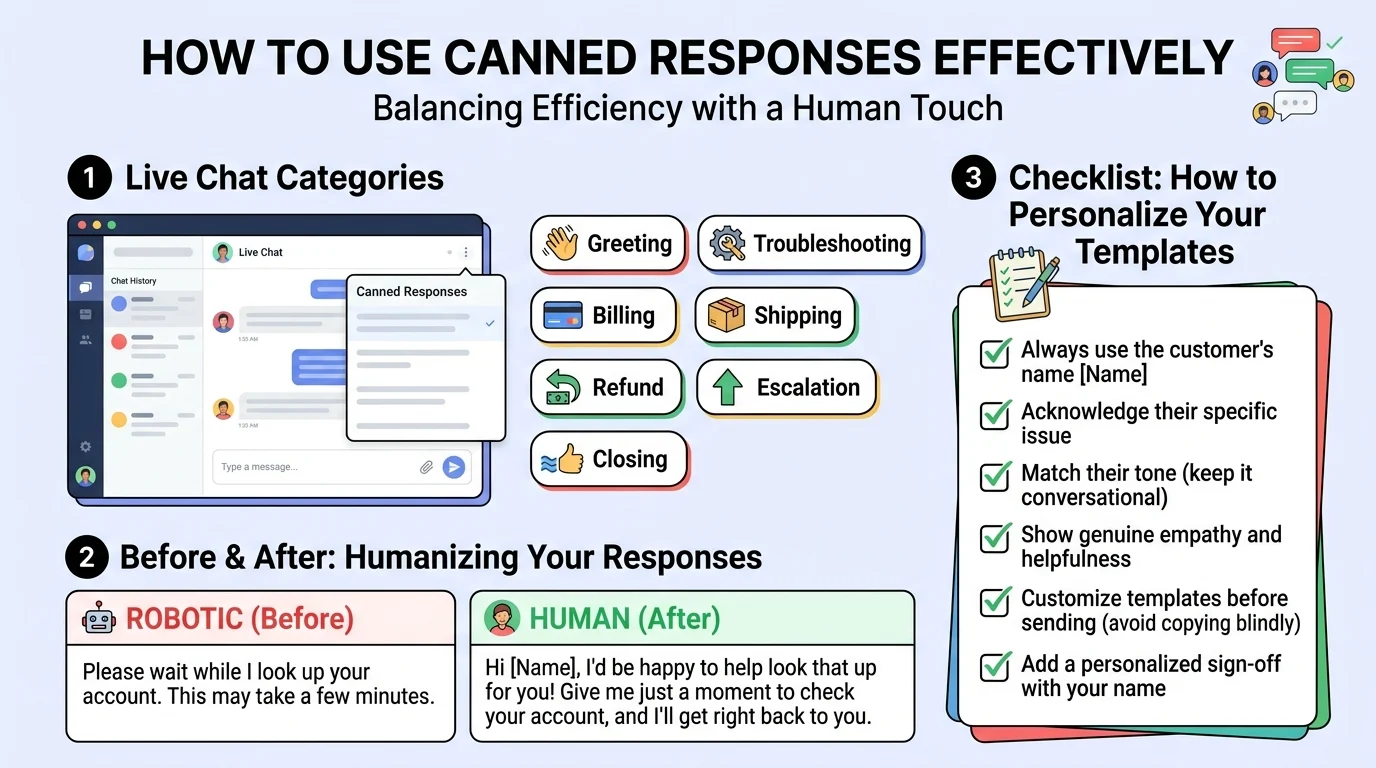
Quick Ans: Live chat canned responses are pre-written message templates agents use to answer common customer questions instantly. Examples include greetings like “Hi [Name], thanks for reaching out!”, troubleshooting openers like “Let’s get this fixed for you”, and closings like “Anything else I can help with today?”. The best canned responses are short, personal, and always customized with the customer’s name and issue. They cut response times by up to 50% while keeping conversations human.
Your chat queue is piling up. Three customers are typing at once. Someone just asked the same shipping question you’ve answered forty times today. Sound familiar? This is exactly where live chat canned responses save the day.
Canned responses (also called saved replies, snippets, or macros) are pre-written templates your support team can drop into a chat with one click. They handle the repetitive stuff so agents can focus energy on the conversations that actually need a human brain. Done badly, they sound robotic and customers notice immediately. Done well, they feel like a fast, friendly human who happens to type at lightning speed.
The difference is in the writing. A great canned response is short, warm, and always personalized with the customer’s name and specific situation. This guide gives you over 200 ready-to-use examples across every stage of a live chat conversation, plus the rules that keep them from sounding like copy-paste chaos.
What Are Live Chat Canned Responses?
1. Pre-Written Message Templates
Canned responses are saved replies agents insert into chats with a shortcut or click.
2. Also Called Snippets or Macros
Different platforms use different names, but the concept is identical.
3. Triggered by Keywords or Shortcuts
Type “/shipping” or “hi” and the full template appears instantly.
4. Designed for Repetitive Questions
They cover FAQs like pricing, shipping, refunds, and hours.
5. Customizable Before Sending
Good agents always edit the template before hitting send.
6. Available in Most Help Desk Tools
Intercom, Zendesk, Freshdesk, and LiveChat all support them.
7. Shared Across the Whole Team
Managers create them once and every agent benefits.
8. Measurable for Performance
Teams track usage rates, response times, and satisfaction scores.
9. Not Meant to Replace Real Answers
They’re a starting point, not a full conversation.
10. Updated Regularly
Templates should evolve as products, policies, and customer questions change.
11. Organized by Category
Greetings, troubleshooting, billing, escalations, and closings each get their own set.
12. Available in Multiple Languages
Global teams maintain translated versions for each market.
13. Tested for Tone
The best teams A/B test templates to see what customers respond to.
14. Tied to Chat Workflows
Canned responses often pair with routing rules and automation.
15. Part of a Larger Knowledge Base
They should match your help articles and FAQ content.
Benefits of Using Canned Responses
1. Faster Response Times
Agents reply in seconds instead of typing from scratch.
2. Consistent Brand Voice
Every customer gets the same tone and accuracy.
3. Reduced Agent Burnout
Less repetitive typing means less mental fatigue.
4. Better First Contact Resolution
Agents can focus on solving rather than composing.
5. Easier Onboarding
New hires sound confident from day one.
6. Fewer Typos and Errors
Templates eliminate sloppy mistakes in critical info.
7. Scalable Support
Handle volume spikes without hiring immediately.
8. Improved CSAT Scores
Fast, accurate answers keep customers happy.
9. Multilingual Coverage
Templates make language support more manageable.
10. Data-Driven Optimization
Track which templates perform best and refine them.
11. Shorter Training Time
New agents learn faster with ready-made responses.
12. Better Compliance
Legal and policy language stays consistent.
13. Higher Agent Confidence
Knowing the right words are ready reduces stress.
14. Time for Complex Issues
Agents save energy for the conversations that need it.
15. Stronger Team Collaboration
Everyone contributes to and improves the shared library.
Greeting Canned Responses Examples
1. Hi [Name], thanks for reaching out! How can I help today?
Example: Standard opener for any new chat
Meaning: Friendly, professional, and invites the customer to explain their issue.
2. Hey [Name]! Welcome back. What can I do for you?
Example: For returning customers you recognize
Meaning: Acknowledges their history and feels personal.
3. Hello! You’re chatting with [Agent] from [Company]. What’s going on?
Example: When you want to introduce yourself clearly
Meaning: Sets expectations and builds trust immediately.
4. Hi there! Thanks for your patience. I’m here now.
Example: When there was a queue wait
Meaning: Apologizes lightly and reassures the customer.
5. Good morning, [Name]! How’s your day going so far?
Example: Warm opener for morning chats
Meaning: Adds a human touch before diving into business.
6. Hi [Name], I see you’re asking about [topic]. Let’s dive in!
Example: When chat routing already told you the topic
Meaning: Shows you’re prepared and saves the customer repeating themselves.
7. Welcome! Before we start, can I grab your order number?
Example: For order-related inquiries
Meaning: Moves the conversation forward efficiently.
8. Hey there! I’m [Agent]. What brings you in today?
Example: Casual brands with a relaxed tone
Meaning: Keeps it conversational and approachable.
9. Hi [Name]! Thanks for choosing [Company]. How can I assist?
Example: For new customers
Meaning: Reinforces their choice and offers help.
10. Hello! I’m here to help. Tell me what’s happening.
Example: Simple, universal opener
Meaning: Direct and reassuring without fluff.
11. Hi [Name], hope you’re well! What can I help you with?
Example: Friendly opener for repeat chats
Meaning: Polite and warm without being overly familiar.
Troubleshooting Canned Responses Examples
1. Let’s get this fixed for you, [Name]. Can you tell me what you’re seeing?
Example: When a customer reports a bug or error
Meaning: Signals action and asks for specifics.
2. Thanks for those details! Let me walk you through the fix.
Example: Before giving step-by-step instructions
Meaning: Confirms you have what you need and prepares them.
3. I’m sorry you’re dealing with this. Let’s troubleshoot together.
Example: When the issue is frustrating
Meaning: Empathizes before solving.
4. Could you try clearing your cache and reloading the page?
Example: Common first troubleshooting step
Meaning: Offers a simple fix that resolves many issues.
5. Can you send me a screenshot of what you’re seeing?
Example: When the problem is visual or unclear
Meaning: Gets concrete evidence to diagnose faster.
6. I’ve checked on my end and everything looks normal. Let’s dig deeper.
Example: When you can’t reproduce the issue
Meaning: Acknowledges the problem is real and continues investigating.
7. Let me escalate this to our technical team for a closer look.
Example: When the issue is beyond first-level support
Meaning: Shows you’re taking it seriously and moving it forward.
8. This is a known issue and our team is working on a fix.
Example: When the bug is already reported
Meaning: Sets honest expectations and avoids wasted troubleshooting.
9. Can you confirm which device and browser you’re using?
Example: When compatibility might be the cause
Meaning: Gathers technical context efficiently.
10. I’ve reset things on my end. Can you try again now?
Example: After performing an account-side fix
Meaning: Invites the customer to test the solution.
Billing and Payment Canned Responses Examples
1. I can see your last payment posted on [date]. Want me to walk through the charges?
Example: When a customer questions a bill
Meaning: Offers transparency without being defensive.
2. Your refund was processed on [date] and should arrive within [timeframe].
Example: For refund status questions
Meaning: Gives a clear, specific answer.
3. Let me check why that charge went through. One moment please.
Example: When a customer disputes a charge
Meaning: Shows you’re investigating rather than dismissing.
4. I’ve applied a credit to your account for the inconvenience.
Example: When a billing error occurred
Meaning: Makes it right and rebuilds trust.
5. Here’s a breakdown of your current plan and what it includes.
Example: When customers forget what they’re paying for
Meaning: Clarifies value and reduces confusion.
6. Would you like me to update your payment method on file?
Example: When a card has expired or failed
Meaning: Offers a proactive solution.
7. I can send you an itemized invoice by email right now.
Example: When customers need documentation
Meaning: Provides a paper trail quickly.
8. Your subscription renews on [date]. Want a reminder before then?
Example: For subscription anxiety
Meaning: Prevents surprise charges and cancellations.
9. I’ve paused your billing for [timeframe] while we sort this out.
Example: During disputes or account issues
Meaning: Shows good faith and reduces pressure.
10. That promotional price ended on [date]. Here are your current options.
Example: When customers notice a price increase
Meaning: Explains the change and offers alternatives.
11. Let me connect you with our billing specialist for this one.
Example: For complex payment issues
Meaning: Routes to the right expert without delay.
12. I’ve emailed you a secure payment link. It’s valid for 24 hours.
Example: When collecting payment in chat
Meaning: Keeps the transaction safe and simple.
Order and Shipping Canned Responses Examples
1. I found your order! It shipped on [date] and should arrive by [date].
Example: For “where is my order” questions
Meaning: Answers the most common chat question fast.
2. Your tracking number is [number]. You can follow it here: [link].
Example: When customers want to track a package
Meaning: Gives them self-service tools immediately.
3. I’m sorry your package is delayed. Let me check with the carrier.
Example: When tracking shows a delay
Meaning: Empathizes and takes action.
4. It looks like your order hasn’t shipped yet. Want me to check why?
Example: When the order is stuck in processing
Meaning: Proactively investigates without waiting to be asked.
5. I can update your shipping address if it hasn’t shipped yet.
Example: When customers realize they used the wrong address
Meaning: Offers a fix before it becomes a bigger problem.
6. Your order was delivered on [date]. Can you check with neighbors?
Example: When tracking says delivered but the customer can’t find it
Meaning: Handles a delicate situation with practical steps.
7. I’ve issued a replacement for your lost package. It ships today.
Example: When a package is confirmed lost
Meaning: Resolves the issue without making the customer fight.
8. We offer free shipping on orders over [amount]. Want me to add that?
Example: When customers are close to the threshold
Meaning: Adds value and increases order size.
9. Your order is being prepared now. You’ll get tracking within 24 hours.
Example: For orders in the fulfillment stage
Meaning: Sets clear expectations for the next step.
10. I can cancel this order since it hasn’t shipped yet.
Example: When customers change their mind quickly
Meaning: Offers flexibility before it’s too late.
11. International orders usually take [timeframe] to arrive.
Example: For overseas customers
Meaning: Manages expectations about longer delivery times.
Refund and Return Canned Responses Examples
1. I’m sorry this didn’t work out. Let’s get your return started.
Example: When a customer wants to return an item
Meaning: Empathizes and moves straight to action.
2. Your refund has been approved and will appear in 5-7 business days.
Example: After processing a refund
Meaning: Sets clear timing expectations.
3. Can you tell me what was wrong with the item? It helps us improve.
Example: When processing a return
Meaning: Gathers feedback while solving the issue.
4. I’ve emailed you a prepaid return label. Just drop it off anytime.
Example: For return shipping
Meaning: Removes friction from the process.
5. We don’t require the original packaging for returns.
Example: When customers worry about boxes
Meaning: Removes a common return anxiety.
6. Your return was received and your refund is being processed.
Example: For return status updates
Meaning: Confirms progress and reduces follow-up chats.
7. I can offer a replacement instead of a refund if you prefer.
Example: When the item is defective
Meaning: Gives the customer options.
8. Since it’s past 30 days, I’ll need to check with my manager.
Example: For late returns
Meaning: Shows you’re advocating rather than refusing.
9. I’ve made an exception and approved your return this time.
Example: For policy edge cases
Meaning: Builds goodwill and loyalty.
10. Your store credit is now available in your account.
Example: When refunds are issued as credit
Meaning: Directs them to where the value lives.
11. Let me confirm the return address so nothing gets lost.
Example: Before customers ship items back
Meaning: Prevents errors and delays.
12. I’m sorry for the hassle. I’ve also added a discount for your next order.
Example: When a return caused real inconvenience
Meaning: Goes beyond the basics to recover trust.
Escalation and Apology Canned Responses Examples
1. I’m really sorry about this. Let me get the right person to help.
Example: When the issue is beyond your scope
Meaning: Apologizes and escalates without making the customer repeat themselves.
2. I understand your frustration. I’d feel the same way.
Example: When a customer is upset
Meaning: Validates their feelings before solving.
3. I’ve escalated this to our [team] and marked it urgent.
Example: For serious issues
Meaning: Shows urgency and action.
4. You’ll hear back from our specialist within [timeframe].
Example: After escalation
Meaning: Sets a clear expectation so they don’t chase you.
5. This isn’t the experience we want you to have. I’m on it.
Example: When something went clearly wrong
Meaning: Takes ownership without excuses.
6. Let me personally make sure this gets resolved.
Example: For high-value or high-frustration chats
Meaning: Offers a human commitment, not a ticket number.
7. I’ve credited your account for the trouble this caused.
Example: After a service failure
Meaning: Puts real value behind the apology.
8. Thank you for bringing this to our attention.
Example: When feedback reveals a bigger issue
Meaning: Turns a complaint into improvement.
9. I’m sorry for the wait. You have my full attention now.
Example: After a long queue or silence
Meaning: Acknowledges the delay directly.
10. I can’t fix this in chat, but I can get you to someone who can today.
Example: When the fix needs another team
Meaning: Honest and action-oriented.
11. I’ve flagged this for our product team. It’s valuable feedback.
Example: When a customer reports a recurring issue
Meaning: Shows their voice matters.
12. Let me follow up with you personally once this is resolved.
Example: For trust-building after a failure
Meaning: Promises a closed loop.
Closing Canned Responses Examples
1. Anything else I can help you with today?
Example: Standard closing for any chat
Meaning: Invites additional questions before ending.
2. Glad I could help, [Name]! Have a great rest of your day.
Example: After resolving an issue
Meaning: Warm, human sign-off.
3. I’ll send a summary of this chat to your email.
Example: For complex resolutions
Meaning: Gives the customer a record.
4. Thanks for chatting with us! We’re here 24/7 if you need us.
Example: When promoting always-on support
Meaning: Reinforces availability.
5. Your issue is resolved, but reply here anytime if it comes back.
Example: For technical fixes
Meaning: Keeps the door open without forcing a new ticket.
6. I’ve emailed you the steps we discussed. Let us know how it goes!
Example: After walking through a process
Meaning: Provides reference material.
7. Is there anything I could have done better today?
Example: For feedback collection
Meaning: Shows humility and desire to improve.
8. Thanks for your patience, [Name]. Take care!
Example: After a longer session
Meaning: Acknowledges their time.
9. We appreciate your business. Have a wonderful day!
Example: For customers or clients
Meaning: Ends with gratitude.
10. If you need us again, just hit this chat bubble.
Example: For website chat users
Meaning: Reminds them how to return.
11. I’m marking this as resolved. Reopen anytime if needed.
Example: For ticketing systems
Meaning: Clarifies status without closing the door.
FAQs
What are live chat canned responses?
They’re pre-written message templates agents insert into chats to answer common questions quickly.
Are canned responses bad for customer experience?
Not if they’re personalized. Bad canned responses feel robotic. Good ones feel like a fast, helpful human.
How many canned responses should a team have?
Start with 20-30 covering your top questions. Expand based on actual chat transcripts and recurring issues.
Should agents edit canned responses before sending?
Always. Add the customer’s name, reference their specific issue, and remove anything irrelevant.
What’s the difference between canned responses and macros?
Macros often include actions (like tagging or assigning), while canned responses are just text. Many tools use the terms interchangeably.
Can canned responses hurt SEO or support quality?
No. They improve response times and consistency, which boosts CSAT. Just audit them quarterly so they stay accurate.
Which tools support live chat canned responses?
Intercom, Zendesk, Freshdesk, LiveChat, HubSpot, and Drift all support them natively.
How do I keep canned responses from sounding robotic?
Write like you talk, keep them short, use the customer’s name, and always add a personal line before sending.
Conclusion
Live chat canned responses are one of the highest-leverage tools in customer support. They cut response times, keep your brand voice consistent, and free agents to focus on conversations that actually need a human brain. But the magic is in the writing. Short, warm, personalized templates win. Long, robotic, copy-paste walls of text lose every time.
Use this guide as your starting library. Pick the templates that fit your product and audience, then edit them until they sound like your team. Review them quarterly. Retire the ones that flop. Add new ones as your customers teach you what they need.
Your chat queue will never feel the same. Save this list, share it with your support team, and watch your response times drop while your satisfaction scores climb.
Discover More:
- Understanding Trauma Responses: Fight, Flight, Freeze, and Fawn 2026
- Acoustic Website Response Time Monitoring Tools: 10 Powerful Options for 2026

1 thought on “Live Chat Canned Responses Examples: 200+ Templates for 2026”