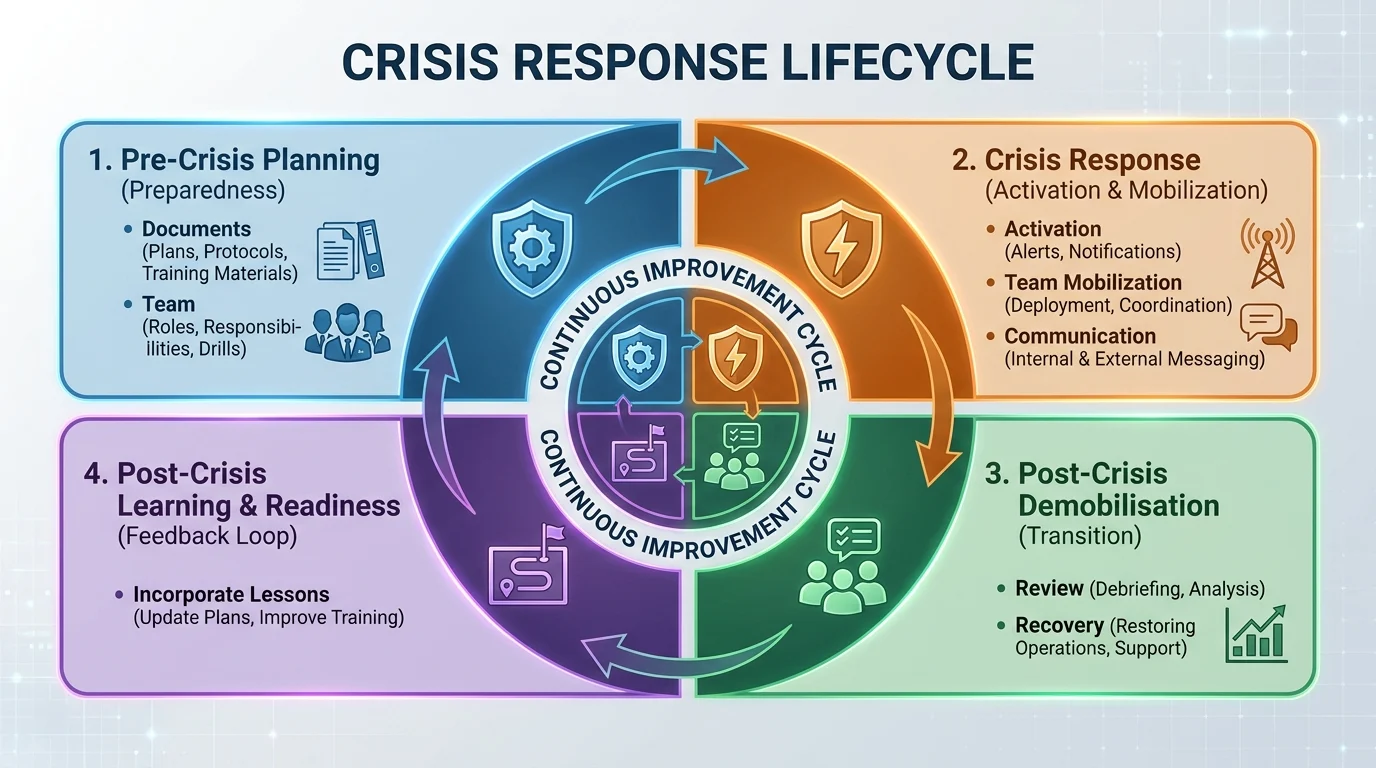
Quick Ans: A crisis response plan (CRP) is a documented roadmap that guides your team through unexpected disruptions . It defines clear roles, establishes communication protocols, and outlines step-by-step actions to protect people and operations. Key components include: an activation protocol to trigger the response, an emergency contact list for key players, a detailed communication strategy for internal and external audiences, and a business continuity section to maintain critical functions. A well-crafted plan turns chaos into controlled action .
The phone rings at 2 AM. A fire has broken out at your main warehouse. Or perhaps your IT director just discovered a massive data breach. Or a severe storm has knocked out power across your entire region. What happens next determines everything. This is why a crisis response plan is essential for every organization . It might feel like a daunting task to build one from scratch. But breaking the process down into manageable steps makes it achievable.
A crisis response plan, which is the central document of a crisis management program, ensures your team acts quickly and decisively when normal operations are disrupted . Without it, you risk chaotic decision-making, mixed messages, and missed opportunities to protect your people and reputation. The goal of this guide is to provide a clear, actionable framework for creating or strengthening your plan. We’ll walk through the fundamental components, from identifying the right team to testing and updating the plan for continuous improvement.
What is a Crisis Response Plan?
A crisis response plan is a comprehensive document your team can use repeatedly. It explains exactly how to respond to unexpected events that disrupt normal work . The purpose is to move from panic to a controlled, structured response.
A well-designed plan acts as a guide that you can update as needed . It doesn’t need to predict every single detail. Instead, it provides a clear structure and set of procedures for common or high-risk scenarios. This ensures everyone knows their roles and responsibilities when a crisis hits.
Key Benefits of a Crisis Response Plan
1. Faster, More Coordinated Response
Defined roles and designated owners in a plan allow the team to act immediately without wasting time figuring out who does what. This significantly speeds up the decision-making process .
2. Clearer Communication
A robust communication strategy is at the heart of a good plan . It ensures messages are consistent, audiences are identified, and spokespeople are prepared. This prevents misinformation and confusion during a crisis.
3. Ongoing Visibility and Accountability
A plan provides a repeatable process that helps your team stay organized. By tracking tasks and progress in a shared workspace, you maintain visibility over all aspects of the response and know who is responsible for each action .
4. Improved Resilience
A crisis response plan acts as a compass, helping teams to handle disruption effectively and achieve the best possible outcome . Organizations that embrace crisis as a catalyst emerge stronger with more agile systems .
The Three Phases of Crisis Management
Phase 1: Pre-Crisis Planning
The most crucial work happens before a crisis occurs . This phase involves identifying systemic risks, organizing resources, and training teams to minimize potential impacts. Key activities include creating a crisis management policy, developing the response plan, and crafting communication strategies .
Phase 2: Crisis Response
This is the activation of your plan. It involves mobilizing teams to control the situation and resolve issues through rapid decision-making and clear communication. This phase requires an agile response team that is tailored to the specific crisis . In the chaos, it’s easy to forget essential duties, which is why having a plan with clear checklists is vital .
Phase 3: Post-Crisis Demobilisation
The work doesn’t stop when the immediate threat is gone. This final phase focuses on supporting your teams, analyzing the new landscape, and adapting strategies for the future. This includes conducting debriefs, reviewing your plan’s performance, and implementing changes to be stronger for the next challenge .
Types of Crises to Prepare For
Operational Crises
These disrupt day-to-day business functions. Examples include supply chain failures, equipment breakdowns, or system outages .
Technological Crises
These involve compromised digital systems. A data breach, a major cyberattack, or a prolonged software failure can cause significant harm .
Reputational Crises
Negative press, a major social media backlash, or a public misstep by a leader can threaten your credibility and public trust .
Financial Crises
Cash flow shortages, sudden market shifts, or the loss of a major client can put business continuity at risk .
Natural and Environmental Crises
These affect physical workspaces and safety. Earthquakes, floods, severe storms, and fires are all scenarios that require a clear response .
Human Resource Crises
A leadership departure, a labor dispute, or a health emergency can impact your team’s capacity and morale .
Essential Components of a Crisis Response Plan
Activation Protocol
This is the set of factors that triggers your plan . It defines the specific conditions or events that must occur before the team decides to activate the crisis response. Think of it as a dependency checklist. For example, “When an incident is assessed as having a ‘High’ impact on operations, the crisis team is activated.”
Risk Analysis and Assessment
This is the research that outlines potential risks your organization may encounter. It helps you determine the likelihood of an event occurring and prioritize your planning efforts. A risk register is a common tool for this .
Emergency Contact List
This is a vital part of any plan . It should have contact details for your crisis management team and local emergency responders, such as the fire department, poison control, or other key authorities .
Response Procedures
These are the clear, step-by-step actions your team takes during a crisis once the activation protocol is met . The response should specify the initial assessment, team mobilization, and operational steps to contain the incident .
Communication Strategy
This is a critical component for internal and external communication . This plan covers how you’ll keep everyone informed during an emergency. It must identify key audiences like employees, customers, media, and regulators . It should also include pre-scripted message templates and designate a spokesperson to maintain a consistent and credible voice .
Business Continuity
This section details how to maintain your most critical business functions during and after the crisis. It addresses the minimum viable operations needed to serve customers and keep the organization afloat.
Logistics and Support
Having a point person in charge of logistics is a huge help . This role coordinates critical operational support, from securing laptops and access for team members to drafting work rotas.
Roles and Responsibilities
A clear command structure is vital. Many organizations use a tiered system with distinct roles :
- Gold (Strategic Lead): The named first-in-command responsible for overseeing the entire crisis communications response and making high-level strategic decisions.
- Silver (Tactical Lead): The second in command who assists the Gold lead and manages the operational aspects of the response.
- Bronze (Operational Lead): The third in command who works on the ground or with specific teams to execute the Silver lead’s instructions.
- Communications Lead: Manages the flow of information to all stakeholders.
- Legal Team: Advises on compliance, liability, regulatory communication, and manages evidence preservation .
- Logistics Lead: Manages the physical resources needed for the team to function, such as a location, IT access, and supplies .
How to Create a Crisis Response Plan
Step 1: Assemble Your Crisis Management Team
Identify the people who will lead the organization’s response. This should include an incident commander to coordinate decisions across teams and representatives from operations, communications, legal, and HR . Map your team’s current capabilities into a clear structure to visualize how critical roles will be filled .
Step 2: Identify and Assess Potential Risks
List the crises most likely to affect your organization. Assess their potential severity with a risk matrix. This helps you prioritize which scenarios need the most detailed planning . A key part of this process is identifying the skills, locations, and resources you have within your group to handle those risks .
Step 3: Set Activation Triggers
Decide on clear rules for when your plan is initiated. This could be a call from a key stakeholder, a specific report, or the assessment of an incident’s severity . For a community group, this might involve both a call from emergency responders and a decision from the group itself if responders are unavailable .
Step 4: Develop the Response and Communication Strategies
This is where you plan the “how.” Outline your response procedures and craft a detailed communication plan that covers how you will handle messaging . This includes identifying audiences, designated spokespeople, and likely questions .
Step 5: Solidify the Plan and Conduct Training
Once you’ve identified threats and mapped out responses, document everything formally. It’s not just a document; it’s a training tool . Ensure everyone understands their role and can perform it under pressure. This also means calculating how many people you need to staff different crisis scenarios, including provision for shifts .
Step 6: Test and Update the Plan
Without testing, your plan is just a document . Conduct simulation exercises, like tabletop drills, to test your plan in a realistic scenario. This helps your team practice their roles and identify weaknesses. Schedule tests at reasonable intervals, such as every 6 to 12 months . After any real crisis or simulation, conduct a debrief to learn what worked, what didn’t, and how to improve .
Frequently Asked Questions
What is the difference between a crisis response plan and a crisis management plan?
The terms are often used interchangeably. A crisis management plan is the overarching strategy, which includes the crisis response plan as its key operational component.
When should we activate our crisis response plan?
You should activate the plan when the activation protocol conditions are met. This could be a high-impact event or an assessment from key personnel .
Who should be on the crisis management team?
Include representatives from operations, communications, legal, HR, IT, and senior leadership. The exact composition depends on your organization’s structure and risks .
How often should a crisis response plan be updated?
At least annually, after any real crisis, or if your organization undergoes significant changes (e.g., new leadership, major systems changes) .
Do all crisis response plans need a communication strategy?
Yes. Communication is one of the most critical functions during a crisis. A communication strategy ensures consistent and accurate messaging to all stakeholders .
How can I test my crisis response plan?
Use simulation exercises like tabletop drills where the crisis team walks through a fictional but realistic scenario. This is a low-cost, high-value way to test knowledge and find gaps .
Conclusion
Creating a crisis response plan is one of the most important investments an organization can make. It’s the difference between a controlled, effective response and chaotic, reactive damage control. By following a structured approach, you can build a resilient organization ready to face any challenge.
Your Next Step: Start today by identifying a champion to lead the planning initiative. Use the steps in this guide to begin building or updating your plan. Remember, the goal isn’t perfection on day one, but continuous improvement. The best plan is one that is regularly exercised, reviewed, and revised to become stronger over time. By taking action now, you’re not just preparing for a crisis – you’re building a more resilient future.
Discover More:
- 200+ Best Habari Gani Responses for Every Situation in 2026
- 200+ Best Out of Office Replies for Every Situation in 2026
