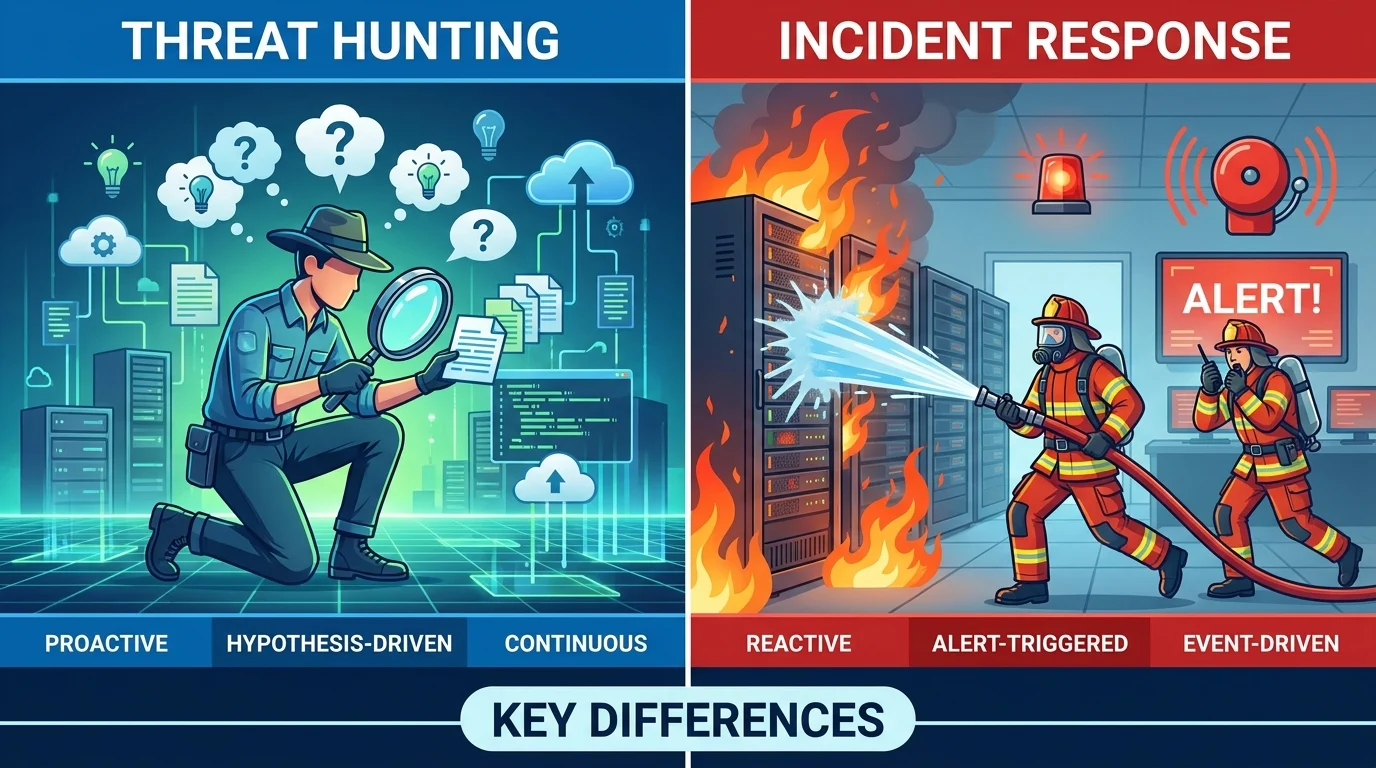
Quick Ans: Threat hunting is a proactive practice that searches for hidden threats before they trigger alerts, operating continuously without a specific trigger . Incident response is a reactive process triggered by confirmed security events, focused on containing, eradicating, and recovering from active attacks . The two are complementary: threat hunting reduces dwell time and generates high-fidelity intelligence, while incident response ensures swift action when threats are found .
Imagine your security operations center has two teams with the same tools and budget. One team processes alerts as they come in — something fires, they investigate, they close or escalate. They are fast and thorough. They find exactly what the SIEM tells them to find. The second team does all of that. And then, when the queue is manageable, they go looking for things the SIEM never flagged .
The first team catches what surfaces. The second team catches what hides. This is the fundamental difference between incident response and threat hunting .
Incident response is reactive. It begins when a security alert fires — evidence of an incident becomes clear, and the team mobilizes to contain and remediate the threat . Threat hunting, by contrast, is proactive and hypothesis-driven. It assumes an adversary is already in the environment and actively searches for evidence of compromise that has evaded existing detection tools .
These two disciplines are not mutually exclusive. In fact, they create a continuous feedback loop that strengthens overall security posture. The goal is not to choose between them but to understand how they complement each other and build a program that leverages both.
What Is Incident Response?
Incident response is the structured process an organization follows when a security breach is detected or reported. It is reactive by nature — something triggers the response, whether that’s a SIEM alert, a user report, or an external notification .
The Reactive Firefighting Model
Think of incident response like a fire alarm. When the alarm sounds, firefighters respond. They contain the fire, extinguish it, and work to restore normal operations . Incident responders do the same thing in the digital world.
The process follows the well-established PICERL framework :
- Preparation: Developing incident response plans, training teams, and establishing communication protocols.
- Identification: Detecting and confirming that a security incident has occurred.
- Containment: Limiting the scope and impact of the incident to prevent further damage.
- Eradication: Removing the root cause and malicious artifacts from the environment.
- Recovery: Restoring affected systems to normal operation.
- Lessons Learned: Analyzing what happened and improving future response.
Trigger-Based Activation
Incident response activities are typically triggered by specific events :
- Anomalous activity detected by SIEM, firewalls, or intrusion detection systems
- Alerts from endpoint protection tools
- Reports from users or external sources
- Evidence that a security event has occurred
Once triggered, the focus is on immediate action. Time is of the essence, and the primary goal is business continuity — minimizing the impact of the attack and returning to normal operations as quickly as possible .
Key Characteristics of Incident Response
Reactive orientation: The process only begins when evidence of an incident becomes clear .
Event-driven timeline: Focused on the present and immediate past — what is happening or has just happened .
Narrow focus: Limited to investigating, containing, and resolving known or ongoing incidents .
Pressure and urgency: Responders must act swiftly under pressure, often at any time of day or night .
What Is Threat Hunting?
Threat hunting is a proactive security practice where skilled analysts actively search through networks, endpoints, and data to discover malicious or suspicious activities that have evaded detection by routine tools .
The Proactive Detective Model
If incident response is like firefighting, threat hunting is like detective work. Threat hunters don’t wait for an alarm. They assume that threats already exist in the environment but have gone unnoticed, and they actively search for evidence .
Hypothesis-Driven Approach
Unlike incident response, threat hunting is not triggered by an alert. Instead, it begins with a hypothesis — a theory about how an adversary might be operating in the environment .
For example, a hunting hypothesis might be: “I believe adversary X is present because they are likely targeting our engineering department, and they are using technique Y to maintain persistence.”
From this hypothesis, the hunter develops specific tactics, techniques, and procedures (TTPs) to search for and develops queries and analytics to test the theory .
Key Characteristics of Threat Hunting
Proactive orientation: Actively searching for threats before they become full-blown incidents .
Hypothesis-driven: Begins with a theory and evolves based on evidence gathered during the investigation .
Continuous and ongoing: Hunting is not a one-time event. It is a sustained practice that operates outside the reactive cycle of alert handling .
Strategic focus: Aimed at finding hidden adversaries, advanced persistent threats (APTs), and previously unrecognized security gaps. The emphasis is on broad, proactive network defense rather than incident-specific recovery .
No specific trigger: Hunters start without a clear sign that an attack is underway, operating in the absence of any concrete evidence of compromise .
Side-by-Side Comparison of Threat Hunting vs Incident Response
| Dimension | Incident Response | Threat Hunting |
|---|---|---|
| Orientation | Reactive — responds to confirmed threats | Proactive — searches for unknown threats |
| Trigger | Alerts, user reports, or detection of suspicious activity | Hypotheses, threat intelligence, or suspicious trends |
| Timeline | Event-driven — focused on what is happening or just happened | Strategic and forward-looking — anticipatory and continuous |
| Scope | Narrow — limited to specific confirmed incidents | Broad — comprehensive search across systems and networks |
| Tempo | Urgent sprint — immediate action required | Flexible marathon — sustained investigation over time |
| Goal | Contain, eradicate, recover | Discover, detect, prevent |
| Success Metric | Business returned to normal operation | Discovery of hidden threats, improved detections, reduced blind spots |
The Skills Each Team Requires
Incident Response Skills
Incident responders need to be experts in forensic analysis, root cause analysis, malware remediation, and crisis management. They must be adept at following procedures, documenting actions, and coordinating with stakeholders under pressure. Technical skills like log analysis, system restoration, and evidence preservation are vital in this role .
Threat Hunting Skills
Threat hunters need analytical skills, creativity, and a deep understanding of attacker tactics, techniques, and procedures (TTPs). Their work relies heavily on interpreting subtle patterns, forming hypotheses, and leveraging threat intelligence. The skill set also includes scripting, behavioral analysis, and familiarity with security tooling for in-depth network and endpoint investigation .
How Threat Hunting and Incident Response Complement Each Other
Despite their differences, threat hunting and incident response are not competing disciplines. They are complementary forces that create a continuous feedback loop for improved security .
Threat Hunting Enhances Incident Response
When threat hunters find malicious activity, they provide incident response teams with actionable intelligence. The hunters have already done the detective work — they can hand over the adversary’s TTPs, indicators of compromise, and attack paths directly to the response team, speeding up the containment and eradication phases .
Additionally, threat hunting reduces the attack surface. When hunters analyze systems the way attackers would, they gain visibility into :
- Hosts visible from an endpoint
- Critical assets accessible on the network
- Lateral movement pathways across networks and systems
This intelligence allows organizations to implement controls that limit an attacker’s ability to exploit vulnerabilities, reducing the number of devices that the incident response team needs to investigate when an alert fires .
Incident Response Feeds Threat Hunting
The reverse is equally important. When incident responders investigate a breach, they gather forensic artifacts, attack vectors, and indicators of compromise. These findings can be fed back into threat hunting hypotheses, helping uncover related activity elsewhere in the environment .
The Continuous Feedback Loop
Together, threat hunting and incident response create a virtuous cycle :
- Threat hunting discovers new TTPs and weaknesses.
- These findings are used to improve incident response playbooks.
- Incident response uncovers intelligence during real attacks.
- This intelligence feeds into new hunting hypotheses.
- Hunting teams use these hypotheses to find additional hidden threats.
Practical Integration Strategies
Create hybrid roles to cross-pollinate expertise: Designate security personnel who rotate between threat hunting and incident response duties. This cross-training enhances threat detection strategies with real-world IR insights and improves IR agility by incorporating proactive mindset and tactics .
Use hunting data to refine IR triage logic: Analyze threat hunting findings to tune incident response alert logic, such as adjusting SIEM correlation rules or prioritizing specific TTPs. This reduces noise and improves incident triage efficiency .
Build “threat hunting triggers” into post-incident reviews: After every incident, define at least one follow-up hunting hypothesis derived from the IR artifacts. This ensures that threat hunting continuously evolves based on real attacker behavior within the environment .
Establish a unified timeline for correlation: Develop a normalized, environment-wide timeline that includes both hunting discoveries and IR artifacts. This supports more efficient incident reconstruction and helps validate or disprove hunting hypotheses .
Leverage unresolved IR anomalies as hunting seeds: Use incomplete or ambiguous indicators from IR investigations, like unexplained lateral movement or unknown binaries, as leads for new threat hunts, even if the initial incident is closed .
Frequently Asked Questions
What is the main difference between threat hunting and incident response?
Threat hunting is proactive — you search for threats before they trigger alerts. Incident response is reactive — you respond after a threat has been confirmed .
Do I need both threat hunting and incident response?
Yes. They are complementary. Incident response ensures you can contain and recover from active attacks, while threat hunting finds the threats that traditional tools miss .
How do I know if my organization is ready for threat hunting?
A SOC should effectively respond to incidents, address IR tickets accurately and in a timely fashion, and have the right data to see both network and host activity broadly and with high fidelity .
Can incident responders also be threat hunters?
Yes, but the mindsets are different. Incident responders focus on containment and recovery under pressure. Threat hunters need creativity and a long-term investigative mindset. Cross-training is valuable but requires different skills .
What does a threat hunting hypothesis look like?
An example: “I believe adversary X is present because they are likely targeting our engineering department using technique Y. I will search for evidence of this TTP across relevant logs” .
Is threat hunting just “advanced alert investigation”?
No. Hunting is initiated outside routine incident investigation. It is not just investigating alerts — it is proactively searching for evidence of compromise that hasn’t generated any alert yet .
What tools do threat hunters and incident responders use?
Both use SIEM, EDR/XDR, and forensic tools. However, hunters often require more advanced analytics, behavioral analysis, and threat intelligence platforms to formulate and test hypotheses .
Conclusion
Threat hunting and incident response are two sides of the same cybersecurity coin. One finds the threats that evade detection, and the other ensures swift action when confirmed threats appear. They are not alternatives — they are essential partners.
Organizations that fund only the reactive model catch what surfaces. Those that invest in both models catch what hides . The hidden threats are the ones designed to avoid detection entirely, and they are the ones most likely to cause significant damage.
Invest in threat hunting to reduce attacker dwell time and discover threats early. Invest in incident response to contain and recover when threats are found. Build the feedback loop between them, and you create a security program that is both proactive and reactive, capable of defending against today’s sophisticated adversaries.
Discover More:
- 200+ Best Out of Office Replies for Every Situation in 2026
- 150+ Clear Explanations of Response and Explanatory Variables 2026

2 thoughts on “Threat Hunting vs Incident Response: 7 Key Differences and How They Work Together for Cyber Resilience 2026”