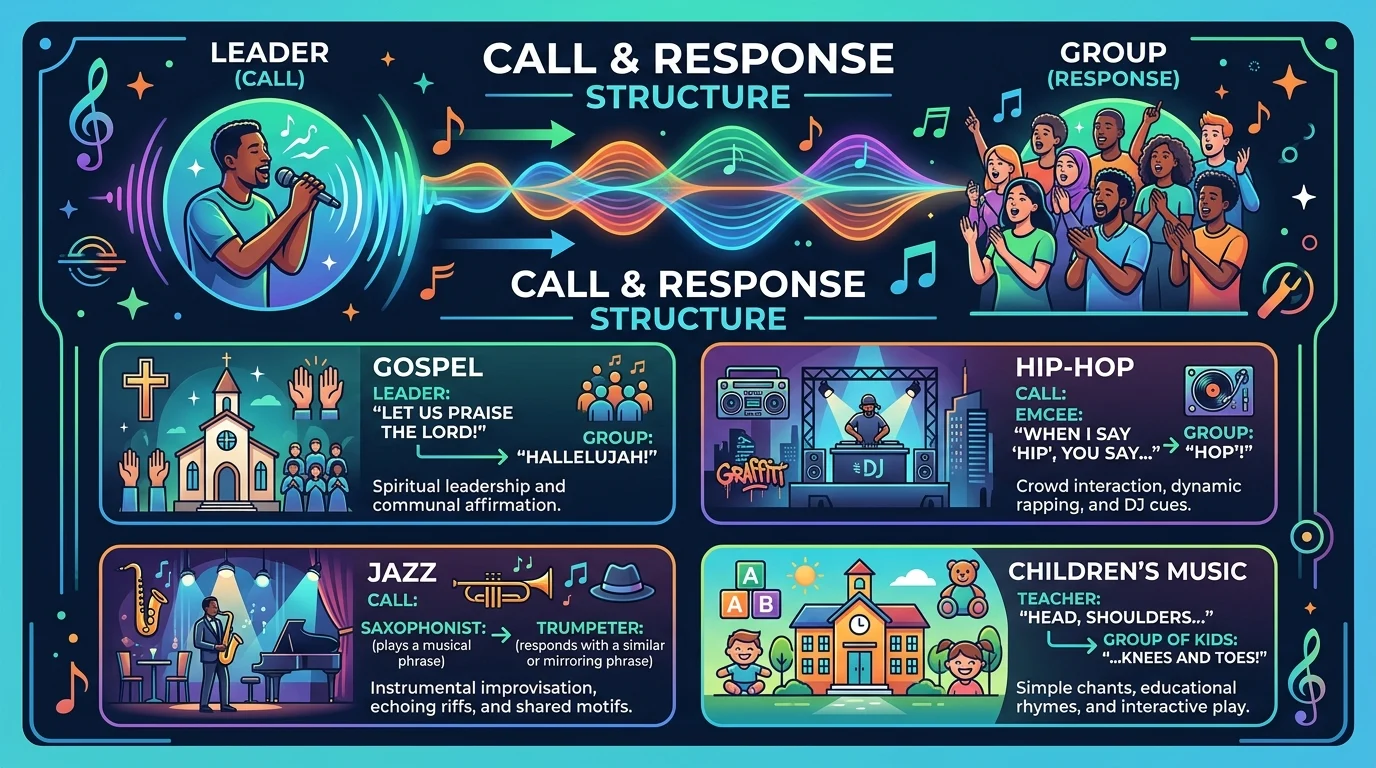
Quick Ans: Call and response is a musical technique where one phrase (the call) is answered by another phrase (the response), typically performed by a leader and a group. Rooted in African musical traditions, it appears across gospel, blues, jazz, hip-hop, work songs, and children’s songs. Key examples include “When the Saints Go Marching In,” gospel church singing, James Brown’s “Say It Loud,” and classroom chants like “1-2-3, eyes on me.” The technique builds community, reinforces memory, and creates musical dialogue.
One person sings a line. The group answers back. That simple exchange is one of the oldest and most powerful musical tools in human history.
Call and response is a technique where a distinct musical phrase is followed by a direct answer, usually performed by a different musician or group. The leader delivers the call, and the ensemble delivers the response. This pattern appears in nearly every musical tradition descended from African roots, including gospel, blues, jazz, R&B, hip-hop, and children’s songs. It’s also a fundamental element of oral storytelling, religious worship, protest movements, and even classroom management.
The technique survived the transatlantic slave trade, shaped American popular music, and continues to influence artists worldwide. From church pews to stadium concerts to elementary school classrooms, call and response creates connection. It turns listeners into participants and individuals into a community. Understanding where it came from and how it works reveals why this simple exchange has endured for centuries.
What Is Call and Response?
1. A Musical Dialogue Technique
Call and response is a technique where one phrase is answered by another phrase, creating a musical conversation.
2. Leader and Group Structure
A leader (soloist) performs the call, and an ensemble or audience performs the response.
3. Rooted in African Traditions
The technique originates from sub-Saharan African musical traditions, where it is a fundamental component of community performance.
4. Not Just Music
The technique extends beyond music into storytelling, religious worship, protest chants, and education.
5. A Universal Pattern
It appears in cultures worldwide, though its specific forms vary by region and tradition.
6. A Participatory Form
Call and response breaks the barrier between performer and audience, inviting everyone into the performance.
7. A Memory Aid
The repetitive structure helps participants learn and remember lyrics, melodies, and information.
8. A Community Builder
The exchange creates shared experience and collective identity among participants.
9. A Flexible Tool
It works across genres from gospel to hip-hop to children’s music.
10. A Surviving Tradition
Enslaved Africans carried call and response to the Americas, where it shaped generations of music.
11. A Foundation of Popular Music
Elements of call and response appear in blues, jazz, R&B, soul, funk, and hip-hop.
12. A Living Practice
Artists continue to use and reinvent call and response in contemporary music.
Origins and History
1. African Roots
Call and response originated in sub-Saharan African cultures, where it was central to communal music-making.
2. Community Participation
In African traditions, music was a community activity, not a performance by a select few.
3. The Transatlantic Slave Trade
Enslaved Africans brought call and response traditions to the Americas, preserving them despite brutal conditions.
4. Survival Through Adaptation
The technique survived enslavement because it required no instruments, only voices.
5. Work Songs
Call and response became a tool for coordinating labor and maintaining morale during forced work.
6. Field Hollers
Solo field hollers and group responses evolved into early blues forms.
7. The Black Church
Gospel music became a powerful vehicle for call and response in worship settings.
8. The Blues Tradition
Blues musicians incorporated call and response between voice and guitar.
9. Jazz Evolution
Jazz bands used call and response between sections, soloists, and the ensemble.
10. R&B and Soul
Artists like James Brown, Ray Charles, and Aretha Franklin made call and response a signature.
11. Hip-Hop Culture
Hip-hop inherited call and response from its African American musical ancestors.
12. Global Influence
The technique spread worldwide, influencing music in Latin America, the Caribbean, and beyond.
Call and Response in Gospel Music
1. The Church Setting
Gospel worship relies heavily on call and response between the worship leader and the congregation.
2. “Can I Get an Amen?”
The most familiar example: a leader asks, and the congregation responds with “Amen!”
3. Praise Breaks
Worship leaders use call and response to build energy during praise and worship segments.
4. Choir Arrangements
Gospel choirs often structure songs with a lead singer calling and the choir responding.
5. Traditional Hymns
Many traditional hymns include refrains that the congregation sings in response to the leader.
6. Modern Worship
Contemporary worship music continues the tradition with leader-congregation exchanges.
7. Emotional Release
The technique allows for emotional expression and collective spiritual experience.
8. Community Affirmation
The response affirms shared belief and belonging among worshippers.
9. Historical Significance
The Black church preserved call and response through centuries of oppression.
10. Influence on Secular Music
Gospel’s call and response techniques shaped soul, R&B, and rock music.
11. Famous Examples
“Swing Low, Sweet Chariot” and “Wade in the Water” are classic examples.
12. Modern Gospel Artists
Artists like Kirk Franklin and Tasha Cobbs Leonard use call and response in contemporary gospel.
Call and Response in Blues and Jazz
1. Blues Origins
Early blues musicians used call and response between voice and guitar.
2. The Twelve-Bar Structure
Classic blues forms often feature a vocal call followed by an instrumental response.
3. Field Hollers
Solo field hollers and group responses evolved into blues songs.
4. Jazz Ensemble Exchanges
Jazz bands exchange phrases between sections, soloists, and the full ensemble.
5. The Trumpet Section
Big bands used call and response between brass sections and reeds.
6. Scat Singing
Vocalists like Ella Fitzgerald traded phrases with instrumentalists in call and response.
7. The Blues Shout
Blues shouters used call and response to energize audiences.
8. Boogie-Woogie Piano
Piano players created call and response between left and right hands.
9. New Orleans Jazz
Second-line bands used call and response between the leader and the crowd.
10. Modern Jazz
Contemporary jazz musicians continue to use call and response in improvisation.
11. Famous Examples
“Take the ‘A’ Train” and “C Jam Blues” feature call and response elements.
12. Jazz Education
Teachers use call and response to teach improvisation and rhythm.
Call and Response in R&B, Soul, and Funk
1. James Brown’s Signature
Brown’s “Say It Loud – I’m Black and I’m Proud” features iconic call and response.
2. “Cold Sweat”
Brown’s classic uses call and response between his vocals and the band.
3. Ray Charles
Charles used call and response with his Raelettes vocal group.
4. Aretha Franklin
“Respect” features call and response between Franklin and her backing singers.
5. Otis Redding
Redding’s live performances featured extensive call and response with audiences.
6. Sam and Dave
“Hold On, I’m Comin'” showcases call and response between the duo and band.
7. The Temptations
The group traded lines between lead singers and the ensemble.
8. Sly and the Family Stone
“Thank You (Falettinme Be Mice Elf Agin)” uses call and response.
9. Funk Bands
Funk groups used call and response between horns, vocals, and rhythm section.
10. Prince
Prince incorporated call and response into his live performances.
11. Modern R&B
Contemporary R&B artists continue the tradition.
12. Beyoncé
Beyoncé’s music frequently features call and response with backing vocalists.
Call and Response in Hip-Hop
1. Inherited Tradition
Hip-hop inherited call and response from its African American musical ancestors.
2. Party Chants
Early hip-hop DJs used call and response to engage crowds at parties.
3. “Throw Your Hands in the Air”
Classic hip-hop call and response phrase that gets audiences involved.
4. “When I Say Hip, You Say Hop”
The most basic form of hip-hop call and response.
5. Call and Response in Rap Verses
Rappers trade lines with hype men, backing vocalists, or the crowd.
6. Live Performance
Hip-hop concerts rely heavily on call and response to build energy.
7. Famous Examples
“Rapper’s Delight” by Sugarhill Gang features call and response elements.
8. The Hype Man
The hype man’s role is built on call and response with the main rapper.
9. Modern Hip-Hop
Artists like Drake, Kendrick Lamar, and Cardi B use call and response.
10. Crowd Participation
“Everybody say hey!” is a staple of hip-hop live shows.
11. Call and Response in Trap
Trap music uses ad-libs as responses to the main vocal.
12. Global Hip-Hop
Call and response appears in hip-hop cultures worldwide.
Call and Response in Children’s Music
1. Simple and Repetitive
Children’s songs use simple, repetitive call and response patterns.
2. “The Wheels on the Bus”
The song features verses with repetitive responses.
3. “Old MacDonald Had a Farm”
Each animal sound is a response to the call.
4. “If You’re Happy and You Know It”
The clapping, stomping, and shouting are responses to the call.
5. “Head, Shoulders, Knees, and Toes”
The song builds memory through call and response.
6. “B-I-N-G-O”
The spelling and clapping pattern is call and response.
7. “Row, Row, Row Your Boat”
The round structure creates overlapping call and response.
8. “Baby Shark”
The repetitive family responses are call and response.
9. “The Hokey Pokey”
The actions are responses to the leader’s call.
10. Classroom Chants
“1-2-3, eyes on me” and “Ready, set, go” are call and response.
11. Educational Benefits
The technique helps children learn language, rhythm, and memory.
12. Cultural Transmission
Children’s games and songs pass traditions through generations.
Call and Response in Other Contexts
1. Protest Movements
“Whose streets? Our streets!” is a classic protest call and response.
2. Sports Chants
Stadium chants use call and response to unify fans.
3. Military Cadences
“Left, left, left right left” and other cadences use call and response.
4. Work Songs
Call and response coordinated labor and maintained morale.
5. Storytelling Traditions
Oral storytellers use call and response to engage audiences.
6. Religious Liturgy
Many religious traditions use call and response in prayers and readings.
7. Political Rallying
“Fired up! Ready to go!” is a political call and response.
8. Cheerleading
Cheers use call and response between the cheer captain and squad.
9. Audience Participation
Comedians and performers use call and response to engage crowds.
10. Language Learning
Call and response is used to teach vocabulary and pronunciation.
11. Therapy and Counseling
Group therapy uses call and response for affirmation and support.
12. Community Building
Any gathering can use call and response to create shared identity.
Frequently Asked Questions
What is call and response?
Call and response is a musical technique where one phrase (the call) is answered by another phrase (the response), typically between a leader and a group.
Where did call and response originate?
It originated in sub-Saharan African musical traditions and was brought to the Americas through the transatlantic slave trade.
What are some examples of call and response?
“Can I get an Amen?” in church, “When I say hip, you say hop” in hip-hop, and “1-2-3, eyes on me” in classrooms.
How is call and response used in gospel music?
Worship leaders deliver calls, and the congregation responds, creating collective spiritual expression and community affirmation.
How does call and response work in jazz?
Jazz musicians exchange phrases between soloists, sections, and the full ensemble.
What is the role of call and response in blues?
Blues musicians use call and response between voice and guitar, and between the singer and the audience.
How does hip-hop use call and response?
Hip-hop inherited the tradition from earlier Black music forms. Rappers trade lines with hype men, backing vocalists, or crowds.
Why is call and response important in children’s music?
It helps children learn language, rhythm, and memory while building social connection and participation.
Is call and response only in music?
No. It appears in protest chants, sports cheers, military cadences, storytelling, religious liturgy, and education.
What is the difference between call and response and a round?
In call and response, one part answers another. In a round, the same melody is sung at different times by different groups.
How does call and response build community?
It turns passive listeners into active participants, creating shared experience and collective identity.
Conclusion
Call and response is one of the most enduring and powerful tools in human expression. From its roots in African traditions through centuries of survival and evolution, it has shaped gospel, blues, jazz, R&B, funk, hip-hop, children’s music, protest movements, and classroom management.
The technique works because it turns listeners into participants. It breaks down the barrier between performer and audience, creating shared experience and collective identity. It helps people remember, learn, and connect. Whether you’re a worship leader, a teacher, a rapper, or a protest organizer, call and response is a tool you can use to engage, energize, and unify.
The next time you hear “Can I get an Amen?” or “When I say hip, you say hop,” you’ll recognize the ancient tradition at work. Share this guide with someone who loves music, teaching, or history, and keep the call and response tradition alive.
Discover More:

1 thought on “What Is Call and Response: Complete Guide for 2026”