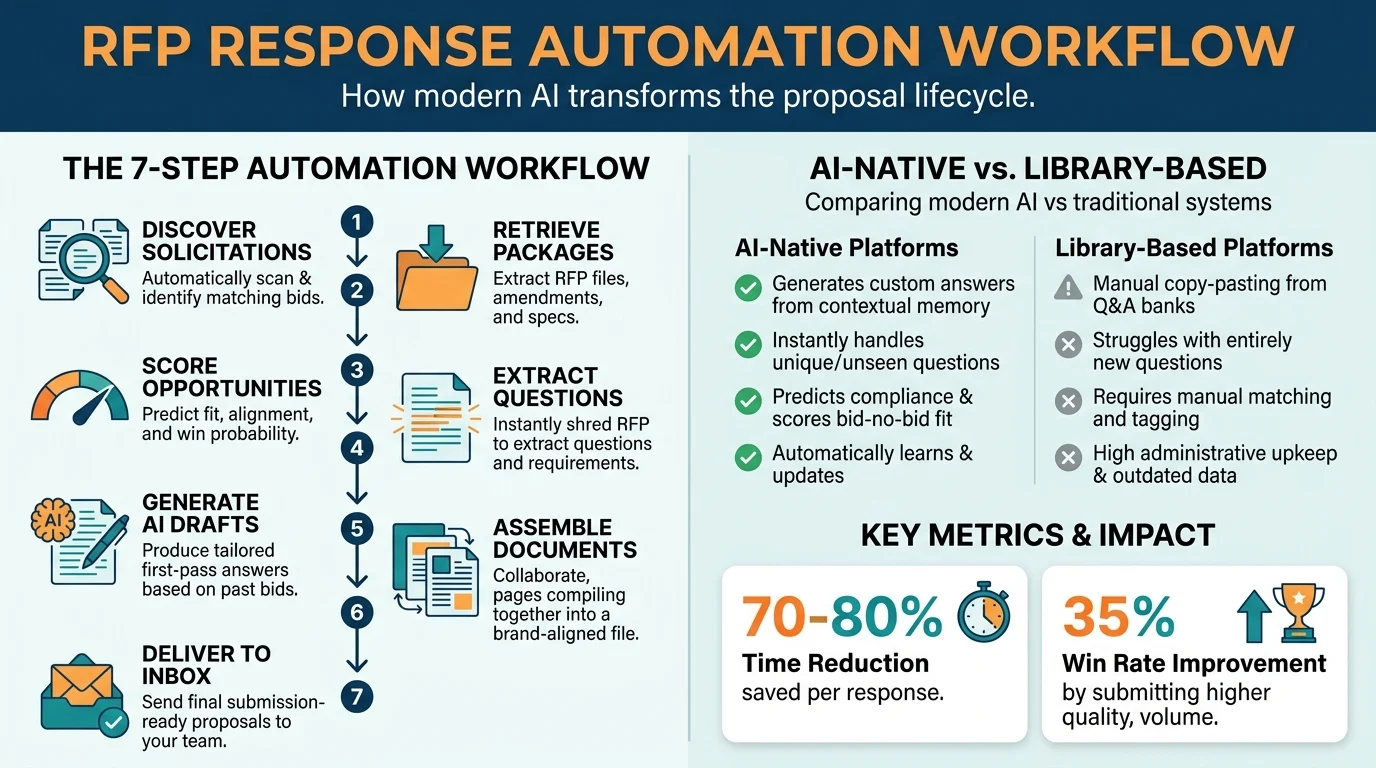
Quick Ans: RFP response automation software uses AI to automate the process of responding to Requests for Proposals. These platforms extract questions from RFP documents, generate draft answers from your knowledge base, and produce polished Word or PDF documents. Key benefits include 70-80% reduction in response time, 35% improvement in win rates, and elimination of manual portal-hopping and blank-page drafting. Top platforms include AutoRFP.ai ($899/month flat), Iris (4.9/5 rating), Loopio (library-focused), Responsive (enterprise integrations), and SiftHub (AI-powered RFX automation).
Responding to an RFP used to mean days of portal-hopping, copying answers from old documents, and chasing subject matter experts for input. A single solicitation could consume 20+ hours of manual work. Now imagine that entire process running while your team sleeps.
RFP response automation software uses artificial intelligence to discover solicitations, retrieve full packages, score opportunities against your win profile, and draft proposals in Microsoft Word. The same four-step loop—discover, retrieve, score, draft, and route—runs continuously against configured sources and criteria .
The market has split into two architectural approaches. Legacy platforms like Loopio and Responsive focus on content library management: storing approved answers, tagging them, and helping teams search and reuse past responses . AI-native platforms like AutoRFP.ai and Iris generate context-aware first drafts from your connected knowledge sources, treating your content as a live knowledge ledger rather than a static repository .
Understanding these differences matters because the wrong choice creates administrative bottlenecks instead of eliminating them. Let’s break down exactly how these platforms work and which one fits your team.
What Is RFP Response Automation Software?
1. AI-Powered Document Processing
Platforms extract text from PDFs, Word files, and images using OCR integration, supporting formats like .docx, .pdf, .png, and .jpg .
2. Intelligent Question Detection
The software automatically finds and extracts questions from RFP documents, separating them from instructions and boilerplate text .
3. Knowledge Base Retrieval
Embeddings-based semantic search matches RFP questions against your uploaded content, retrieving relevant answers from past proposals and documentation .
4. AI-Generated Draft Responses
Large language models generate context-aware draft answers using retrieval-augmented generation (RAG), pulling from approved knowledge sources and citing sources on every answer .
5. Professional Document Generation
Platforms export polished Word or PDF documents with consistent branding, dynamic tokens like [BUSINESS_NAME], and auto-generated tables .
6. Workflow and Collaboration Tools
Task assignment, progress tracking, review cycles, and approval workflows keep sales, legal, and security teams aligned during complex RFP cycles .
7. Multi-Source Integration
Platforms connect with CRMs, cloud storage, Confluence, Slack, and other systems to centralize institutional knowledge .
8. Continuous Pipeline Monitoring
Managed services monitor public-sector and enterprise procurement portals continuously, retrieving full solicitation packages as they appear .
9. Scoring Against Win Profiles
AI scores each opportunity against your configured criteria, helping teams prioritize which RFPs to pursue .
10. Automated Routing and Delivery
Ready-to-review packages are delivered to assigned reps via their existing inbox, eliminating the need for a new tool .
Key Features to Look For
1. AI-Native Drafting Versus Library Search
AI-native platforms generate first drafts from connected knowledge, while library-based platforms suggest answers from a curated repository. The drafting step delivers the biggest time savings .
2. Knowledge Base Architecture
Some platforms use manual Q&A pairs requiring ongoing curation. Others use live source connectors that sync with existing documents, Slack, Salesforce, and Notion .
3. Question Detection Accuracy
The platform should reliably identify questions versus instructions, dropdowns, sections, and answer cells within complex questionnaires .
4. Source Citation and Grounding
Every AI-generated answer should cite its grounding source. Platforms that draft without a source create hallucination risk .
5. Approval Workflows
Sequential approval layers, approval-gated saves to shared content, and locked approved answers prevent unvetted content from entering responses .
6. Integration Ecosystem
Native connectors for Slack, Microsoft Teams, Salesforce, CRM systems, and document storage platforms determine how seamlessly the tool fits your stack .
7. Security Certifications
SOC 2 Type II, ISO 27001, HIPAA, and GDPR compliance are essential for regulated industries. Verify certifications and data residency options .
8. Pricing Transparency
Per-seat fees, project-based pricing, annual contracts, and implementation costs vary dramatically. Some platforms charge $899/month flat with unlimited users; others start at $20,000/year .
9. Automation Rate Reporting
The platform should report the percentage of AI draft content that survives to final approval without edits, making the automation rate meaningful .
10. Time to Value
Setup time ranges from under an hour for simple tools to weeks for enterprise platforms requiring content library curation .
Top RFP Response Automation Platforms in 2026
1. AutoRFP.ai
Flat pricing at $899/month for 24 projects/year with unlimited users, AI, content, SSO, integrations, and implementation included. Best for SMB-mid-market teams wanting transparent pricing .
2. Iris
AI-native RFP response platform with 4.9/5 G2 rating. Strong for small and mid-market teams wanting rapid first-draft generation with high knowledge accuracy .
3. Loopio
Established library-first platform with centralized answer repository. Best for enterprises committed to a library-centric workflow with resources to maintain a large content repository .
4. Responsive (formerly RFPIO)
Comprehensive platform with 40+ integrations and workflow automation. Best for large enterprises with complex tech stacks and multi-stage approval workflows .
5. SiftHub
AI-powered RFX automation with autofill, AI Teammate, and project features. SOC 2 Type II and ISO 27001 certified .
6. Respond AI by Caspio
Managed pipeline service with continuous monitoring, scoring, and drafting. Delivers ready-to-ship packages to existing inboxes. HIPAA and SOC 2 Type II certified .
7. Tribble
AI-powered RFP assistant with Slack and Microsoft Teams integration. Strong API extensibility for custom workflow layers .
8. Qvidian (Upland)
Long-standing enterprise platform with template automation and version control. Best for high-volume proposal environments prioritizing template management .
How RFP Response Automation Works
1. Source Monitoring
The platform continuously monitors configured sources—procurement portals, email inboxes, security-review platforms—for new solicitations .
2. Package Retrieval
When a new RFP appears, the system retrieves the full solicitation package, including all attachments and referenced documents .
3. Opportunity Scoring
Each opportunity is scored against your win profile, helping teams prioritize which RFPs align with their strengths .
4. Question Extraction
The platform parses the RFP document, extracting questions and separating them from instructions and boilerplate .
5. Knowledge Retrieval
Semantic search matches each question against your knowledge base, retrieving relevant content from past proposals and documentation .
6. Draft Generation
AI generates context-aware draft answers using RAG, citing grounding sources and flagging items needing subject matter expert input .
7. Document Assembly
Drafts are assembled into the buyer’s template, producing a professional Word document or Excel workbook ready for review .
8. Routing and Delivery
The completed package is routed to the assigned representative via email or dashboard, with all attachments included .
9. Review and Approval
Teams review the draft, make edits, and route through approval workflows before submission .
10. Analytics and Learning
Platforms track automation rates, win rates, and response quality, feeding learnings back into the knowledge base .
Benefits of RFP Response Automation
1. 70-80% Reduction in Per-Response Time
Teams using AI-native tools report massive time savings because the AI handles first drafts, not just search .
2. 35% Improvement in Win Rates
Forrester Research found enterprises automating RFP workflows see 35% win rate improvement within the first year .
3. Eliminates Portal-Hopping
Continuous monitoring replaces manual checking of dozens of procurement portals .
4. Reduces Blank-Page Drafting
AI-generated first drafts eliminate the paralysis of starting from scratch .
5. Captures Institutional Knowledge
Platforms centralize approved content, making organizational expertise searchable and reusable .
6. Improves Response Consistency
Approved content libraries and AI grounding ensure consistent messaging across all responses .
7. Enables Scale Without Headcount
Platform infrastructure scales with volume without additional engineering or proposal headcount .
8. Provides Data-Driven Insights
Analytics reveal automation rates, knowledge gaps, and win/loss patterns for continuous improvement .
Frequently Asked Questions
What is RFP response automation software?
It’s AI-powered software that automates the process of responding to Requests for Proposals. It extracts questions from RFP documents, generates draft answers from your knowledge base, and produces polished Word or PDF documents .
How does AI generate accurate RFP responses?
Platforms use retrieval-augmented generation (RAG) to pull relevant content from your approved knowledge sources, then generate context-aware answers with source citations .
What’s the difference between AI-native and library-based platforms?
AI-native platforms generate first drafts from connected knowledge sources. Library-based platforms suggest answers from a manually curated repository. The drafting step delivers bigger time savings .
How much does RFP response automation software cost?
Pricing varies dramatically. AutoRFP.ai charges $899/month flat. Loopio starts around $20,000/year. Responsive and enterprise platforms often exceed $50,000/year with implementation fees adding 20-40% .
What’s the typical implementation timeline?
AI-native platforms with live source connectors can be operational in days. Library-based platforms requiring content curation take weeks to months .
Should I build RFP automation in-house or buy?
For any volume under 300 RFPs/year, buying is more cost-effective. Building requires 4-8 senior engineers for 6-12 months plus ongoing maintenance. Platform economics win at every volume level .
How do I measure if the software is working?
Track automation rate (percentage of AI draft content surviving to final approval), per-response time reduction, win rate changes, and response consistency metrics .
Is RFP response automation software secure?
Reputable platforms are SOC 2 Type II certified with ISO 27001 compliance, encryption, RBAC, SSO, and audit logging. Verify data residency and model-provider terms .
Can I use it for security questionnaires too?
Yes. Most platforms handle RFPs, RFIs, DDQs, security questionnaires, and vendor qualification questionnaires through the same pipeline .
Conclusion
RFP response automation software has evolved from simple content libraries to AI-native platforms that generate context-aware first drafts while your team sleeps. The four-step loop—discover, retrieve, score, draft—runs continuously, delivering ready-to-review packages to your inbox instead of weeks of manual catch-up.
The choice between library-based and AI-native platforms comes down to your workflow. Library-based tools work for teams with well-maintained content repositories and standardized response formats. AI-native platforms excel when you want to eliminate blank-page drafting and compress response cycles dramatically.
For teams processing any volume of RFPs, the build-versus-buy analysis is clear: platform economics win at every volume level. A 12-month build timeline means thousands of hours of recoverable capacity burned before the first line of code goes to production .
Start with a proof of concept using your actual RFP content. Verify the automation rate, time savings, and win rate impact before committing. Share this guide with your proposal team and bookmark it for your next vendor evaluation.
Discover More:
- Security Incident Response Team: Complete Guide to Building and Managing Your SIRT 2026
- Interactive Voice Response Companies: Complete Guide for 2026

3 thoughts on “RFP Response Automation Software: Complete Guide for 2026”