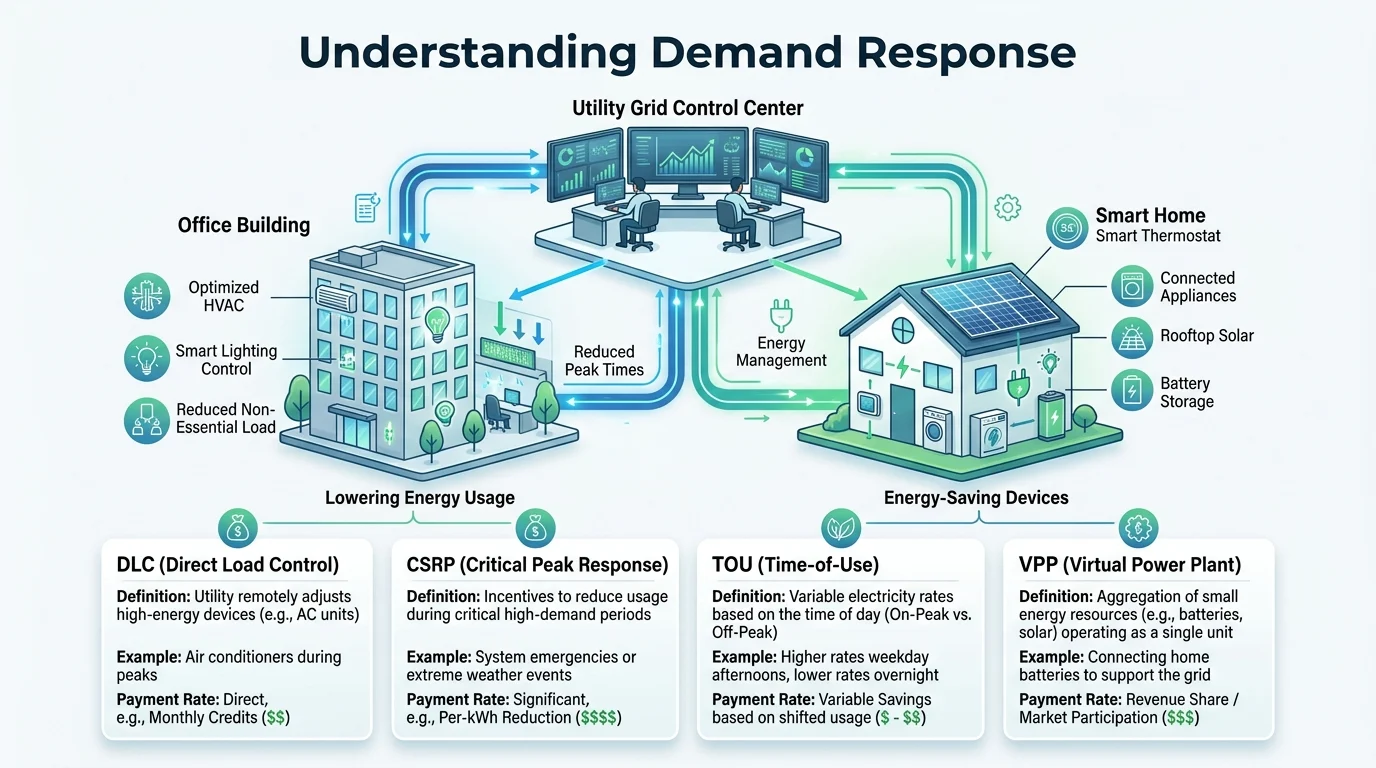
Quick Ans: Utility demand response programs pay electricity customers to reduce consumption during peak demand periods. Programs fall into three main categories: price-based (time-of-use rates, critical peak pricing), incentive-based (direct load control, curtailment programs), and demand reduction bids. Commercial participants can earn $4.25-$8.00 per kW per month in reservation payments plus $0.25-$0.50 per kWh for actual reductions. Residential customers earn bill credits or gift cards for allowing utilities to adjust smart thermostats or batteries during peak events.
When summer heat waves hit, power grids strain under the weight of millions of air conditioners running simultaneously. The traditional solution? Fire up expensive, polluting “peaker plants” that only run during the highest-demand hours. But what if the grid could pay customers to use less instead?
Utility demand response programs do exactly that. They’re agreements between electricity providers and customers where the customer gets compensated for reducing usage during peak periods . For commercial facilities, this can mean pausing production lines for a few hours in exchange for substantial payments. For homeowners, it might mean letting the utility adjust the thermostat by a few degrees during a heat wave in return for bill credits .
The concept is simple but powerful: instead of building more power plants, use demand flexibility as a virtual power plant . With U.S. electricity demand projected to grow significantly through 2030, driven by electrification, extreme weather, and data center expansion, these programs are becoming essential grid management tools . Let’s break down how utility demand response programs work and how you can participate.
What Are Utility Demand Response Programs?
1. Programs That Pay Customers to Reduce Usage
Utility demand response programs compensate electricity customers for reducing consumption during peak demand periods .
2. A Virtual Power Plant Alternative
Instead of building new peaker plants, utilities use aggregated demand reductions as a virtual power plant .
3. Three Main Program Types
Programs fall into price-based, incentive-based, and demand reduction bid categories .
4. Grid Reliability Is the Core Goal
All programs aim to relieve grid stress during periods of high demand .
5. Peak Periods Trigger Events
Utilities call “events” when demand is highest, typically summer afternoons .
6. Commercial and Residential Options
Programs exist for both large businesses and individual homeowners .
7. Payments Come in Multiple Forms
Compensation includes reservation payments, performance payments, bill credits, and gift cards .
8. Enrollment Is Voluntary
Customers choose to participate and can typically opt out of specific events .
9. Aggregators Simplify Participation
Third-party aggregators bundle smaller customers to meet minimum capacity thresholds .
10. Programs Are Growing Rapidly
U.S. demand response capacity has expanded significantly, with over 800 MW acquired in the Pacific Northwest alone as of 2025 .
11. Technology Enables Automation
Smart thermostats, batteries, and building management systems automate demand reductions .
12. Both Energy and Capacity Benefits
Programs reduce energy costs and provide capacity reserves during critical hours .
13. Environmental Benefits Included
Demand response reduces reliance on polluting peaker plants .
14. Regulatory Oversight Exists
Public utility commissions approve and oversee demand response programs .
15. The Market Is Evolving
Programs now include battery storage, EV charging, and AI-powered forecasting .
Types of Demand Response Programs
1. Direct Load Control (DLC)
Utilities remotely adjust enrolled equipment like thermostats, water heaters, or pool pumps during peak events .
2. Commercial System Relief Program (CSRP)
Commercial customers receive payments for committing to reduce load during called events .
3. Distribution Load Relief Program (DLRP)
Targeted programs address specific distribution constraints at transformer stations .
4. Time-of-Use (TOU) Rates
Customers pay lower rates during off-peak hours and higher rates during peak periods .
5. Critical Peak Pricing
Electricity prices spike significantly during the highest-demand events, incentivizing reduction .
6. Demand Bidding/Buyback
Customers submit bids to reduce consumption, and utilities select the lowest-cost offers .
7. Interruptible Load Programs
Large customers agree to curtail operations when called in exchange for rate discounts .
8. Bring Your Own Battery (BYOB)
Residential and commercial customers enroll home batteries to discharge during peak events .
9. Virtual Power Plant (VPP) Programs
Networks of distributed resources (batteries, solar, thermostats) operate as a single power plant .
10. Residential Battery Programs
Utilities offer upfront incentives and annual payments for battery participation .
11. Commercial Battery Storage
Businesses deploy BESS to earn capacity and performance payments .
12. Electric Vehicle Charging Programs
EV chargers pause or shift charging during peak demand periods .
13. Smart Thermostat Programs
Utilities adjust thermostat setpoints by a few degrees during peak events .
14. Water Heater Control
Utilities cycle water heaters off briefly during peak demand .
15. Dynamic Load Management (DLM)
Umbrella term covering multiple demand response program types .
How Demand Response Programs Work
1. Customer Enrolls in a Program
Customers sign agreements outlining commitments and compensation .
2. Baseline Usage Is Established
Utilities calculate typical usage patterns to measure reductions against .
3. Utility Issues Event Notification
Customers receive advance notice, often 21 hours before an event .
4. Customer Reduces Consumption
Participants curtail load through automated systems or manual actions .
5. Reduction Is Measured
Utilities compare actual usage to baseline to calculate performance .
6. Payment Is Calculated
Compensation is based on verified load reductions .
7. Events Typically Last 1-4 Hours
Most demand response events run for short durations during peak periods .
8. Performance Factors Apply
Customers must meet minimum response thresholds to qualify for payments .
9. Aggregators Manage Enrollment
Third parties handle enrollment and settlement for smaller customers .
10. Automation Maximizes Performance
Smart devices respond automatically without customer intervention .
11. Events Are Called When Needed
Utilities dispatch events based on grid conditions and forecasts .
12. Customer Baselines Adjust
Utilities update baseline calculations as usage patterns change .
13. Settlement Occurs Periodically
Payments are made after program periods end, often annually or monthly .
14. Performance Is Tracked
Utilities monitor participation rates and load reductions .
15. Programs Evolve Based on Results
Regulators and utilities refine programs based on performance data .
Compensation and Payments
1. Commercial Reservation Payments
Businesses earn $4.25-$8.00 per kW per month for committed capacity .
2. Commercial Performance Payments
Participants earn $0.25-$0.50 per kWh for actual load reductions .
3. Residential Bill Credits
Homeowners receive credits on their electricity bills for participation .
4. Upfront Battery Incentives
Austin Energy offers $500 upfront for home battery enrollment .
5. Annual Battery Payments
Battery participants earn an average of $300+ annually .
6. Gift Card Rewards
AEP Ohio offers $25 gift cards for 75% event participation .
7. Time-of-Use Savings
Customers save by shifting usage to off-peak hours .
8. Capacity Market Revenues
Demand response resources earn capacity payments in wholesale markets .
9. Aggregator Revenue Sharing
Aggregators take a portion of payments for managing programs .
10. Performance Factors Multiply Payments
Higher response rates increase compensation .
11. Seasonal Payment Variations
Rates may differ for summer vs. winter programs .
12. Annual Program Totals
ERCOT models show $70 million in annual program payments at 500 MW .
13. Effective Payment Considerations
Frequent events reduce per-event effective compensation .
14. Uplift Costs Are Distributed
Program costs are shared across all ratepayers .
15. Tax Implications May Apply
Businesses should consult tax advisors on payment treatment.
Eligibility and Enrollment
1. Commercial Customers Need Interval Meters
Businesses must have telecommunications-capable interval meters .
2. Minimum Capacity Thresholds
Commercial programs typically require 50 kW or more of reduction capability .
3. Aggregation Allows Smaller Participation
Aggregators bundle customers to meet minimum thresholds .
4. Residential Customers Need Smart Devices
Smart thermostats, batteries, or EV chargers enable participation .
5. Location Matters
Some programs target specific grid areas or transformer stations .
6. Enrollment Deadlines Apply
Programs have specific enrollment windows .
7. Contract Agreements Required
Participants sign agreements outlining terms and commitments .
8. Test Events May Be Required
Some programs require participation in test events .
9. Response Capability Required
Customers must demonstrate ability to reduce load when called .
10. Opt-Out Provisions Exist
Participants can typically opt out of specific events .
11. Notification Systems Required
Customers must be reachable via email, phone, or app .
12. Baseline Verification Occurs
Utilities verify baseline calculations before enrollment .
13. Program Rules Govern Participation
Detailed rules outline requirements and obligations .
14. Annual Renewal May Be Required
Some programs require re-enrollment each season .
15. Aggregator Relationships Simplify Process
Working through aggregators reduces administrative burden .
Benefits of Demand Response Programs
1. Lower Energy Bills for Participants
Customers save money through payments and reduced usage .
2. Reduced Grid Stress
Demand reductions relieve pressure on transmission and distribution systems .
3. Avoided Peaker Plant Emissions
Less reliance on polluting peaker plants improves air quality .
4. Deferred Infrastructure Upgrades
Demand response can delay costly grid upgrades .
5. Enhanced Grid Reliability
Programs help prevent outages during extreme conditions .
6. Support for Renewable Integration
Demand flexibility helps balance intermittent renewables .
7. Community Resilience
Local demand reductions support community reliability .
8. Customer Engagement
Programs educate customers about energy usage .
9. Affordability Benefits
Demand response reduces system-wide costs .
10. Capacity Resource Value
Demand response provides capacity without new generation .
11. Emissions Reductions
Lower peak demand means less fossil fuel generation .
12. Scalability
Programs can expand as participation grows .
13. Technology Innovation
Programs drive smart device and software development .
14. Economic Development
Demand response industry creates jobs .
15. Climate Goal Support
Programs contribute to state and national climate targets .
Frequently Asked Questions
What are utility demand response programs?
They are programs that pay electricity customers to reduce consumption during peak demand periods to support grid reliability .
How much can commercial customers earn?
Reservation payments range from $4.25-$8.00 per kW per month, plus $0.25-$0.50 per kWh for actual reductions .
What do residential customers receive?
Bill credits, gift cards, and annual payments. Austin Energy offers $500 upfront plus $300+ annually for battery participation .
What are the main types of demand response programs?
Price-based, incentive-based, and demand reduction bid programs .
How long do demand response events last?
Most events run 1-4 hours during peak demand periods .
Do I need special equipment to participate?
Commercial customers need interval meters. Residential customers need smart thermostats, batteries, or EV chargers .
Can small businesses participate?
Yes, through aggregators who bundle smaller customers to meet minimum thresholds .
How much notice do I get before an event?
Typically 21 hours advance notice plus a 2-hour reminder before the event window .
What happens if I don’t reduce enough during an event?
Performance factors apply. Participants must meet minimum response thresholds to qualify for payments .
Can I opt out of specific events?
Yes, most programs allow participants to opt out of individual events .
How is my baseline usage calculated?
Utilities use customer baseline load procedures based on historical usage patterns .
Are demand response payments taxable?
Businesses should consult tax advisors. Residential bill credits are typically not taxable.
How do I enroll in a demand response program?
Contact your utility directly or work through an approved aggregator .
What technology enables automated demand response?
Smart thermostats, building management systems, batteries, and AI-powered forecasting tools .
Why are demand response programs growing?
Rising electricity demand from electrification, data centers, and extreme weather, combined with the need to avoid new peaker plants .
Conclusion
Utility demand response programs represent a fundamental shift in how the grid balances supply and demand. Instead of simply building more power plants, utilities now pay customers to use less during critical hours. This virtual power plant approach delivers reliability, affordability, and environmental benefits simultaneously.
For commercial facilities, the financial opportunity is substantial: reservation payments of $4.25-$8.00 per kW per month plus performance payments for actual reductions. For homeowners, bill credits, gift cards, and battery incentives make participation worthwhile. The technology has never been more accessible, with smart thermostats, batteries, and AI-powered systems automating the entire process.
As U.S. electricity demand continues to grow, demand response will only become more valuable. Whether you’re a facility manager looking to monetize flexible load or a homeowner wanting to lower your bill, there’s likely a program for you. Start by contacting your utility or an aggregator to explore options. The grid needs your flexibility, and it’s willing to pay for it.
Discover More:
- RFP Response Automation Software: Complete Guide for 2026
- Email Response Management Software: Complete Guide for 2026

1 thought on “Utility Demand Response Programs: Complete Guide for 2026”