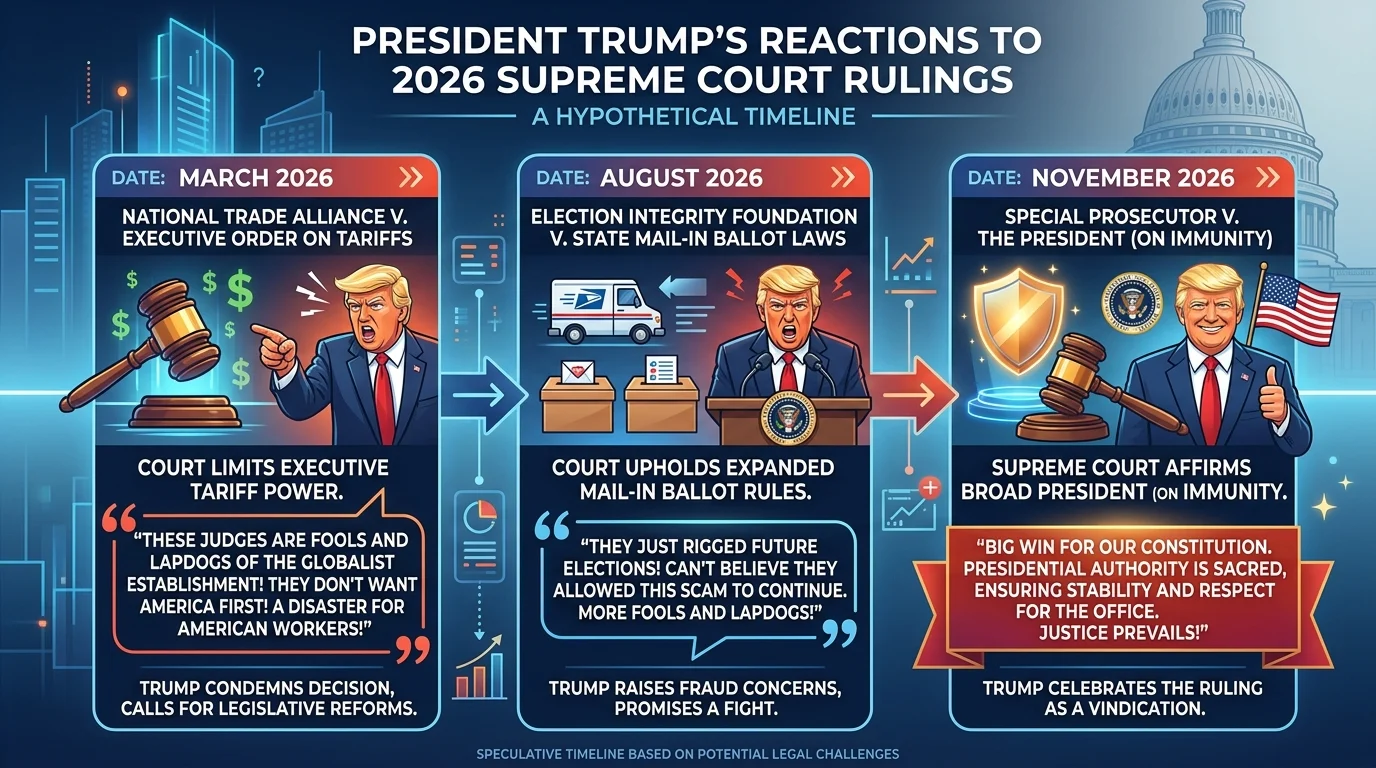
Quick Ans: President Donald Trump has responded to Supreme Court rulings with sharp public criticism across multiple cases in 2026. Key responses include calling the tariff ruling “very unfortunate” and “deeply disappointing,” saying justices who ruled against him are “not the people I interviewed,” labeling the court “fools and lapdogs,” and vowing to work around adverse decisions. He has also celebrated favorable rulings as “a big win for our constitution and democracy.” His responses range from angry social media posts to formal addresses and threats to impose new policies through alternative legal pathways.
The relationship between President Donald Trump and the Supreme Court has been one of the most closely watched dynamics in American politics. When the court rules in his favor, Trump celebrates. When it rules against him, he lashes out. In 2026, this pattern has played out repeatedly across high-stakes cases involving tariffs, immigration, elections, and presidential immunity.
Trump’s responses to Supreme Court decisions reveal a president who views the judiciary as both an ally and an obstacle. He has praised justices he appointed when they side with him and attacked them when they don’t. He has called rulings “very unfortunate,” “deeply disappointing,” and “ridiculous,” while also celebrating victories as constitutional triumphs.
Understanding these responses matters because they shape public perception of the court, influence political discourse, and signal how the administration plans to navigate legal setbacks. From tariff rulings that struck down his trade agenda to election decisions that blocked his voting restrictions, Trump has made clear he will not accept adverse rulings quietly. Let’s break down his most significant responses.
Trump Response to Supreme Court Tariff Ruling
1. Called the Ruling “Very Unfortunate”
Trump criticized the Supreme Court’s tariff decision during his State of the Union address, calling it “very unfortunate” in front of justices who had supported the ruling .
2. Said He Was “Absolutely Ashamed” of Certain Justices
At a press conference after the ruling, Trump said he was “ashamed of certain members of the court” for what he described as a lack of courage .
3. Accused Justices of Being Swayed by Foreign Interests
Without evidence, Trump claimed the justices were “swayed by foreign interests” in their decision to strike down his global tariffs .
4. Called Justices “Fools and Lapdogs”
In an extraordinary response, Trump attacked the court’s justices as “fools and lapdogs” after the tariff ruling .
5. Vowed to Resurrect Tariffs Through Other Laws
Trump signed an order for a new 10 percent tariff on all foreign imports under a different law and vowed to hike it to 15 percent .
6. Threatened Countries That “Play Games”
Trump threatened nations with “much higher” tariffs if they tried to take advantage of the court ruling, writing on social media that any country that “wants to ‘play games'” would face consequences .
7. Claimed the Ruling Gave Him “Far More Powers”
In a Truth Social post, Trump insisted the court actually gave him “far more powers and strength” with its ruling .
8. Questioned Whether a “Rehearing” Was Possible
Trump posed a question on social media about whether a “Rehearing or Readjudication” of the tariff case was possible .
9. Claimed Trading Partners Want to Keep Deals
Trump said US trading partners “want to keep the deal that they already made” with his administration, knowing his legal power to make a new deal “could be far worse for them” .
Trump Response to Supreme Court Mail-In Ballot Ruling
1. Said Justices Were “Not the People I Interviewed”
Trump attacked the Supreme Court after it rejected his push to restrict mail-in voting, saying justices who opposed him were “not the people I interviewed” .
2. Claimed the Court Was “Bullied and Cajoled”
Trump wrote that “This Supreme Court is bullied and cajoled by the Radical Left into making decisions that have set America back at least a hundred years” .
3. Called the Decision a “Blow” to Republicans
Trump wrote that “Republicans just got another bad decision from the United States Supreme Court” .
4. Said the Court “Really Let Our Country Down”
In a Truth Social post, Trump wrote that “The Supreme Court has really let our Country down!” .
5. Claimed Justices Lacked “Courage Necessary to Save Our America”
Trump alleged some justices were “totally unable to show the courage necessary to save our America” .
6. Said the Court’s Inaction Would Go Down “in a Very Negative Way”
Trump wrote that “The Court’s inability and unwillingness to do the right thing for our Country will go down, in a very negative way, in the annals of History” .
7. Claimed the Court Was Costing the US “Trillions of Dollars”
Trump asserted that the court “is costing the United States Trillions of Dollars with shockingly bad rulings” .
8. Said He Felt an “Obligation and Duty” to Criticize
Trump wrote, “It is not easy for me to write this criticism of the United States Supreme Court — it will likely cost me dearly for years to come — but I feel it my obligation and duty, as President, to do so” .
9. Called Dissenting Justices “Legends”
Trump praised Justices Alito and Thomas, who publicly dissented from the order, calling them “legends both” .
Trump Response to Supreme Court Immunity Ruling
1. Celebrated as “a Big Win for Our Constitution and Democracy”
Trump posted in all capital letters shortly after the decision: “BIG WIN FOR OUR CONSTITUTION AND DEMOCRACY. PROUD TO BE AN AMERICAN!” .
2. Said He Was “Very Honored” by the Ruling
In an interview, Trump said he was pleased by the ruling, stating “I was very honored by a nine-to-nothing vote” .
3. Claimed the Ruling Was “for Future Presidents”
Trump said the decision was “for future presidents, this is not for me” .
4. Used the Ruling to Seek Pause in Classified Documents Case
Trump’s lawyers asked a judge to partially pause the criminal case accusing him of mishandling classified documents, citing the Supreme Court’s immunity ruling .
5. Argued the Ruling Boosted His Immunity Claim
Trump said the Supreme Court’s ruling that he has broad immunity from criminal prosecution also boosts his claim of immunity in the classified documents prosecution .
6. Sought to Overturn Hush Money Conviction
Trump’s legal team sent a letter to the judge in the hush money case seeking to have the conviction set aside following the immunity ruling .
7. Claimed “Total Exoneration”
After the ruling, Trump posted “TOTAL EXONERATION” on Truth Social, though the court did not actually find him innocent of any crimes .
8. Asked Supreme Court to Overturn $83.3 Million Carroll Award
Trump asked the Supreme Court to step in and overturn an $83.3 million jury award against him for defaming E. Jean Carroll, asserting that the immunity decision shielded him from liability .
9. Argued His Statements Were “Official Presidential Statements”
Trump’s lawyers argued that his statements about Carroll, which came during his first term as president, were “official presidential statements” and thus could not be used as evidence against him .
Trump Response to Supreme Court Ballot Eligibility Ruling
1. Said He Was “Very Honored” by the Unanimous Decision
In an interview on a conservative radio program, Trump said he was pleased by the ruling, stating “I was very honored by a nine-to-nothing vote” .
2. Claimed the Ruling Was for Future Presidents
Trump said, “And this is for future presidents, this is not for me” .
3. Celebrated the Unanimous Nature of the Decision
Trump emphasized that the decision was unanimous, which he viewed as a validation .
4. Used the Ruling to Claim Vindication
Trump framed the decision as a vindication of his position that states could not unilaterally remove him from ballots .
5. Continued to Attack the Court on Other Issues
Despite celebrating the ballot ruling, Trump continued to attack the court over other decisions, showing that his praise is issue-specific .
6. Highlighted the 9-0 Vote Repeatedly
Trump repeatedly emphasized the 9-0 vote in public statements and interviews .
7. Framed the Decision as a Victory for Democracy
Trump positioned the ruling as a win for democratic principles and the Constitution .
8. Used the Decision to Fundraise
Trump’s campaign used the favorable ruling to rally supporters and raise funds .
9. Praised the Court for “Getting It Right”
Trump praised the court for what he viewed as a correct interpretation of the Constitution .
10. Contrasted This Ruling with Others He Disliked
Trump contrasted the ballot ruling with tariff and election rulings he criticized, showing selective praise .
11. Claimed the Decision Validated His Legal Position
Trump claimed the unanimous ruling validated his long-held position that the challenges were politically motivated .
12. Said the Ruling Prevented “Chaos”
Trump argued that allowing states to remove candidates from ballots would have created chaos in elections .
13. Used the Ruling to Attack Opponents
Trump used the favorable decision to criticize those who brought the ballot challenges .
Patterns in Trump’s Supreme Court Responses
1. Celebrating Favorable Rulings
When the court rules in his favor, Trump celebrates with capital letters and declarations of constitutional victory .
2. Attacking Adverse Rulings
When the court rules against him, Trump attacks the justices, questions their motives, and vows to work around the decisions .
3. Targeting His Own Appointees
Trump has been particularly critical of justices he nominated, including Amy Coney Barrett and Brett Kavanaugh, when they rule against him .
4. Praising Dissenting Justices
Trump consistently praises Justices Alito and Thomas when they dissent in his favor .
5. Using Social Media as Primary Platform
Truth Social is Trump’s primary platform for responding to Supreme Court decisions .
6. Framing Rulings as Political
Trump frequently characterizes adverse rulings as politically motivated rather than legally sound .
7. Claiming Rulings Cost the Country Money
Trump repeatedly claims adverse rulings cost the United States “trillions of dollars” .
8. Questioning the Legitimacy of the Court
Trump has questioned whether the court is “bullied” or “swayed” by foreign interests .
9. Vowing to Work Around Adverse Decisions
Trump consistently responds to losses by announcing new policies under different legal authorities .
10. Using Rulings for Political Mobilization
Trump uses both favorable and adverse rulings to rally his base and fundraise .
11. Personalizing the Conflict
Trump makes the conflict personal, targeting specific justices by name and questioning their character .
12. Claiming Victories Even in Losses
Trump often claims adverse rulings actually give him more power or strengthen his position .
13. Threatening Consequences
Trump threatens countries, companies, or political opponents with consequences following adverse rulings .
14. Questioning the Timing of Decisions
Trump complained that the mail ballot decision took too long to issue .
15. Claiming Historical Significance
Trump frames both victories and defeats as historically significant moments for the country .
Frequently Asked Questions
What did Trump say about the Supreme Court tariff ruling?
Trump called the ruling “very unfortunate” and “deeply disappointing,” said he was “absolutely ashamed” of certain justices, accused them of being swayed by foreign interests, and called them “fools and lapdogs” .
What did Trump say about the mail-in ballot ruling?
Trump said justices who opposed him were “not the people I interviewed,” claimed the court was “bullied and cajoled” by the Radical Left, and said the court “really let our Country down” .
How did Trump respond to the immunity ruling?
Trump celebrated it as a “big win for our constitution and democracy” and posted “PROUD TO BE AN AMERICAN!” in all capital letters .
Did Trump criticize justices he appointed?
Yes. Trump said justices who ruled against him “are not the people I interviewed” and are “merely a shell of their original selves” .
What did Trump say about the ballot eligibility ruling?
Trump said he was “very honored” by the unanimous decision and claimed it was “for future presidents” .
How does Trump typically respond to adverse rulings?
Trump attacks the justices, questions their motives, claims the rulings cost the country money, and vows to work around the decisions through alternative legal pathways .
What did Trump call the justices who ruled against him on tariffs?
Trump called them “fools and lapdogs” and said he was “absolutely ashamed” of them .
Did Trump threaten countries after the tariff ruling?
Yes. Trump threatened “much higher” tariffs for any country that “wants to ‘play games'” with the court decision .
How did Trump use the immunity ruling in his other legal cases?
Trump used the ruling to seek pauses in his classified documents case and to challenge his hush money conviction .
Conclusion
President Donald Trump’s responses to Supreme Court rulings in 2026 reveal a consistent pattern: celebrate favorable decisions, attack adverse ones, and vow to work around any legal setbacks. When the court sided with him on immunity and ballot eligibility, Trump declared constitutional victories. When it ruled against him on tariffs and mail-in voting, he called justices “fools and lapdogs,” said they were “not the people I interviewed,” and accused them of being swayed by foreign interests.
These responses matter because they shape public perception of the judiciary and signal how the administration will navigate legal constraints. Trump has shown he will not accept adverse rulings quietly. He will question the court’s legitimacy, threaten consequences, and pursue alternative legal pathways to achieve his policy goals.
Understanding these patterns helps observers anticipate how Trump will respond to future Supreme Court decisions. The relationship between the executive branch and the judiciary remains one of the most consequential dynamics in American politics. Share this guide with someone who wants to understand how Trump engages with the Supreme Court, and bookmark it for the next major ruling.
Discover More:
- Hospital Emergency Response: Complete Guide for 2026
- Stimulus Generalization vs Response Generalization: Complete Guide for 2026
