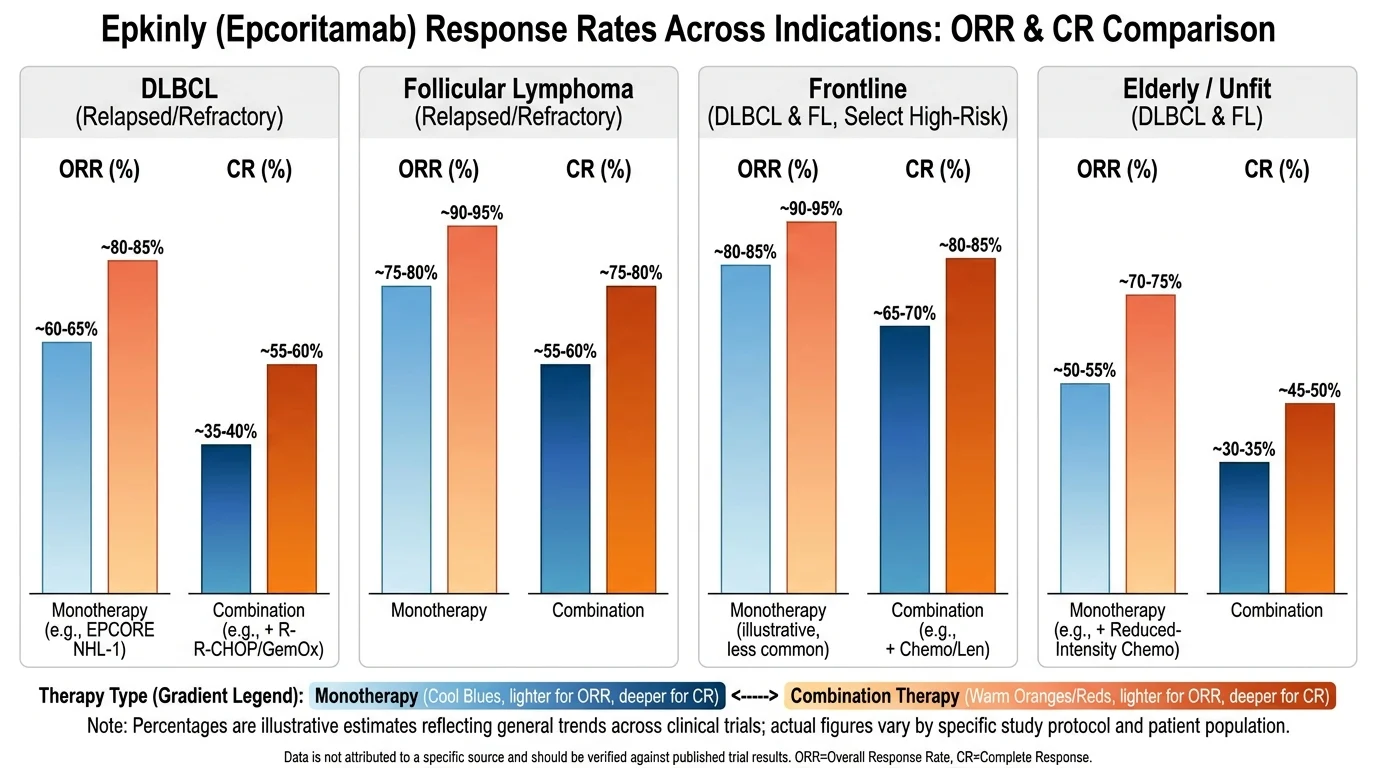
Quick Ans: Epkinly (epcoritamab-bysp) demonstrates strong response rates across multiple lymphoma types and treatment settings. In relapsed/refractory DLBCL after one prior therapy, the overall response rate (ORR) is 64.3% with a complete response (CR) rate of 47.6% . In combination with R-mini-CHOP for older newly diagnosed DLBCL, ORR reaches 93% with 86% CR . For relapsed/refractory follicular lymphoma with R2, ORR is 89% with 74% CR . First-line DLBCL combination with R-CHOP shows 98% ORR and 85% CR . Response rates vary significantly based on line of therapy, combination partners, and patient population.
Epkinly (epcoritamab-bysp) has emerged as a breakthrough in B-cell lymphoma treatment since its initial FDA approval in May 2023 for relapsed or refractory diffuse large B-cell lymphoma (DLBCL) . As a subcutaneous CD3xCD20 bispecific antibody, Epkinly directs T-cells to attack malignant B-cells. Understanding its response rate across different settings is essential for patients, caregivers, and healthcare providers considering treatment options. This guide compiles the latest efficacy data from clinical trials, covering response rates for DLBCL, follicular lymphoma (FL), and large B-cell lymphoma (LBCL) across multiple lines of therapy and combination regimens. Data comes from phase 1/2 and phase 3 trials presented at major conferences and published in peer-reviewed journals through 2025-2026.
Epkinly Response Rates in Diffuse Large B-Cell Lymphoma
Second-Line DLBCL (After One Prior Therapy)
The phase 2 EPCORE NHL-6 trial evaluated Epkinly monotherapy in patients with relapsed/refractory DLBCL who had received at least one prior line of systemic therapy .
Key Response Data:
- Overall Response Rate (ORR): 64.3%
- Complete Response (CR) Rate: 47.6%
- Setting: After one prior therapy
Third-Line or Later DLBCL (After Two or More Prior Therapies)
In patients treated after two or more prior therapies, Epkinly monotherapy continues to show meaningful activity, though response rates are lower than in earlier-line settings .
Key Response Data:
- ORR: 60%
- CR Rate: 38%
Comparative Efficacy vs. CAR T-Cell Therapy
A matching-adjusted indirect comparison (MAIC) compared Epkinly monotherapy to axicabtagene ciloleucel (axi-cel) CAR T-cell therapy in patients with relapsed/refractory DLBCL after two or more prior therapies . This analysis addressed a critical need for therapeutic alternatives to CAR T in this patient population.
Comparative Response Data:
- Epkinly ORR: 73.5%
- Axi-cel ORR: 74.3%
- No statistically significant difference in ORR, CR rate, PFS, or OS between treatments
This suggests Epkinly offers comparable efficacy to CAR T therapy while being an off-the-shelf, subcutaneously administered option .
Epkinly + R-mini-CHOP in older Newly Diagnosed DLBCL
The phase 1/2 EPCORE NHL-2 trial (arm 8) evaluated Epkinly combined with dose-attenuated rituximab, cyclophosphamide, doxorubicin, vincristine, and prednisone (R-mini-CHOP) in older patients with newly diagnosed DLBCL who were unable to receive full-dose therapy .
Key Response Data (n=28, median follow-up 33.4 months):
- ORR: 93%
- CR Rate: 86%
- Partial Response (PR) Rate: 7%
- Median Time to Response: 1.4 months
- Median Time to CR: 1.6 months
Durability:
- 79% remained in response at 2 years
- 79% remained in CR at 2 years
- 90% of patients completing therapy maintained CR at median follow-up of 22.6 months post-treatment
MRD negativity was achieved in 95% of evaluable patients, including 89% with bulky disease and 93% with high IPI scores .
Epkinly + R-CHOP in First-Line DLBCL
The phase 1/2 EPCORE NHL-2 trial (arm 1) evaluated fixed-duration Epkinly plus R-CHOP in patients with newly diagnosed DLBCL .
Key Response Data:
- ORR: 98%
- CR Rate: 85%
Subgroup Consistency:
- IPI score ≤3: 100% ORR (86% CR)
- IPI score 4-5: 94% ORR (83% CR)
- Tumor ≤10 cm: 97% ORR (84% CR)
- Tumor >10 cm: 100% ORR (88% CR)
- Age ≤60: 100% ORR (80% CR)
- Age >60: 96% ORR (89% CR)
- Germinal Center B-cell origin: 97% ORR (79% CR)
- Activated B-cell origin: 100% ORR (100% CR)
Durability:
- 92% remained in CR at 2 years
- 74% remained in CR at 3 years
- 80% progression-free at 2 years; 69% at 3 years
- 87% and 83% alive at 2 and 3 years respectively
MRD negativity was achieved in 86% of patients by day 1 of cycle 3 .
Epkinly Response Rates in Large B-Cell Lymphoma
Older Patients Ineligible for Anthracycline Therapy
The phase 2 EPCORE DLBCL-3 trial evaluated fixed-duration Epkinly monotherapy in older patients with newly diagnosed LBCL who were ineligible to receive anthracycline-based therapy .
Key Response Data (n=45):
- ORR: 69% (full analysis set) / 78% (evaluable patients)
- CR Rate: 62% (full analysis set) / 70% (evaluable patients)
- PR Rate: 7%
- Median Time to Response: 1.5 months
- Median Time to CR: 2.5 months
Durability at 6 months:
- 82% likelihood of remaining in response
- 84% likelihood of remaining in CR
- 84% of responses and 89% of CRs sustained at data cutoff
- PFS rate: 73%
- OS rate: 81%
MRD negativity was achieved in 93% of evaluable patients .
The ScienceDirect publication of the primary analysis further supports Epkinly as a promising chemotherapy-free, fixed-duration option for older adults with DLBCL and comorbidities .
Epkinly Response Rates in Follicular Lymphoma
Relapsed/Refractory Follicular Lymphoma: Phase 3 EPCORE FL-1 Trial
The phase 3 EPCORE FL-1 trial evaluated Epkinly combined with Rituxan (rituximab) and Revlimid (lenalidomide) (R2) versus R2 alone in patients with relapsed/refractory follicular lymphoma . This trial led to FDA approval of the combination on November 18, 2025 .
Key Response Data:
- Epkinly + R2 ORR: 89% (95% CI: 84%-93%)
- R2 Alone ORR: 74% (95% CI: 68%-79%)
- Epkinly + R2 CR Rate: 74% (95% CI: 69%-80%)
- R2 Alone CR Rate: 43% (95% CI: 37%-50%)
Progression-Free Survival:
- 79% reduction in risk of disease progression or death (HR: 0.21; p<0.0001)
- Median PFS not reached in Epkinly arm; 11.2 months in control arm
Safety:
- Consistent with known safety profiles of individual agents
- No new safety signals identified
The FDA also granted traditional approval to Epkinly monotherapy for relapsed/refractory follicular lymphoma after at least two prior lines of systemic therapy .
Response Rate Summary Table
| Setting | Regimen | ORR | CR Rate | Key Citation |
|---|---|---|---|---|
| R/R DLBCL (after 1 prior) | Epkinly monotherapy | 64.3% | 47.6% | |
| R/R DLBCL (after 2+ prior) | Epkinly monotherapy | 60% | 38% | |
| R/R DLBCL (3L+) vs CAR T | Epkinly monotherapy | 73.5% | 48.7% | |
| Older, newly diagnosed DLBCL | Epkinly + R-mini-CHOP | 93% | 86% | |
| Newly diagnosed DLBCL | Epkinly + R-CHOP | 98% | 85% | |
| Older LBCL (no anthracycline) | Epkinly monotherapy | 69-78% | 62-70% | |
| R/R Follicular Lymphoma | Epkinly + R2 | 89% | 74% | |
| R/R Follicular Lymphoma | R2 alone | 74% | 43% |
Factors Influencing Response Rates
Line of Therapy
Response rates decline with later lines of therapy. In DLBCL, ORR dropped from 64.3% after one prior therapy to 60% after two or more prior therapies .
Combination Partners
Adding Epkinly to chemotherapy backbones (R-CHOP, R-mini-CHOP) or immunomodulatory agents (lenalidomide) consistently improves response rates compared to monotherapy.
Patient Population
Older patients with comorbidities who are ineligible for standard chemotherapy still achieve meaningful responses with Epkinly monotherapy (69% ORR) .
Disease Type
Response rates differ by lymphoma subtype, with follicular lymphoma combination therapy showing higher ORR (89%) compared to DLBCL.
Prior Therapies
Prior CAR T exposure, lenalidomide refractoriness, and number of prior treatment lines all impact expected response rates.
Frequently Asked Questions
What is the overall response rate for Epkinly in relapsed/refractory DLBCL?
In patients after one prior therapy, ORR is 64.3% with 47.6% achieving complete response. After two or more prior therapies, ORR is 60% with 38% CR .
How does Epkinly compare to CAR T-cell therapy?
A matching-adjusted indirect comparison found no significant difference in ORR (73.5% vs 74.3%), CR rate (48.7% vs 54.5%), PFS, or OS between Epkinly and axi-cel CAR T therapy .
What is the response rate for Epkinly with R-CHOP in first-line DLBCL?
The combination achieves a 98% ORR with 85% CR, with durable remissions beyond 3 years .
Has Epkinly been approved for follicular lymphoma?
Yes. On November 18, 2025, the FDA approved Epkinly in combination with rituximab and lenalidomide for relapsed/refractory follicular lymphoma .
What response rates are seen in older patients?
In patients 75+ years with comorbidities, Epkinly monotherapy shows 69% ORR and 62% CR . Adding R-mini-CHOP yields 93% ORR and 86% CR .
Are responses durable?
Yes. In frontline DLBCL with R-CHOP, 92% remained in CR at 2 years and 74% at 3 years . In older peopleDLBCL with R-mini-CHOP, 79% remained in response at 2 years .
What is the ORR for Epkinly plus R2 in follicular lymphoma?
The ORR is 89% compared to 74% with R2 alone. CR rate is 74% versus 43% .
Does Epkinly work as monotherapy in first-line LBCL?
Yes. In older patients ineligible for anthracycline-based therapy, monotherapy shows 69-78% ORR and 62-70% CR rates .
Conclusion
Epkinly response rates demonstrate meaningful efficacy across multiple lymphoma types and treatment settings. In relapsed/refractory DLBCL, monotherapy achieves ORRs of 60-64% with CR rates of 38-48%, increasing dramatically when combined with chemotherapy or immunomodulatory agents . The 93% ORR and 86% CR rate with R-mini-CHOP in older people DLBCL represents a significant advance for a historically underserved population . In follicular lymphoma, the 89% ORR and 74% CR rate with Epkinly plus R2 led to FDA approval in November 2025 .
The comparative efficacy data suggesting Epkinly matches CAR T-cell therapy outcomes provides a valuable off-the-shelf alternative for patients . Response durability across trials remains encouraging, with many patients maintaining responses years after completing therapy.
As with any treatment, individual response varies based on disease characteristics, prior therapies, and patient factors. Discussing these data with your healthcare team helps determine whether Epkinly is the right choice for your specific situation.
Discover More:
- National Guard Response Force: Your Complete Guide to Understanding This Critical Mission 2026
- Response Code 304 Not Modified: A Complete Guide to This Web Caching Superhero 2026
