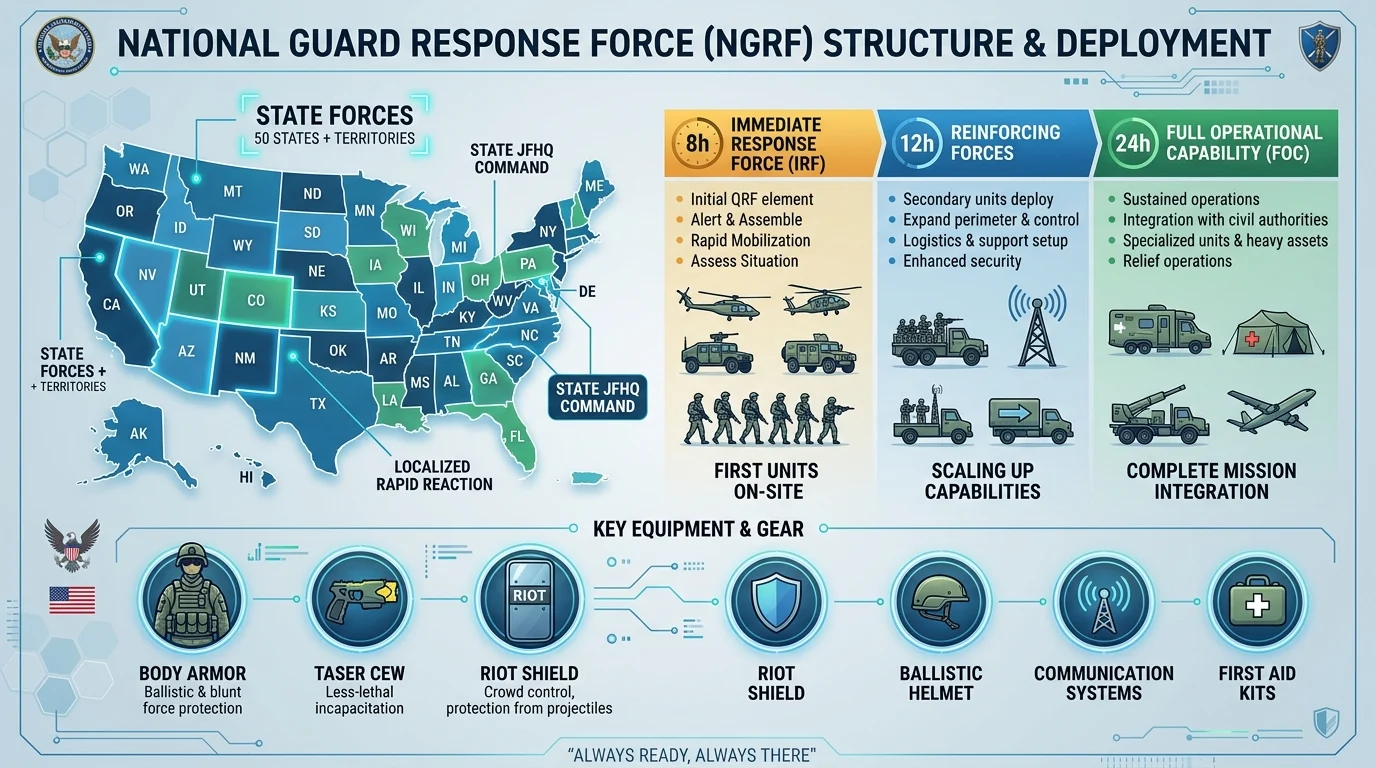
Quick Ans: The National Guard Response Force (NGRF) is a specialized, rapidly deployable team of Soldiers and Airmen available to governors for emergency response. Key facts: deploys 25% within 8 hours, 100% within 24 hours ; each state provides 250-500 personnel ; capabilities include disaster response, crowd control, and infrastructure protection ; and all 54 states/territories must have certified forces by April 1, 2026
Imagine a severe ice storm knocks out power across an entire state. Roads are impassable. People are stranded. Who shows up first? The National Guard Response Force. These highly trained units serve as America’s rapid reaction team for domestic emergencies . But what exactly is the NGRF, and why has it been making headlines recently? While these forces have existed for over 20 years, a new federal initiative is standardizing training and equipment across all states . The goal is simple: ensure every governor has a reliable, versatile tool ready to protect communities within hours . Whether responding to natural disasters like the Maui wildfires or safeguarding neighborhoods during crises, the NGRF embodies the Guard’s promise to be “Always Ready, Always There” . Let’s explore what this force does and why it matters.
What Is the National Guard Response Force?
1. A Dual-Mission Team Serving State and Nation
The NGRF operates under the governor’s command for state emergencies but can also support federal missions when needed .
2. Designed for Rapid, Scalable Deployment
Forces deploy in tiers: 25% ready within 8 hours, 50% within 12 hours, and 100% within 24 hours of activation .
3. Composed of Citizen-Soldiers and Airmen
Most NGRF members are part-time Guard personnel who live and work in the communities they protect .
4. Equipped for Multiple Mission Types
Units receive personal protective gear including body armor, face shields, and shin guards .
5. Trained in De-Escalation and Non-Lethal Tools
Training includes TASERs, batons, and Oleoresin Capsicum spray, focusing on public safety .
6. Not a New Concept, But Newly Standardized
While NGRFs have existed for 20+ years, recent federal guidelines standardize composition and readiness across all states .
7. Serves All 54 States and Territories
Every state, territory, and the District of Columbia must maintain a certified NGRF .
8. Capable of Civil Disturbance Operations
When authorized, forces assist law enforcement with crowd control and area security .
9. Logistically Self-Sustaining for 72 Hours
Units carry their own supplies to operate independently during initial response .
10. Different from Quick Reaction Forces
The NGRF focuses on state-level response, while federal QRFs handle nationwide deployments .
Key Missions of the National Guard Response Force
1. Natural Disaster Response
NGRF units assist communities during hurricanes, wildfires, ice storms, and floods .
2. Critical Infrastructure Protection
Forces safeguard power plants, water systems, and other essential facilities during emergencies .
3. Area Security Operations
Personnel secure evacuated neighborhoods and disaster zones .
4. Civil Disturbance Operations
When called, units support law enforcement with crowd control and de-escalation .
5. Defense Support of Civil Authorities
NGRF provides military support to civilian agencies during complex incidents .
6. Search and Rescue Support
Personnel assist in locating and evacuating stranded individuals during disasters .
7. Logistics and Supply Chain Support
Units clear roads and deliver essential supplies to affected communities .
8. Site Security for Emergency Operations
Forces protect command centers and staging areas during response efforts .
9. Personnel and Detainee Handling
Trained in safe handling procedures during law enforcement support missions .
10. Community Reassurance Operations
Visible Guard presence helps maintain public confidence during uncertain times.
Recent Initiatives and Standardization
1. Presidential Executive Order (August 2025)
The order directed the Department of War to ensure every state has a trained, resourced National Guard Response Force .
2. Department of War Guidance
Formalized the structure, training, and equipment standards for all state NGRFs .
3. Standardization Across 54 Jurisdictions
All states, territories, and DC must meet the new federal requirements by April 1, 2026 .
4. Enhanced Training Programs
Units undergo standardized exercises focusing on de-escalation, site security, and infrastructure protection .
5. Increased Federal Resourcing
States receive additional funding and equipment, including 100 sets of crowd-control gear each .
6. Certification Validation Exercises
Units like Michigan’s 246th Transportation Battalion completed multi-day certifications to prove readiness .
7. 400-500 Personnel Per State
Most states maintain forces of this size, with smaller states having 250-350 personnel .
8. Joint Army and Air Guard Integration
Forces combine Soldiers and Airmen for scalable, joint response capabilities .
9. Focus on De-Escalation Skills
Training emphasizes de-escalation techniques before force escalation .
10. Real-World Activations
Recent examples include the Davis Creek Fire (Nevada, 2024) and Maui Wildfires (Hawaii, 2023) .
Training and Equipment Standards
1. Personal Protective Gear
Guardsmen receive body armor, face shields, body shields, and shin guards .
2. Non-Lethal Equipment
Units train with TASERs, Oleoresin Capsicum spray, and batons for force options .
3. Level I and Level II Civil Disturbance Training
Courses cover de-escalation, crowd control, communications, and public safety .
4. Interservice Nonlethal Individual Weapons Instructor Course
Standardized training for non-lethal equipment usage .
5. Detainee Operations Training
Personnel learn safe handling and processing procedures .
6. Hasty Checkpoint Operations
Training includes establishing and managing temporary checkpoints .
7. 72-Hour Logistical Self-Sufficiency
Units carry supplies to operate independently during initial response .
8. Monthly Readiness Reporting
Commanders provide regular updates on training, personnel, and equipment status .
9. Full-Time Training Managers
Two full-time Guardsmen per state manage training and equipping efforts .
10. Real-World Scenario Exercises
Units validate skills through multi-day exercises like the Michigan certification .
State-by-State Implementation
1. Nevada National Guard
400 personnel (300 Army, 100 Air) ready within 24 hours; activated for Davis Creek Fire (2024) .
2. Michigan National Guard
246th Transportation Battalion certified in March 2026 after successful validation exercise .
3. Hawaiʻi National Guard
500+ Guardsmen; activated during 2023 Maui Wildfires for neighborhood security .
4. All 54 States and Territories
Each jurisdiction must meet the April 1, 2026, deadline for full certification .
5. District of Columbia
Maintains specialized military police battalion for capital region response .
6. Smaller States and Territories
Alaska: 350 personnel; Delaware: 250 personnel; Guam: 100 personnel .
7. Joint Force Integration
States combine Army and Air Guard assets for mission flexibility .
8. Community-Based Personnel
Most members are part-time Guardsmen from the communities they serve .
9. Governors’ Discretion on Activation
Each state’s governor controls NGRF deployment for state emergencies .
10. Support for Civilian Authorities
NGRF responds to requests from local and state law enforcement .
Frequently Asked Questions
What is the National Guard Response Force (NGRF)?
It’s a specialized team of National Guard personnel available to governors for rapid emergency response. Forces can deploy within hours and handle disasters, civil disturbances, and infrastructure protection .
How fast can the NGRF deploy?
Forces use a tiered deployment: 25% ready within 8 hours, 50% within 12 hours, and 100% within 24 hours of activation .
What missions does the NGRF perform?
Capabilities include disaster response, critical infrastructure protection, area security, civil disturbance operations, and defense support to civilian authorities .
Is the NGRF the same as a Quick Reaction Force?
No. NGRF units operate under state governors for state emergencies. Quick Reaction Forces are federal assets for nationwide deployments .
How many personnel are in each state’s NGRF?
Most states have 400-500 personnel, with smaller states like Delaware having 250 and Alaska having 350 .
What equipment does the NGRF use?
Personnel receive body armor, face shields, body shields, shin guards, and non-lethal tools like TASERs, batons, and pepper spray .
What training does the NGRF receive?
Training focuses on de-escalation, crowd control, site security, critical infrastructure protection, and safe detainee handling .
Why is the NGRF being standardized now?
A 2025 presidential executive order directed the Department of War to ensure all states have properly trained and equipped NGRFs by April 1, 2026 .
Can the NGRF make arrests?
Under federal law, Guard personnel cannot make arrests. They may only detain individuals posing a threat until police take custody .
How does the NGRF help during natural disasters?
Units assist with road clearing, supply delivery, search and rescue, area security, and evacuation support during disasters like ice storms, wildfires, and hurricanes .
Conclusion
The National Guard Response Force represents America’s frontline defense for domestic emergencies. These citizen-soldiers and airmen bring military precision to community protection, responding within hours to disasters, civil disturbances, and infrastructure threats. The new standardization initiative ensures every governor has a reliable, well-equipped force ready to serve .
Understanding the NGRF matters because it affects how communities receive help during crises. Whether facing wildfires, ice storms, or complex emergencies, these forces stand ready to protect lives and property .
The Guard’s promise remains unwavering: “Always Ready, Always There” . Next time you see National Guard personnel in your community, you’ll know they represent a carefully trained, rapidly deployable force dedicated to keeping Americans safe.

3 thoughts on “National Guard Response Force: Your Complete Guide to Understanding This Critical Mission 2026”