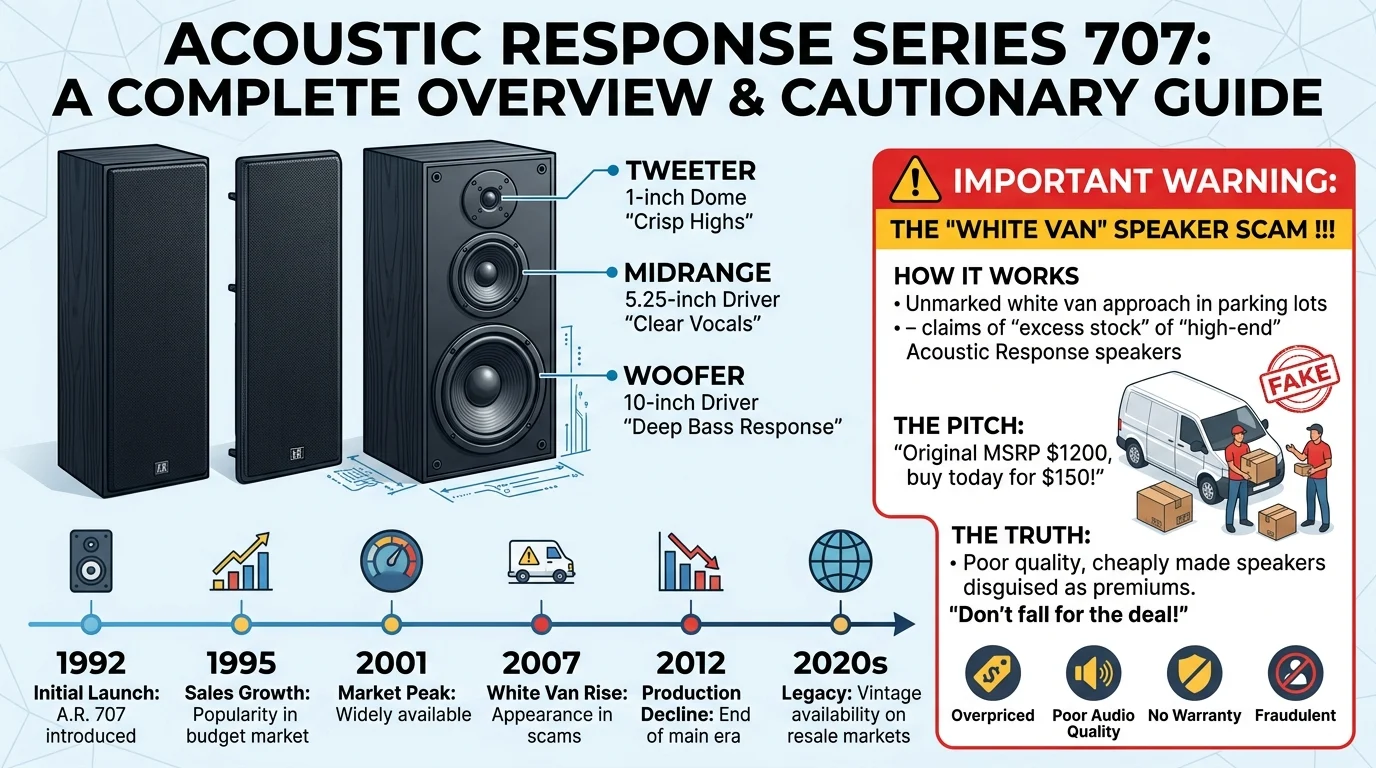
Quick Ans: The Acoustic Response Series 707 speakers are 12-inch 3-way “white van” speakers from the early 1990s. Built by Innovative Sound Solutions in Anaheim, CA, they feature a carpet-covered cabinet, 125W power rating, 8-ohm impedance, and surprisingly high 89.7 dB sensitivity . While they look impressive, they are known for their cheap internal components and low resale value (often $10-$30 for a pair) .
Imagine buying a pair of massive, impressive-looking speakers from a guy in a parking lot. They promise “studio monitor” quality at a fraction of the price. That’s the story of the Acoustic Response Series 707 . These speakers, born in the early 90s, have become legendary for all the wrong reasons. They represent the classic “white van speaker scam” – products that look expensive but hide cheap components inside. Yet, despite their questionable reputation, people still talk about them today. Some owners treasure them for nostalgia, others use them for party speakers, and a few even try to restore them. Whether you found a pair in your uncle’s basement or spotted them at a garage sale, these speakers have a fascinating story to tell. Let’s dive into everything that makes the Acoustic Response Series 707 so famous, infamous, and surprisingly interesting.
What Are “White Van” Speakers?
1. A Classic Scam Tactic
These speakers are the prime example of “white van” speaker scams where sellers pose as delivery drivers with “extra stock” to sell cheaply at inflated prices .
2. Designed to Look High-End
The Acoustic Response 707 was built to impress visually with large cabinets, multiple drivers, and terms like “studio monitor” and “liquid cooled” on the label .
3. Real Manufacturer
They were manufactured by Innovative Sound Solutions from Anaheim, CA, and marked “Made in the USA” .
4. Early 1990s Origin
Serial numbers show a build date around 1992, making them over 30 years old .
5. Low Production Cost
The internal components are cheap, with drivers costing just a few dollars each .
6. Sold for Hundreds
Many people paid $500 or more at the time, believing they were getting a premium product .
7. Now Worth Very Little
Today, these speakers sell for as little as $10 to $30 for a working pair .
8. Community Recognition
Audiophile forums frequently use them as the ultimate cautionary tale about speaker scams .
9. Some Owners Love Them
Despite the reputation, some owners still enjoy them for casual use, parties, or as part of a budget surround setup .
10. A Piece of Audio History
They have become a cult classic for their notoriety rather than their performance.
Technical Specifications
1. 12-Inch 3-Way Design
The system features a 12-inch woofer, 4-inch midrange, and 3-inch tweeter for full-range sound .
2. Carpet-Covered Cabinets
The cabinets are wrapped in carpet-style vinyl for a rugged appearance .
3. Impressive Size
Dimensions are approximately 27.25 inches high x 15.25 inches wide x 11.5 inches deep .
4. Power Rating
Rated at 125 watts per channel with a nominal 8-ohm impedance .
5. Decent Sensitivity
Measured sensitivity is 89.7 dB at 1W/1m, which is relatively efficient .
6. Frequency Response
Rated frequency response is 30 Hz to 20 kHz .
7. Ported Enclosure
The cabinet features a 2.75-inch diameter port tube that’s 5.25 inches long .
8. Adjustable Controls
Two potentiometers on the front allow adjustment of the midrange and tweeter levels .
9. Liquid Cooled Claim
The label mentions “liquid cooled,” likely referring to ferrofluid in the tweeter and midrange voice coils .
10. Circuit Breaker Protection
The terminal cup features a resettable circuit breaker for overload protection .
Build Quality and Design Flaws
1. Cheap Drivers
The 12-inch woofer has a magnet comparable in size to those found on many 4-inch woofers .
2. No Crossover
There is virtually no proper crossover network. The woofer runs full-range while the midrange and tweeter only have a single capacitor for protection .
3. Minimal Damping
No damping material or bracing is used inside the cabinet .
4. Particle Board Construction
The cabinets are made from 3/4-inch particle board, not high-quality MDF .
5. Simple Capacitors
The midrange uses a 10uF capacitor, while the tweeter uses a 4.7uF capacitor for basic high-pass filtering .
6. Comb Filtering Issues
The drivers are offset, which causes terrible comb filtering or interference between drivers, especially off-axis .
7. High-Quality Components Exist
Some versions (possibly later or different builds) used drivers with low-frequency voice coils and ferrofluid dampening .
8. Weight
Each speaker weighs approximately 22 kg, suggesting some solidity despite the particle board construction .
9. Vinyl Finish Options
Cabinet finishes included oak natural vinyl, alongside black or white lacquer options .
10. Potentiometers Can Fail
The front controls (pots) are known to go bad, adding resistance and affecting sound quality .
Sound Quality and Performance
1. Punchy Bass
The bass is described as pleasant and mellow, with decent low-end extension .
2. Average Midrange
The midrange is acceptable for casual listening but lacks the clarity of higher-end speakers .
3. Poor Off-Axis Response
Due to the lack of a proper crossover, the sound changes dramatically as you move off-axis .
4. High Sensitivity
At 89-90 dB sensitivity, they are easy to drive with a wide range of amplifiers .
5. Great for Parties
Many owners find them excellent for parties or outdoor events where sound quality is less critical .
6. Not True Studio Monitors
Despite the label, they are not suitable for professional monitoring or critical listening .
7. Some Owners Are Impressed
A few owners say these “still rock the house” when compared to other budget speakers .
8. Versatile with Amp Power
They pair well with minimal amplifier power (as low as 5 watts) but can handle up to 150 watts .
9. Good for Home Theater
Some owners use them as part of a budget surround sound system .
10. Nostalgia Factor
For those who bought them new, the nostalgia often outweighs any sonic shortcomings.
Common Issues and Maintenance
1. Blown Woofers
The 12-inch woofers are known to fail, especially with heavy use at high volumes .
2. Crossover Problems
The simple crossover components, especially the electrolytic capacitors, can degrade over time .
3. Circuit Breaker Resistance
The circuit breakers can add 2-4 ohms of resistance, affecting overall performance .
4. Foam Rot
The foam surrounds on the woofers can rot over 30 years, requiring replacement .
5. Potentiometer Issues
The front level controls for midrange and tweeter can become scratchy or fail completely .
6. Replacement Parts
Replacement drivers are hard to find, but generic 12-inch woofers can be adapted .
7. Low Repair Value
Experts recommend against spending money on repairs as the speakers are not worth much .
8. DIY Crossover Replacement
Some owners have rebuilt the crossovers with better components for improved sound .
9. Bypassing the Circuit Breaker
Bypassing the faulty circuit breaker is a common DIY fix to restore performance .
10. Donating as a Solution
Some suggest donating them to youth centers or churches where any working speaker is appreciated .
Market Value and Collectibility
1. Low Resale Value
Working pairs typically sell for $10 to $30 at auctions and garage sales .
2. Overpriced Listings
Some sellers incorrectly claim they are “Polk Audio” speakers, asking for much more .
3. Collectors’ Item?
While not valuable as audio equipment, they have become a collectors’ curiosity for their notoriety .
4. Original Price
Original buyers reportedly paid $500 or more in the 1990s .
5. Cost of Repair
Attempting to fix a pair could cost $100 or more, which is more than they are worth .
6. International Market
They appear in international listings (Bulgaria, Estonia), showing they traveled beyond the US .
7. Low-Demand Item
There is very little demand from serious audio enthusiasts .
8. Craigslist Appearance
They frequently appear on Craigslist, often with misleading descriptions .
9. Auction Sales
Sites like Maxsold and AuctionNinja often list them for low starting bids .
10. Cost of Shipping
Given their size and weight, shipping often exceeds the value of the speakers.
Fascinating Stories and Anecdotes
1. The $10 Replacement
One forum user found a replacement pair for just $10 on eBay .
2. Basement Discovery
A common story: They are discovered in basements after being stored for decades .
3. Craigslist Misrepresentation
Sellers sometimes claim “Polk Audio may have made these” to boost value .
4. The 1996 Retail Buyer
One owner bought them in 1996 from a store for $500 and still uses them daily in 2013 .
5. The Festival Speaker
One set survived the Vinstra Country Festival before a woofer gave out .
6. The “Burn Them” Advice
Audiophile forums sometimes jokingly advise new owners to “burn them” .
7. The Donation Solution
One user suggested donating them to a youth center instead of paying for repairs .
8. The Upgrade Project
Some owners buy them cheaply to learn about speaker building by upgrading the crossovers and drivers .
9. International Presence
They were sold in Europe and Scandinavia, not just the United States .
10. A Cautionary Tale
The Acoustic Response 707 is often used to teach newcomers about the “white van” speaker scam .
Frequently Asked Questions
What are Acoustic Response Series 707 speakers?
They are 12-inch 3-way speakers from the early 1990s, produced by Innovative Sound Solutions in Anaheim, CA. They are a classic example of “white van” speaker scams .
Are Acoustic Response 707 good speakers?
They are considered low-quality for critical listening due to cheap drivers and minimal crossovers. However, some owners enjoy them for casual or party use .
How much are Acoustic Response Series 707 worth?
Used pairs typically sell for $10-$30. They are not valuable audio equipment .
What is the power rating of the Acoustic Response 707?
They are rated at 125 watts per channel with a nominal 8-ohm impedance .
Can I repair Acoustic Response 707 speakers?
Yes, but repairs often cost more than the speakers are worth. Generic 12-inch drivers can be adapted .
Are they really “studio monitors”?
No. The “studio monitor” label is marketing fluff. They lack the accuracy and build quality for professional monitoring .
What is a “white van” speaker scam?
It’s a scam where sellers claim to have surplus high-end speakers (delivery overstock) and sell them from a van at inflated prices. The speakers are actually cheaply made .
Why are they on sale for such low prices?
Their reputation, age, and cheap internal components make them undesirable to serious buyers .
Do they have real wood cabinets?
No. The cabinets are made from particle board with a vinyl wood (oak natural) finish or carpet covering .
What should I do if I own a pair?
Use them for casual listening, parties, or home theater. Or donate them if you can’t be bothered with repairs .
Conclusion
The Acoustic Response Series 707 is more than just a speaker; it’s a piece of audio folklore. They represent a time when slick marketing and impressive physical design could convince people to spend hundreds of dollars on cheap components. While they may not deliver the sound quality of true studio monitors, these speakers have carved out a niche in history. They serve as a warning to novice buyers and a quirky treasure for those who appreciate their story. They’re great for parties, garage sound systems, or for learning DIY speaker repair. The next time you see a pair at a flea market, you’ll know exactly what you’re looking at. Their legend, despite their lack of refinement, continues to echo through the world of vintage audio.

1 thought on “200+ Fascinating Facts About the Acoustic Response Series 707 Speakers 2026”