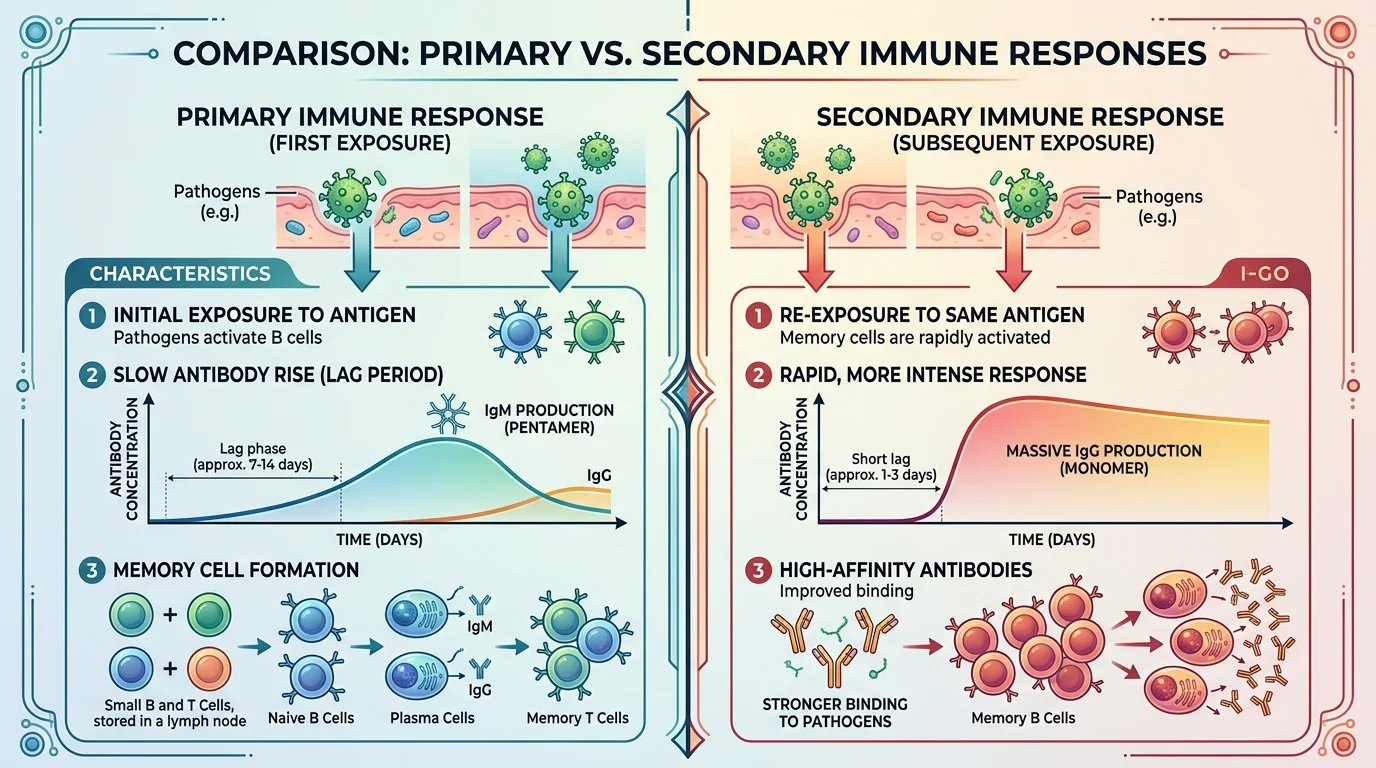
Quick Ans: The primary immune response is your body’s first encounter with a new threat, taking 5-14 days to build defenses and creating memory cells for future protection . The secondary immune response happens when the same threat returns – it’s faster (1-4 days), stronger (100-1000x more antibodies), and longer-lasting because memory cells recognize and attack immediately .
Ever wonder why you don’t get chickenpox twice? Or why vaccines work so well? The answer lives in two distinct immune responses your body runs. The primary immune response is like learning a new skill from scratch – slow, deliberate, and building muscle memory. The secondary immune response is like riding a bike years later – effortless and automatic .
When a new virus or bacteria invades, your immune system has never seen it before. This first encounter triggers the primary response. Naive B and T lymphocytes (immunologically inexperienced cells) must be activated, expanded, and trained . This whole process takes time – up to 14 days. But once the battle is won, specialized memory cells remain on standby .
Then comes the game-changer: a second encounter with the same pathogen. Memory cells spring into action immediately. The secondary immune response is faster, stronger, and more effective . This is why vaccines work – they create memory without the illness. Understanding these two responses explains everything from why you need booster shots to how your body stays healthy year after year.
Primary Immune Response
1. First Exposure Only
The primary response occurs when your body encounters a specific antigen for the very first time .
2. Involves Naive Lymphocytes
Naive B and T cells that have never responded to an antigen lead this initial defense .
3. Longer Lag Phase
There’s a delay of 4-7 days (sometimes weeks) before antibodies become detectable .
4. IgM Is the First Antibody
The initial antibody produced is mainly IgM, with small amounts of IgG appearing later .
5. Peak Response at 7-10 Days
Antibody levels reach their highest point around day 7 to 10 after exposure .
6. Lower Antibody Levels
The primary response produces fewer antibodies compared to subsequent exposures .
7. Lower Antibody Affinity
Antibodies generated have lower affinity for the specific antigen .
8. Takes Time to Establish Immunity
Full protective immunity develops slowly over the initial exposure period .
9. Creates Memory Cells
Memory B and T cells are generated for future protection .
10. Can Respond to Both T-Dependent and T-Independent Antigens
Primary responses activate against a wider range of antigens .
Secondary Immune Response
1. Subsequent Exposure
The secondary response occurs on second or later encounters with the same antigen .
2. Memory Cells Take Charge
Previously generated memory B and T cells activate rapidly .
3. Shorter Lag Phase
A much shorter delay of 1-4 days before antibodies appear .
4. IgG Dominates the Response
IgG shows a rapid rise and reaches higher titers than during the primary response .
5. Faster Peak
Antibody levels peak in just 3-5 days .
6. Antibody Levels 100-1000x Higher
The secondary response produces exponentially more antibodies .
7. Higher Antibody Affinity
Antibodies have greater affinity and specificity for the antigen .
8. Longer-Lasting Immunity
Antibody titers remain high for extended periods .
9. More Plasma Cells
The secondary response generates hundreds of antibody-producing cells compared to very few in the primary response .
10. Only T-Dependent Antigens
Secondary responses typically require thymus-dependent antigens .
Key Differences Between Primary and Secondary Responses
1. Speed of Response
Primary: 4-7 day lag phase. Secondary: 1-4 day lag phase .
2. Antibody Quantity
Primary: Lower levels. Secondary: 100-1000x higher levels .
3. Antibody Quality
Primary: Lower affinity. Secondary: Higher affinity and specificity .
4. Responding Cells
Primary: Naive B and T cells. Secondary: Memory B and T cells .
5. Main Antibody Type
Primary: IgM (then IgG). Secondary: IgG dominates rapidly .
6. Peak Timing
Primary: 7-10 days. Secondary: 3-5 days .
7. Duration of Immunity
Primary: Shorter lasting. Secondary: Longer lasting .
8. Number of Antibody-Producing Cells
Primary: Very few. Secondary: Hundreds .
9. Activation Requirements
Primary: T-dependent or T-independent. Secondary: T-dependent only .
10. Purpose
Primary: Generate memory. Secondary: Rapid, effective pathogen elimination .
The Role of Memory Cells
1. Long-Term Protection
Memory cells remain for years, providing lasting immunity .
2. Rapid Reactivation
Memory cells activate quickly upon re-exposure .
3. Survive After Infection
Most effector cells die post-infection, but memory cells persist .
4. Prevent Naive Cell Activation
Memory cells suppress naive lymphocyte responses to the same antigen, preventing wasteful duplication .
5. Higher Sensitivity
Memory B cells are more sensitive to smaller amounts of antigen .
6. Original Antigenic Sin
Memory cells may suppress responses to new variants of a pathogen, focusing on original epitopes .
7. Found in Secondary Lymphoid Organs
Central memory T cells reside in secondary lymphoid organs awaiting re-exposure .
8. Tissue-Resident Memory
Some memory cells remain in peripheral tissues like lungs and intestine .
9. IL-7 and IL-15 Support Survival
Specific cytokines help memory cells survive long-term .
10. Basis for Vaccination
Vaccines work by creating memory cells without causing disease .
Primary Response: The Step-by-Step Process
1. Antigen Recognition
Naive lymphocytes encounter a new foreign antigen for the first time .
2. Activation and Expansion
Antigen-specific cells undergo clonal proliferation .
3. Differentiation
B cells develop into plasma cells that produce antibodies .
4. Antibody Production Begins
IgM is the first antibody class to appear .
5. IgM to IgG Shift
B cells can switch from IgM to IgG production during the first and second week .
6. Germinal Center Formation
High-affinity B cell selection occurs in germinal centers of secondary lymphoid follicles .
7. Somatic Hypermutation
B cells undergo genetic changes to improve antibody affinity .
8. Contraction Phase
Most effector T cells die via apoptosis after the infection resolves .
9. Memory Cell Generation
Surviving cells become long-lived memory B and T cells .
10. Immunity Established
Protective immunity develops, ready for future encounters .
Secondary Response: Why It’s So Effective
1. Immediate Recognition
Memory cells recognize the antigen instantly .
2. Rapid Clonal Expansion
Memory cells expand quickly, bypassing the lag phase .
3. IgG Dominance
Secondary responses produce high-affinity IgG rapidly .
4. Higher Antibody Titers
Antibody levels far surpass primary response levels .
5. More Plasma Cells
Hundreds of antibody-producing cells develop .
6. Longer Antibody Duration
Antibody titers remain high for extended periods .
7. Enhanced Effector Function
Memory T cells regain cytotoxic activity rapidly .
8. Efficient Pathogen Clearance
Pathogens are eliminated before they can cause significant illness .
9. Sterilizing Immunity Potential
Secondary responses can prevent infection entirely .
10. The Basis of Booster Shots
Boosters leverage the secondary response for enhanced protection .
Clinical Relevance and Applications
1. Vaccination
Vaccines mimic primary responses to create memory cells .
2. Booster Shots
Boosters activate the secondary response for stronger immunity .
3. Original Antigenic Sin
Memory responses may limit immunity to new virus variants .
4. Rh Incompatibility Prevention
Antibody suppression prevents Rh-negative mothers from reacting to Rh-positive babies .
5. Immunological Memory Testing
Secondary response testing diagnoses previous exposure .
6. Autoimmune Disease Understanding
Memory cells play roles in autoimmune conditions .
7. Transplant Rejection
Memory T cells complicate organ transplantation .
8. Cancer Immunotherapy
Memory T cell activation is a key immunotherapy strategy .
9. Allergic Responses
Memory T cells contribute to allergic disease pathogenesis .
10. Immune System Monitoring
Response patterns help track immune competence .
Frequently Asked Questions
What is the primary immune response?
It’s your immune system’s first reaction to a new antigen, involving naive lymphocytes and taking up to 14 days to resolve .
What is the secondary immune response?
It’s your body’s faster, stronger reaction when the same antigen appears again, driven by memory cells and taking just 1-4 days .
Why is the secondary response faster?
Because memory cells are already present and don’t need to be activated from scratch like naive lymphocytes do .
What antibodies appear in the primary response?
IgM appears first, followed by small amounts of IgG later in the response .
What antibodies dominate the secondary response?
IgG dominates rapidly and reaches much higher levels than in the primary response .
How are memory cells formed?
Memory cells survive the contraction phase after an infection, supported by cytokines like IL-7 and IL-15 .
Do memory cells ever die?
Some die, but long-lived memory cells can persist for years, providing durable protection .
Why do we need booster shots?
Boosters trigger the secondary response, producing higher, longer-lasting antibody levels for enhanced protection .
Can memory responses limit new variant immunity?
Yes. Original antigenic sin describes how memory cells may focus on original virus epitopes, potentially reducing responses to new variants .
What is the IgM to IgG shift?
During the primary response, B cells can switch from producing IgM to producing IgG, improving antibody effectiveness .
Conclusion
Understanding the primary and secondary immune responses reveals how your body learns to fight disease. The primary response is slow but builds essential memory. The secondary response is lightning-fast and powerful. This two-phase system is the foundation of lifelong immunity and the reason vaccines work.
The next time you get a vaccine or booster, you’ll know exactly what’s happening inside your body. Your immune system is building and reactivating memory cells to protect you. It’s one of nature’s most elegant defense systems.
Bookmark this guide and share it with anyone curious about how immunity works. Your body’s two-level defense is worth understanding.

2 thoughts on “Primary and Secondary Immune Response: The Body’s Two-Level Defense System 2026”